November 24, 2026
Daily UPSC Current : 24 Nov 2026/BepiColombo Mission: Exploration of Mercury
Why in News? The joint BepiColombo Mission, developed by the European Space Agency (ESA) and the Japan Aerospace Exploration Agency (JAXA), has attracted attention for its mission to explore Mercury, the innermost planet of the Solar System.
About BepiColombo Mission:
-
Nature: Joint robotic space mission of ESA and JAXA.
-
Target Planet: Mercury, the closest planet to the Sun.
-
Mission Cost: Approximately €1.7 billion (US$2 billion).
-
Journey Duration: Approximately 8 years.
-
Distance Travelled: More than 10 billion kilometres.
-
Significance: It is the third mission to explore Mercury, following NASA’s Mariner 10 and MESSENGER missions.
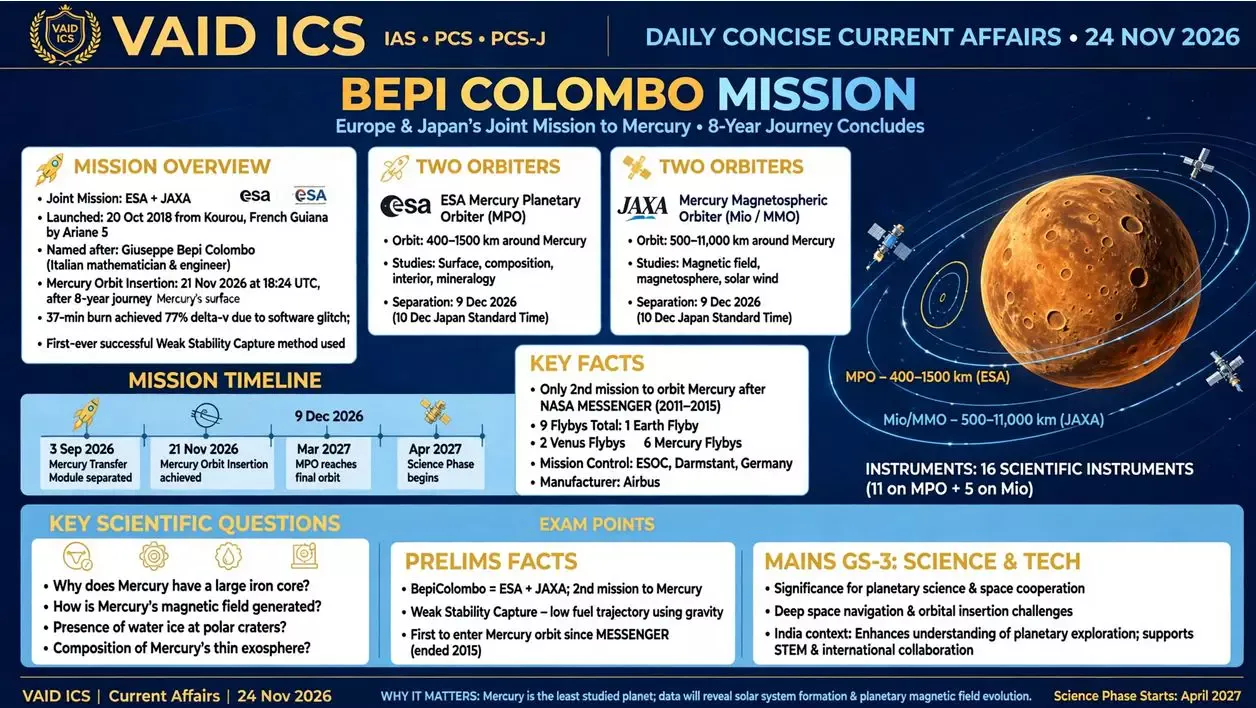
Journey and Orbital Manoeuvres:
-
The spacecraft performed nine planetary gravity-assist flybys to adjust its trajectory and reduce its speed.
-
These included:
-
Earth: 1 flyby.
-
Venus: 2 flybys.
-
Mercury: 6 flybys.
-
-
These manoeuvres helped the spacecraft overcome the challenges of entering Mercury’s orbit.
Two Orbiters of BepiColombo:
The mission consists of two scientific orbiters that will separate and operate independently to conduct complementary investigations.
Mercury Planetary Orbiter (MPO):
-
Developed by the European Space Agency (ESA).
-
Studies Mercury’s surface, internal structure, composition and geological features.
-
Prepares detailed maps of the planet.
Mercury Magnetospheric Orbiter (MMO):
-
Developed by the Japan Aerospace Exploration Agency (JAXA).
-
Also known as Mio.
-
Studies Mercury’s magnetic field, magnetosphere and interaction with solar wind.
Major Scientific Objectives:
-
Internal Structure: Investigate Mercury’s unusually large and dense iron core to understand its formation and evolution.
-
Surface Mapping: Prepare detailed maps of the planet’s surface and examine its geological composition.
-
Magnetic Field: Study Mercury’s magnetic field and its interaction with the solar wind.
-
Planetary Formation: Provide clues about the formation of rocky planets in the early Solar System.
-
Solar Environment: Examine the effects of intense solar radiation on Mercury and its surrounding space.
-
General Theory of Relativity: Conduct high-precision radio-science experiments to study gravitational effects and perihelion precession.
Major Challenges of the Mission:
-
Strong Solar Gravity: Mercury’s proximity to the Sun makes orbital insertion difficult because the spacecraft must lose considerable orbital energy.
-
Extreme Temperature: Mercury experiences surface temperatures exceeding 427°C.
-
Intense Solar Radiation: The spacecraft must withstand high levels of solar radiation and thermal stress.
-
Thermal Protection: Special multi-layer ceramic insulation and radiator-based cooling systems protect sensitive instruments.
Important Scientific Concepts:
Gravity Assist:
A spaceflight technique in which a spacecraft uses the gravitational field and orbital motion of a planet to change its speed and direction, reducing fuel consumption.
Magnetosphere:
The region surrounding a planet where its magnetic field controls the movement of charged particles and interacts with the solar wind.
Perihelion Precession:
The gradual change in the orientation of a planet’s orbit, particularly the rotation of the point at which it comes closest to the Sun.
General Theory of Relativity:
Albert Einstein’s theory explaining gravity as the curvature of spacetime caused by mass and energy. Planetary orbital observations help test its predictions.
Significance of the Mission:
-
Enhances understanding of Mercury’s origin, composition and evolution.
-
Provides insights into the formation of terrestrial planets.
-
Improves understanding of planetary magnetic fields and their interaction with solar wind.
-
Contributes to testing fundamental theories of gravity and planetary motion.
Conclusion:
The BepiColombo Mission represents an important international scientific collaboration. Its dual-orbiter approach will provide complementary information about Mercury’s surface, internal structure and magnetic environment.
पीकोलंबो मिशन: बुध ग्रह का अन्वेषण
चर्चा में क्यों?
यूरोपीय अंतरिक्ष एजेंसी (ESA) और जापान एयरोस्पेस एक्सप्लोरेशन एजेंसी (JAXA) द्वारा संयुक्त रूप से विकसित बेपीकोलंबो मिशन (BepiColombo Mission) बुध ग्रह के अन्वेषण के लिए चर्चा में है। यह मिशन सौरमंडल के सबसे भीतरी ग्रह बुध की संरचना, चुंबकीय क्षेत्र एवं भूवैज्ञानिक विशेषताओं का अध्ययन करेगा।
बेपीकोलंबो मिशन के बारे में:
-
प्रकृति: ESA और JAXA का संयुक्त रोबोटिक अंतरिक्ष मिशन।
-
लक्ष्य ग्रह: बुध, जो सूर्य के सबसे निकट स्थित ग्रह है।
-
मिशन की लागत: लगभग 1.7 अरब यूरो (2 अरब अमेरिकी डॉलर)।
-
यात्रा की अवधि: लगभग 8 वर्ष।
-
कुल दूरी: 10 अरब किलोमीटर से अधिक।
-
महत्त्व: यह बुध ग्रह का अन्वेषण करने वाला तीसरा अंतरिक्ष मिशन है। इससे पहले NASA के मेरिनर-10 (Mariner 10) और मैसेंजर (MESSENGER) मिशन बुध का अध्ययन कर चुके हैं।
यात्रा एवं कक्षीय गतिविधियाँ:
-
अंतरिक्षयान ने अपनी गति एवं प्रक्षेप पथ में परिवर्तन करने के लिए 9 गुरुत्वीय सहायता परिभ्रमण (Gravity Assist Flybys) किए।
-
इनमें शामिल हैं:
-
पृथ्वी: 1 परिभ्रमण।
-
शुक्र: 2 परिभ्रमण।
-
बुध: 6 परिभ्रमण।
-
-
इन गुरुत्वीय सहायता गतिविधियों ने अंतरिक्षयान को बुध की कक्षा में प्रवेश के लिए आवश्यक गति प्राप्त करने में सहायता की।
बेपीकोलंबो मिशन के दो प्रमुख कक्षित्र:
इस मिशन में दो वैज्ञानिक कक्षित्र शामिल हैं, जो अलग-अलग होकर स्वतंत्र रूप से कार्य करेंगे तथा बुध ग्रह का पूरक वैज्ञानिक अध्ययन करेंगे।
मर्करी प्लैनेटरी ऑर्बिटर (MPO):
-
इसका विकास यूरोपीय अंतरिक्ष एजेंसी (ESA) ने किया है।
-
यह बुध की सतह, आंतरिक संरचना, रासायनिक संघटन एवं भूवैज्ञानिक विशेषताओं का अध्ययन करेगा।
-
ग्रह की विस्तृत सतही मानचित्रण प्रक्रिया में सहायता करेगा।
मर्करी मैग्नेटोस्फेरिक ऑर्बिटर (MMO):
-
इसका विकास जापान एयरोस्पेस एक्सप्लोरेशन एजेंसी (JAXA) ने किया है।
-
इसे मियो (Mio) के नाम से भी जाना जाता है।
-
यह बुध के चुंबकीय क्षेत्र, चुंबकमंडल तथा सौर पवन के साथ उसकी अंतःक्रिया का अध्ययन करेगा।
प्रमुख वैज्ञानिक उद्देश्य:
-
आंतरिक संरचना का अध्ययन: बुध के असामान्य रूप से बड़े एवं सघन लौह क्रोड (Iron Core) का अध्ययन करना तथा उसके निर्माण एवं विकास को समझना।
-
सतही मानचित्रण: बुध की सतह का विस्तृत मानचित्र तैयार करना तथा उसकी भूवैज्ञानिक संरचना का अध्ययन करना।
-
चुंबकीय क्षेत्र का अध्ययन: बुध के चुंबकीय क्षेत्र एवं सौर पवन के साथ उसकी अंतःक्रिया का विश्लेषण करना।
-
ग्रहों का निर्माण: प्रारंभिक सौरमंडल में स्थलीय ग्रहों के निर्माण एवं विकास से संबंधित जानकारी प्राप्त करना।
-
सौर पर्यावरण का अध्ययन: तीव्र सौर विकिरण का बुध की सतह एवं उसके आसपास के अंतरिक्षीय वातावरण पर पड़ने वाले प्रभावों का अध्ययन करना।
-
सामान्य सापेक्षता का परीक्षण: रेडियो विज्ञान आधारित उच्च परिशुद्धता मापों के माध्यम से गुरुत्वीय प्रभावों एवं उपसौर पूर्वगमन (Perihelion Precession) का अध्ययन करना।
मिशन की प्रमुख चुनौतियाँ:
-
सूर्य का प्रबल गुरुत्वाकर्षण: सूर्य के निकट होने के कारण बुध की कक्षा में प्रवेश करना चुनौतीपूर्ण है। इसके लिए अंतरिक्षयान की कक्षीय ऊर्जा एवं गति को पर्याप्त रूप से कम करना आवश्यक होता है।
-
अत्यधिक तापमान: बुध की सतह का तापमान 427°C से अधिक हो सकता है।
-
तीव्र सौर विकिरण: अंतरिक्षयान को अत्यधिक सौर विकिरण एवं तापीय दबाव का सामना करना पड़ता है।
-
तापीय सुरक्षा: संवेदनशील उपकरणों की सुरक्षा के लिए बहुस्तरीय सिरेमिक ऊष्मारोधी परतों तथा विकिरणकों पर आधारित शीतलन प्रणालियों का उपयोग किया जाता है।
प्रमुख वैज्ञानिक अवधारणाएँ:
गुरुत्वीय सहायता (Gravity Assist):
यह एक अंतरिक्ष उड़ान तकनीक है, जिसमें अंतरिक्षयान किसी ग्रह के गुरुत्वाकर्षण क्षेत्र एवं कक्षीय गति का उपयोग करके अपनी गति और दिशा में परिवर्तन करता है। इससे ईंधन की खपत कम करने में सहायता मिलती है।
चुंबकमंडल (Magnetosphere):
किसी ग्रह के चारों ओर स्थित वह क्षेत्र, जहाँ उसका चुंबकीय क्षेत्र आवेशित कणों की गति को नियंत्रित करता है तथा सौर पवन के साथ अंतःक्रिया करता है।
उपसौर पूर्वगमन (Perihelion Precession):
किसी ग्रह की कक्षा में उस बिंदु के अभिविन्यास में होने वाला क्रमिक परिवर्तन, जहाँ वह सूर्य के सबसे निकट होता है।
सामान्य सापेक्षता का सिद्धांत (General Theory of Relativity):
यह अल्बर्ट आइंस्टीन द्वारा प्रतिपादित सिद्धांत है, जिसके अनुसार द्रव्यमान एवं ऊर्जा के कारण दिक्-काल (Spacetime) में वक्रता उत्पन्न होती है, जिसे हम गुरुत्वाकर्षण के रूप में अनुभव करते हैं। ग्रहों की कक्षीय गतिविधियों के अध्ययन से इस सिद्धांत की भविष्यवाणियों का परीक्षण किया जा सकता है।
मिशन का महत्त्व:
-
बुध ग्रह की उत्पत्ति, संरचना एवं विकास को समझने में सहायता मिलेगी।
-
स्थलीय ग्रहों के निर्माण से संबंधित वैज्ञानिक जानकारी प्राप्त होगी।
-
ग्रहों के चुंबकीय क्षेत्रों एवं सौर पवन के साथ उनकी अंतःक्रिया को समझने में मदद मिलेगी।
-
गुरुत्वाकर्षण एवं ग्रहों की गति से संबंधित मौलिक वैज्ञानिक सिद्धांतों के परीक्षण में योगदान मिलेगा।
निष्कर्ष:
बेपीकोलंबो मिशन अंतरराष्ट्रीय अंतरिक्ष सहयोग का एक महत्त्वपूर्ण उदाहरण है। इसके दो कक्षित्रों द्वारा किए जाने वाले पूरक अध्ययन से बुध ग्रह की सतह, आंतरिक संरचना एवं चुंबकीय वातावरण के संबंध में महत्त्वपूर्ण वैज्ञानिक जानकारी प्राप्त होगी।

May 19, 2026
October 17, 2025
October 16, 2025
October 6, 2025

