March 24, 2026
Daily UPSC Current : 24 March 2026/ What is AgriPV ?
Why in the News?
The topic is trending because the Indian government is preparing to launch PM-KUSUM 2.0. As the original scheme’s deadline (March 2026) approaches, the Ministry of New and Renewable Energy (MNRE) has proposed a National Agri-photovoltaics Mission. This mission aims for a dedicated 10-GW target for AgriPV, signaling a transition from small-scale pilots to a major national infrastructure goal.
Key Points of the Transition:
- Solving the Land Conflict: India needs $300\text{ GW}$ of solar by 2030, but land is scarce. AgriPV allows solar expansion without taking land away from food production.
- Economic Synergy: Farmers shift from being just “Annadatas” (food providers) to “Urjadatas” (energy providers). They can earn from three sources: crop sales, electricity sales to the grid, and land leasing.
- Climate Resilience: The panels act as a “physical shield” against extreme heatwaves, unseasonal rain, and hail—threats that are increasing due to climate change.
- Water Efficiency: Shading from panels can reduce water loss (evapotranspiration) by $20\%$ to $40\%$, making it a “blue-green” solution for water-stressed states like Rajasthan.
About AgriPV:
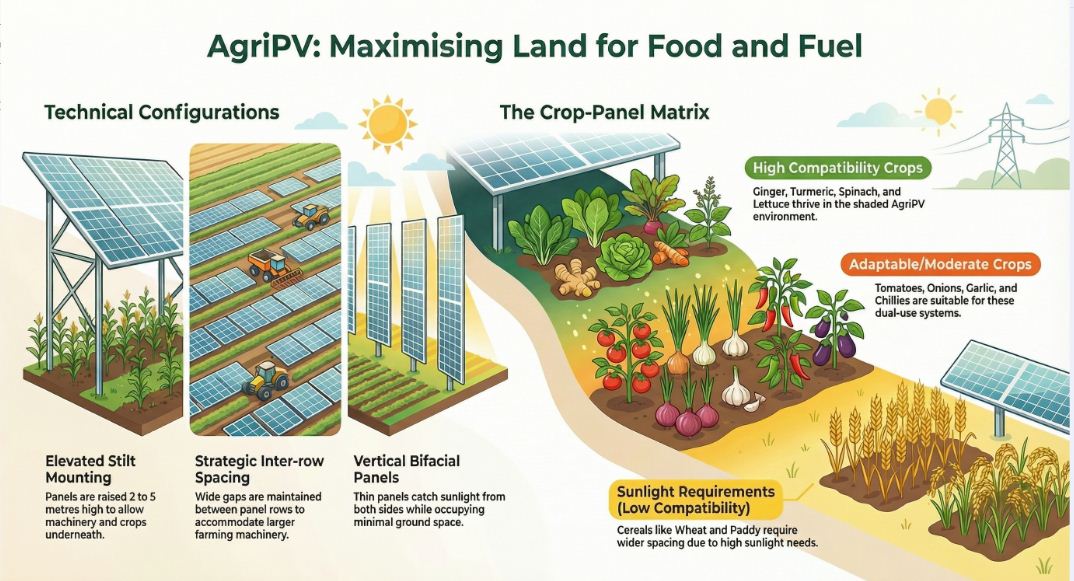
AgriPV (or Agrivoltaics) is the co-development of the same land area for both solar PV power and agriculture.
- Technical Configurations:
To ensure crops get enough sunlight and tractors can still move, AgriPV uses specialized setups:
- Stilt/Elevated Mounting: Panels are raised $2$ to $5$ meters high.
- Inter-row Spacing: Wide gaps between panel rows for larger machinery.
- Vertical Bifacial Panels: Thin vertical panels that catch sunlight from both sides and take up minimal ground space.
- Crop Compatibility:
| Highly Compatible | Ginger, Turmeric, Spinach, Lettuce, Medicinal plants (Tulsi) |
| Moderate/Adaptable | Tomatoes, Onions, Garlic, Chillies, Brinjal |
| Low Compatibility | Sun-loving cereals (Wheat, Paddy) — these usually require wider panel spacing. |
- Current Barriers:
- High Cost: Raising panels on stilts increases capital expenditure (CAPEX) by $15\%$ to $30\%$ compared to ground-mounted solar.
- Regulatory Gaps: Current laws often require “Non-Agricultural” (NA) land conversion for solar, which can make farmers lose their agricultural subsidies.
- Yield Risk: Poorly designed shading can lead to “leggy” plants or reduced grain weight.
The Policy Pathway: PM-KUSUM 2.0:
The proposed National Agri-photovoltaics Mission aims to solve these hurdles by:
- Viability Gap Funding (VGF): Providing government grants to cover the extra cost of elevated structures.
- Dual-Use Classification: Creating a new land category so farmers can keep their agricultural status while generating power.
- Feeder-Level Solarization: Connecting entire rural grids to these farm-based plants to ensure the power actually reaches the community.

October 17, 2025
October 16, 2025
October 6, 2025
September 24, 2025

