October 17, 2026
Daily UPSC Current : 17 oct 2026/Immunity to Chief Election Commissioner and Election Commissioners
Why in News?
The Supreme Court has issued a notice to the Centre on a petition filed by the Association for Democratic Reforms (ADR) challenging Section 16 of the Chief Election Commissioner and Other Election Commissioners Act, 2023, which grants immunity for official actions even after retirement.
What is Equality Before Law?
Article 14 guarantees equality before the law and equal protection of the laws.
-
Equality before law: No person enjoys special privileges; everyone is subject to the ordinary law.
-
Equal protection of laws: People in similar circumstances must receive equal treatment.
-
Equality before law is part of the Basic Structure Doctrine and reflects the Rule of Law propounded by A.V. Dicey.
What are Constitutional Immunities?
-
Article 361: Provides certain immunities to the President and Governors during their term of office, including protection from criminal proceedings.
-
Articles 105 and 194: Provide privileges to Members of Parliament and State Legislatures, including freedom of speech within the legislature, subject to constitutional provisions.
-
Diplomatic Immunity: Protects diplomats under international law to facilitate diplomatic relations.
What Immunity Do CEC and ECs Enjoy?
Section 16 of the CEC and Other ECs Act, 2023 provides that courts shall not entertain or continue civil or criminal proceedings against a current or former CEC or Election Commissioner for acts done or purportedly done in the discharge of official duties.
Why Is This Provision Controversial?
-
Lifetime immunity: Unlike the immunity of the President and Governors, it continues after retirement.
-
Equality concerns: It raises questions under Article 14 regarding equality before law.
-
Lack of justification: The provision was introduced through an amendment during the Bill’s passage in Parliament.
-
Unequal treatment: Other independent constitutional and statutory authorities, such as judges, the CAG and Public Service Commission members, do not enjoy similar blanket immunity.
-
Accountability concerns: It may weaken legal accountability for official actions.
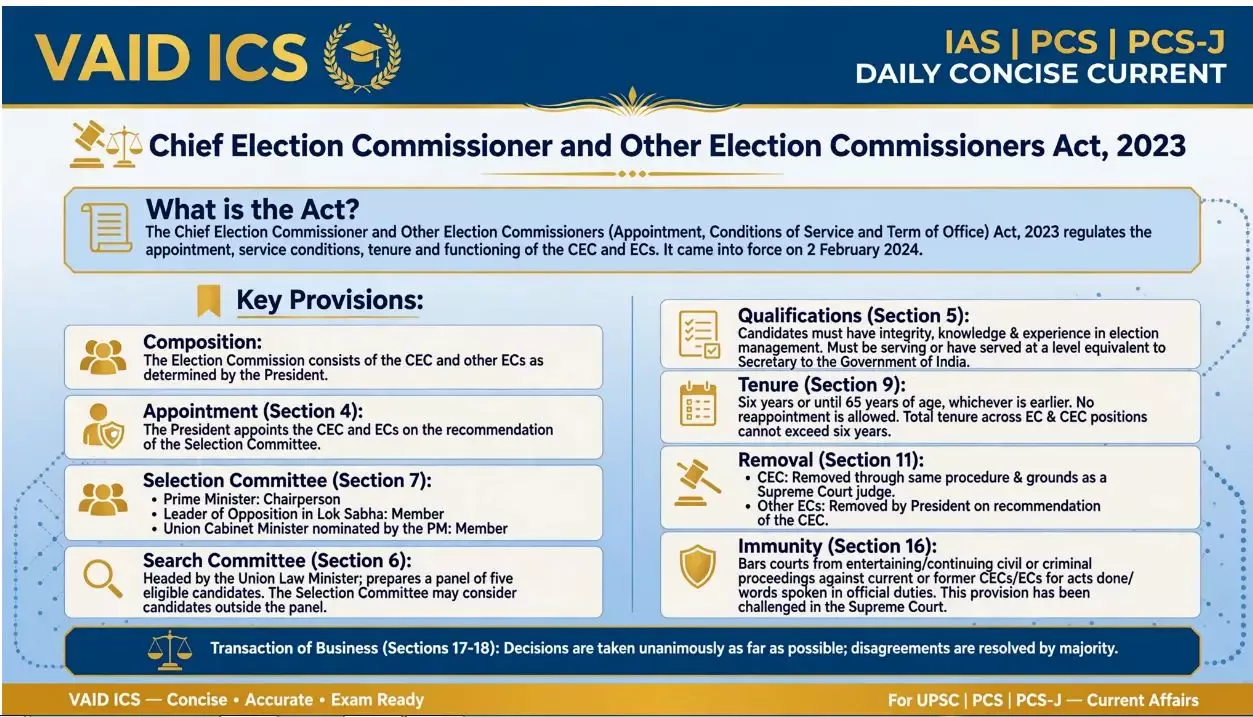
Chief Election Commissioner and Other Election Commissioners Act, 2023
What is the Act?
The Chief Election Commissioner and Other Election Commissioners (Appointment, Conditions of Service and Term of Office) Act, 2023 regulates the appointment, service conditions, tenure and functioning of the Chief Election Commissioner (CEC) and Election Commissioners (ECs). It came into force on 2 February 2024.
Key Provisions:
1. Composition:
– The Election Commission consists of the CEC and such number of other ECs as the President may determine.
2. Appointment (Section 4)
– The President appoints the CEC and ECs on the recommendation of the Selection Committee.
3. Selection Committee (Section 7)
-
Prime Minister — Chairperson.
-
Leader of Opposition in the Lok Sabha — Member.
-
Union Cabinet Minister nominated by the Prime Minister — Member.
4. Search Committee (Section 6):
-
Headed by the Union Minister of Law and Justice.
-
Prepares a panel of five eligible candidates for consideration by the Selection Committee.
-
The Selection Committee may consider candidates outside this panel.
5. Qualifications (Section 5):
-
Persons of integrity with knowledge and experience in the conduct and management of elections.
-
Must be serving or have served in a position equivalent to Secretary to the Government of India.
6. Tenure (Section 9)
-
Six years or until attaining the age of 65 years, whichever is earlier.
-
Not eligible for reappointment.
-
An EC appointed as CEC cannot have a combined tenure exceeding six years.
7. Removal (Section 11)
-
The CEC can be removed in the same manner and on the same grounds as a Supreme Court judge.
-
Other ECs can be removed by the President on the recommendation of the CEC.
8. Protection from Legal Proceedings (Section 16)
– Bars courts from entertaining or continuing civil or criminal proceedings against a current or former CEC or EC for acts done or words spoken in the discharge of official duties. This provision is being challenged in the Supreme Court.
9. Transaction of Business (Sections 17–18)
-
The Election Commission regulates its business according to the Act.
-
Decisions are taken unanimously as far as possible; differences are resolved by majority.
Why is the Act Important?
-
Establishes a statutory framework for appointments and service conditions.
-
Seeks to provide institutional stability and protect the functioning of the Election Commission.
-
Raises concerns about the independence of appointments and the scope of legal immunity under Section 16.
-
What is the Way Forward?
-
Ensure that legal protection does not become blanket immunity from accountability.
-
Examine the provision against the principles of Article 14 and the Rule of Law.
-
Protect the independence of the Election Commission while preserving appropriate legal remedies.
-
Ensure that immunity, if provided, is reasonable, justified and proportionate.
Conclusion:
The independence of the Election Commission is essential for free and fair elections. However, independence must be balanced with accountability and equality before law. Legal safeguards should protect bona fide official decisions without unnecessarily placing public authorities above the law.
मुख्य निर्वाचन आयुक्त एवं अन्य निर्वाचन आयुक्त अधिनियम, 2023:
समाचार में क्यों?
मुख्य निर्वाचन आयुक्त एवं अन्य निर्वाचन आयुक्त अधिनियम, 2023 की धारा 16 के अंतर्गत आधिकारिक कर्तव्यों के निर्वहन में किए गए कार्यों के लिए वर्तमान एवं पूर्व निर्वाचन आयुक्तों को प्राप्त कानूनी संरक्षण को सर्वोच्च न्यायालय में चुनौती दी गई है।
अधिनियम का उद्देश्य:
यह अधिनियम मुख्य निर्वाचन आयुक्त (CEC) एवं अन्य निर्वाचन आयुक्तों (ECs) की नियुक्ति, सेवा की शर्तों, पदावधि तथा कार्यप्रणाली को विनियमित करता है। यह 2 फरवरी 2024 को लागू हुआ।
प्रमुख प्रावधान:
निर्वाचन आयोग की संरचना:
– मुख्य निर्वाचन आयुक्त तथा राष्ट्रपति द्वारा निर्धारित संख्या में अन्य निर्वाचन आयुक्त।
नियुक्ति (धारा 4):
– राष्ट्रपति चयन समिति की सिफारिश पर नियुक्ति करते हैं।
चयन समिति (धारा 7):
-
प्रधानमंत्री: अध्यक्ष।
-
लोकसभा में विपक्ष का नेता: सदस्य।
-
प्रधानमंत्री द्वारा नामित केंद्रीय मंत्रिमंडल का मंत्री: सदस्य।
खोज समिति (धारा 6):
-
केंद्रीय विधि एवं न्याय मंत्री की अध्यक्षता में गठित।
-
चयन समिति के विचारार्थ पाँच पात्र व्यक्तियों का पैनल तैयार करती है।
-
चयन समिति पैनल से बाहर के व्यक्तियों पर भी विचार कर सकती है।
अर्हताएँ (धारा 5):
-
व्यक्ति सत्यनिष्ठा वाला तथा निर्वाचन संचालन एवं प्रबंधन का ज्ञान और अनुभव रखने वाला हो।
-
भारत सरकार के सचिव के समकक्ष पद पर कार्यरत हो अथवा उस पद पर कार्य कर चुका हो।
पदावधि (धारा 9):
-
छह वर्ष या 65 वर्ष की आयु, इनमें से जो पहले हो।
-
पुनर्नियुक्ति का पात्र नहीं।
-
निर्वाचन आयुक्त एवं मुख्य निर्वाचन आयुक्त के रूप में कुल पदावधि छह वर्ष से अधिक नहीं हो सकती।
पद से हटाना (धारा 11):
-
मुख्य निर्वाचन आयुक्त: सर्वोच्च न्यायालय के न्यायाधीश के समान प्रक्रिया एवं आधारों पर पद से हटाया जा सकता है।
-
अन्य निर्वाचन आयुक्त: मुख्य निर्वाचन आयुक्त की सिफारिश पर राष्ट्रपति द्वारा हटाए जा सकते हैं।
कानूनी कार्यवाहियों से संरक्षण (धारा 16):
-
आधिकारिक कर्तव्यों के निर्वहन में किए गए या किए जाने का दावा किए गए कार्यों के संबंध में वर्तमान एवं पूर्व निर्वाचन आयुक्तों के विरुद्ध दीवानी या आपराधिक कार्यवाही शुरू करने अथवा जारी रखने पर रोक लगाती है।
-
इस प्रावधान को सर्वोच्च न्यायालय में चुनौती दी गई है।
कार्य-संचालन (धारा 17–18):
-
आयोग अपने कार्यों का संचालन अधिनियम के अनुसार करता है।
-
यथासंभव निर्णय सर्वसम्मति से लिए जाते हैं; मतभेद होने पर बहुमत से निर्णय होता है।
अधिनियम का महत्त्व:
-
निर्वाचन आयुक्तों की नियुक्ति एवं सेवा-शर्तों के लिए वैधानिक ढाँचा प्रदान करता है।
-
निर्वाचन आयोग की कार्यप्रणाली को व्यवस्थित करता है।
-
नियुक्ति प्रक्रिया की स्वतंत्रता तथा धारा 16 के अंतर्गत कानूनी संरक्षण की सीमा पर प्रश्न उठाता है।
मुख्य परीक्षा अभ्यास प्रश्न:

May 19, 2026
October 17, 2025
October 16, 2025
October 6, 2025

