May 30, 2026
Daily Gist of Article/The Hindu/ Mains Current Qns/30 May 2026/Raipur’s Rainwater Revolution
Why in News?
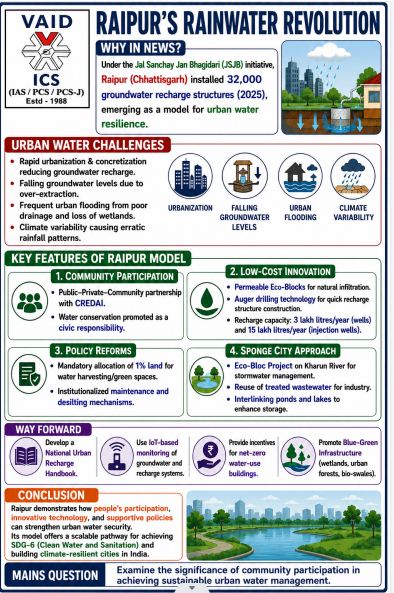
Under the nationwide Jal Sanchay Jan Bhagidari (JSJB) initiative, Raipur (Chhattisgarh) has successfully institutionalized community-led rainwater harvesting. The city has completed the installation of 32,000 groundwater recharge structures in 2025, positioning itself as a leading model for urban water resilience in India.
Major Urban Water Issues in India:
- Rapid Urbanization & Concretization: Excessive use of impermeable surfaces (concrete/asphalt) prevents natural percolation, leading to high surface runoff.
- Declining Groundwater Tables: Over-extraction for domestic and industrial use has outpaced natural recharge.
- Urban Flooding: Inadequate drainage combined with the loss of natural sponges (wetlands/ponds) causes waterlogging during monsoon.
- Climate Variability: Increasingly erratic rainfall patterns necessitate better storage mechanisms to bridge dry spells.
Key Pillars of Raipur’s Model:
- Public-Private-Community Collaboration: * Collaboration with CREDAI to integrate harvesting systems in residential and commercial complexes.
- Treating water conservation as a “Civic Responsibility” rather than just a government task.
- Technical Innovation & Cost-Effectiveness:
- Permeable Eco-Blocks: Used in footpaths and parking to allow natural infiltration.
- Tractor-mounted Auger Drilling: Allows rapid, low-cost construction of recharge structures.
- Scalable Efficiency: Individual wells recharge up to 3 lakh litres/annum, while injection wells in stressed zones recharge up to 15 lakh litres/annum.
- Policy & Institutional Reform:
- Mandatory Planning: Town planning now requires 1% of land to be reserved for water harvesting/green spaces.
- Maintenance Institutionalized: Mechanisms for regular desilting and upkeep are now part of municipal policy.
- Holistic Water Resilience (“Sponge City” Approach):
- Eco-Bloc Project: A ₹30 crore project on the Kharun River to manage storm runoff.
- Circular Water Economy: Promoting treated wastewater reuse for industrial applications.
- Blue Infrastructure: Interconnection of urban ponds and lakes to enhance storage capacity.
Way Forward:
- Standardization: Use Raipur’s model to create a “National Handbook for Urban Recharge” for other Tier-2 and Tier-3 cities.
- Smart Monitoring: Integrate IoT-based sensors to monitor groundwater levels and the performance of recharge structures in real-time.
- Incentivization: Implement tax rebates for commercial or residential properties that achieve verified “net-zero” water usage or high recharge rates.
- Nature-Based Solutions (NbS): Shift focus from pure “Grey Infrastructure” (pipes/concrete) to “Blue-Green Infrastructure” (urban forests, wetlands, and bio-swales).
Conclusion:
Raipur’s transition from a city struggling with waterlogging and depletion to a model of groundwater recharge exemplifies the “Jan Bhagidari” (People’s Participation) spirit. It demonstrates that urban water security is not merely an engineering challenge to be solved with heavy infrastructure, but a participatory governance mission. By integrating low-cost technical innovation with policy mandates, Raipur provides a scalable template for achieving SDG 6 (Clean Water and Sanitation) and building climate-resilient cities in India.

May 19, 2026
October 17, 2025
October 16, 2025
October 6, 2025

