December 13, 2025
Daily Current Affairs UPSC : 13 Dec 2025/ Removal of High Court Judges
Over 100 opposition MPs from Lok Sabha recently submitted to Speaker Om Birla a notice to move a motion for the removal of Madras high court’s Justice GR Swaminathan, saying his functioning has raised questions over “impartiality, transparency and secular nature” of the judiciary.
- the Government of India Act of 1935, the Indian Constitution has established a single-integrated judicial system with a three-tier structure:
-
- The Supreme Court
- The High Courts
- The Subordinate Courts (District Courts, and other Lower Courts)
- This single system of courts enforces both Central and State Laws across the country.
Constitutional Provisions related to High Courts:
- Articles 214 to 231 in Part VI of the Indian Constitution deal with the provisions related to the High Courts.
- The constitutional provisions mentioned under these articles deal with the organization, independence, jurisdiction, powers, and procedures of the High Courts.
- The Parliament and State Legislature both are authorized to regulate these provisions.
Territorial Jurisdiction of High Court:
- The Constitution of India provides for a High Court for each State.
- However, the 7th Constitutional Amendment Act of 1956 authorized the Parliament to establish a common High Court for two or more States or for two or more States and a Union Territory. For example-
- The Union Territories of Jammu and Kashmir and Ladakh have a common High Court.
- The territorial jurisdiction of a High Court is co-terminus with the territory of a State.
- The territorial jurisdiction of a common High Court is co-terminus with the territory of a State as well as a Union Territory.
- The Parliament can extend the jurisdiction of a High Court to any Union Territory or exclude the jurisdiction of a High Court from any Union Territory.
Composition of Judges of High Court:
- The Constitution does not specify the strength of a High Court and leaves it to the discretion of the President.
- Thus, every High Court consists of a Chief Justice and such other Judges as determined by the President.
- The President determines the strength of a High Court from time to time depending upon the workload of the High Court.
Judges in the High Courts of India are governed by the Constitution and procedural rules as it relates to who appoints and who are qualified to hold these positions; their term (how long they will serve as a Judge), how they can be removed from their positions, and their jurisdiction
Appointment of CJ:
The Chief Justice (CJ) is appointed by the President of India, after he/she/they have consulted with the CJI and the Governor of the state where the High Court is located.
Appointment of Other Judges
- Other judges of the High Court are appointed by the President of India after consultation with the CJI and the Governor of the state where the High Court is located. Additionally, the President must also consult with the Chief Justice of the High Court in question.
* If there are common High Court for more than one state, then the governors of each of the states must also provide input to the President as to recommend the appointment of a Judge to that Common High Court.
Growth of Collegium System:
Judicial Interpretation:
Second Judges Case, 1993: In this case it was determined that the term “consultation” meant “concurrence”, meaning the CJ’s recommendation is binding on the President.
Third Judges Case, 1998: In this case it was ruled that the CJI must consult a collegium of the two oldest senior judges in the Supreme Court before making a recommendation regarding a potential appointment of a judge to the High Court. Any recommendation without that consultation will not be binding on the President.
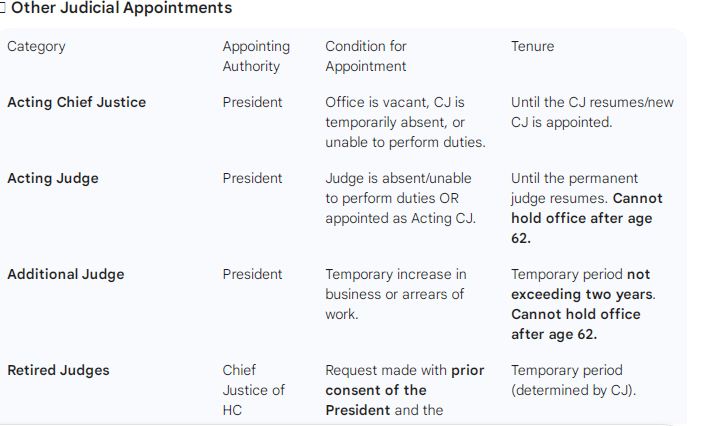
Qualifications for High Court Judges:
A person must be a Citizen of India and meet one of the following criteria:
- Held a judicial office in India for at least ten years.
- Been an Advocate of a High Court (or High Courts in succession) for at least ten years.
Key Differences from Supreme Court:
- The Constitution does not provide for the appointment of a distinguished jurist as a High Court Judge.
- There is no minimum age prescribed for appointment.
Oath and Affirmations
The Chief Justice and Judges subscribe to an oath before the Governor of the State (or a person appointed by the Governor). The oath mandates upholding the Constitution, sovereignty, and performing duties “without fear or favor, affection or ill-will.”
Salaries, Tenure, and Removal:
Salaries and Allowances
Salaries, allowances, privileges, leave, and pension are determined by the Parliament.
- These cannot be varied to a judge’s disadvantage after their appointment, except during a Financial Emergency.
Tenure
The Constitution does not fix a permanent tenure but sets specific provisions:
- Holds office until attaining the age of 62 years.
- Can resign by writing to the President.
- Can be removed by the President upon the recommendation of the Parliament.
- Vacates office upon appointment as a Supreme Court Judge or transfer to another High Court.
Removal Procedure
A High Court Judge is removed by an order of the President on the grounds of proved misbehaviour or incapacity. The process is regulated by the Judges Enquiry Act, 1968 and mirrors that of a Supreme Court Judge:
| Step | Action | Requirement |
| 1. Initiation | Motion notice submitted to Speaker/Chairman. | Signed by 100 Lok Sabha MPs or 50 Rajya Sabha MPs. |
| 2. Investigation | If admitted, Speaker/Chairman forms a three-member Committee. | Must include: Supreme Court Judge/CJI, High Court Chief Justice, and a distinguished Jurist. |
| 3. Parliamentary Vote | If the Committee finds the judge guilty, the motion is debated and voted upon in both Houses. | Must be passed by a Special Majority in each House (absolute majority of total membership + $\ge$ two-thirds of members present and voting). |
| 4. Final Order | Address presented to the President. | President issues the final order for removal. |
| Note: No High Court Judge has been impeached (removed) to date. |
Transfer of Judges:
The President of India can transfer a judge after consulting the Chief Justice of India.
- Third Judges Case (1998): The CJI, for a transfer, must consult a collegium of four senior-most Supreme Court judges PLUS the Chief Justices of the two High Courts
Jurisdiction and Powers of the High Court:
The Constitution outlines that the High Court’s jurisdiction remains the same as before the Constitution’s commencement, with added powers. Their powers are governed by multiple sources (Constitution, Acts of Parliament/State Legislatures, etc.).
1. Original Jurisdiction
The power to hear disputes in the first instance, including:
-
Election disputes of MPs and State Legislatures.
-
Revenue matters.
-
Enforcement of Fundamental Rights (concurrent with the Supreme Court).
-
Transfer of cases from subordinate courts involving constitutional interpretation.
-
Civil cases of higher value in Calcutta, Bombay, Madras, and Delhi HCs.
2. Writ Jurisdiction (Article 226)
The High Court can issue various writs (Habeas Corpus, Mandamus, etc.) for:
-
Enforcement of Fundamental Rights.
-
Enforcement of any ordinary legal right.
Comparison with Supreme Court (SC) Writ Jurisdiction:
-
Concurrent: Both HC and SC can be moved for Fundamental Rights violation.
-
Wider Scope: HC’s writ jurisdiction is wider than the SC’s, as it can issue writs for the violation of any legal right, not just Fundamental Rights.
3. Appellate Jurisdiction
The High Court is primarily an appellate court, hearing appeals from subordinate courts.
| Category | Type of Appeal | Basis of Appeal |
| Civil Matters | First Appeals | Both questions of law and fact (from District/Subordinate Courts). |
| Civil Matters | Second Appeals | Questions of law only (from District/Subordinate Courts). |
| Criminal Matters | Appeals from Sessions Court | If the sentence is imprisonment for more than seven years. |
| Mandatory Review | Death Sentence | A death sentence awarded by a Sessions Court must be confirmed by the High Court before execution, regardless of whether an appeal is filed. |

October 17, 2025
October 16, 2025
October 6, 2025
September 24, 2025

