February 27, 2026
Daily Current Affairs for UPSC : 27 Feb 2026/ What is Net Household Financial Savings?
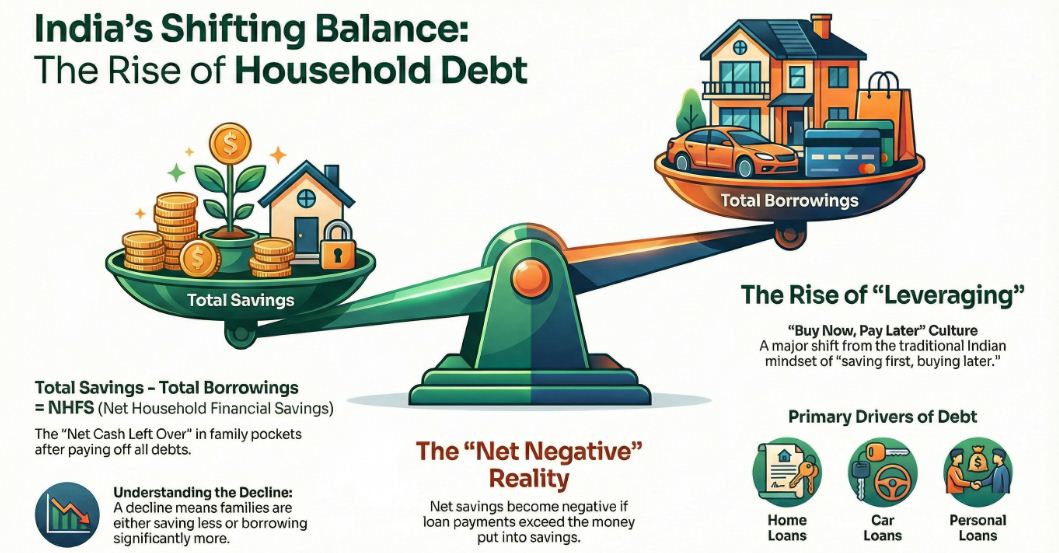
Net Household Financial Savings is like the “Net Cash Left Over” in the pockets of all Indian families at the end of the year after they have paid off their debts.
Think of it using this simple formula:
(Total Money Saved in Banks/Stocks/PF) MINUS (Total Money Borrowed via Loans/Credit Cards) = Net Financial Savings
When experts say this is “declining,” they mean one (or both) of these things is happening:
1. We are borrowing a lot more (The “Leveraging” Effect):
In the past, Indians were famous for “saving first, buying later.” Now, the trend has shifted to “buy now, pay later.”
-
Families are taking more Home Loans, Car Loans, and Personal Loans.
-
Even if you are putting ₹10,000 in a fixed deposit, but you just took a loan where you pay ₹12,000 in EMIs, your net financial saving is actually negative.
2. We are shifting from “Financial” to “Physical” assets:
Instead of keeping money in bank accounts, insurance, or shares (Financial Assets), many Indians are putting their money into Real Estate (Buying houses) or Gold.
-
While you are still “saving” by buying a house, it doesn’t count as “financial” saving in this specific report. It’s seen as “locking up” money in a physical object rather than keeping it in the flow of the banking system.
3. Why does this matter to the Economy?
-
The Country’s “Piggy Bank”: When families save in banks, the banks use that money to give loans to businesses to build factories and create jobs.
-
The Problem: If households stop saving in banks (or borrow too much), the government and businesses have to look for money elsewhere—often borrowing from foreign countries, which can be more expensive and risky.
For a layman, the “decline” doesn’t necessarily mean Indians are becoming poor. It means Indians are spending more on lifestyle/housing and are much more comfortable with debt (EMIs) than their parents were.

October 17, 2025
October 16, 2025
October 6, 2025
September 24, 2025

