December 27, 2025
Daily Current Affairs for UPSC : 27 Dec 2025
The recent discussion hilights the urban growth & issue arising out of it .
What is urbanisation?
- Urbanisation is the process by which a growing share of the population shifts from rural to urban areas, leading to the expansion of cities in population, economic activity, and spatial footprint. It is driven by industrialisation, migration, better livelihoods, and access to services.
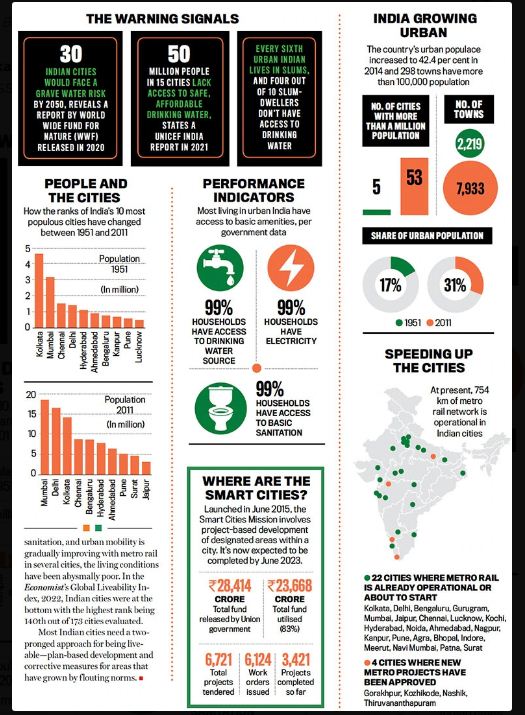
Data trends in India:
- Urban population: ~36% (2024), projected to exceed 50% by 2050–60s.
- Economic role: Urban India contributes ~65–70% of GDP despite housing a smaller population share.
- Migration: Increasing inter-State and rural–urban migration, especially to Tier-1 and Tier-2 cities.
- Transport access: Only ~37% of urban residents have easy access to public transport (Economic Survey).
- Infrastructure gap: Need for ~2 lakh urban buses; operational fleet ~35,000.
Existing urbanisation pattern:
- Concentration in metros: Expansion of Tier-1 cities rather than balanced growth of new towns.
- Peripheral sprawl: Growth of informal settlements and urban fringes without commensurate services.
- Sectoral hubs: Cities specialising in IT, manufacturing, services, creating uneven regional development.
- Smart city skew: Infrastructure-centric planning, often neglecting social inclusion and lived experience.
Challenges Associated with Urbanisation:
- Exclusion and inequality: Migrants and informal workers face linguistic, cultural, and documentation barriers, limiting access to jobs, welfare, and civic participation, and pushing them to the urban margins.
E.g. Gaps in implementing the Inter-State Migrant Workmen Act mean migrant workers in Surat often fail to access PDS benefits due to lack of local proof.
- Housing deficit: High land prices and weak rental markets force the urban poor into slums and insecure housing, perpetuating informality and eviction risks.
E.g. The Dharavi Redevelopment Project reflects the challenge of formalising housing without disrupting livelihoods and social networks.
- Urban mobility stress: Inadequate public transport and over-reliance on private vehicles cause congestion, long commute times, and productivity losses.
E.g. Bengaluru’s Outer Ring Road (ORR) illustrates the mismatch between rapid IT-sector growth and lagging transport infrastructure.
- Governance gaps: Urban Local Bodies suffer from fragmented authority, overlapping agencies, and weak fiscal autonomy, reducing accountability and efficiency.
E.g. Recurrent flooding in Chennai and Gurugram exposes poor coordination among municipal, drainage, and road agencies.
- Environmental stress: Unplanned expansion creates urban heat islands, air pollution, and water scarcity, threatening public health and sustainability.
E.g. Delhi’s winter smog (AQI 400+) is worsened by dense traffic, construction dust, and limited green cover.
- Social cohesion: Rapid urbanisation weakens community bonds and shared identity, leading to alienation and social fragmentation.
E.g. The gated-community culture in Noida creates physical and social silos separating elites from service-providing populations.
Way Ahead: Transforming Indian Cities
- People-centric planning: Cities must be viewed as dynamic ecosystems, where infrastructure design prioritises human well-being over rigid master plans.
E.g. Bhubaneswar’s Child-Friendly City initiative integrates safe play spaces and walkable, inclusive urban design.
- Inclusive governance: Multilingual services and representation of migrants in decision-making improve access, trust, and civic participation.
E.g. Kerala’s ‘Awas’ health insurance scheme uses multilingual outreach to ensure migrant worker inclusion.
- Sustainable mobility mix: Strengthening buses, integrating alternative modes like trams, and improving last-mile connectivity reduces congestion and emissions.
E.g. The Indore iBus (BRTS) boosted ridership through dedicated lanes and efficient feeder services.
- Fiscal empowerment of ULBs: Financial autonomy through municipal bonds and rational user charges enables long-term infrastructure investment.
E.g. Pimpri-Chinchwad Municipal Corporation (PCMC) raised capital via municipal bonds for urban infrastructure.
- Affordable housing: Transit-oriented development and in-situ slum redevelopment integrate housing with jobs and services.
E.g. PM Awas Yojana (Urban) and ARHCs target affordable housing for migrant workers post-pandemic.
Conclusion:
India’s urban future will define its economic and social trajectory. Infrastructure alone cannot deliver success without inclusion, empathy, and efficient governance. Designing cities for people—present and future—is the cornerstone of a sustainable, resilient, and equitable urban India.

October 17, 2025
October 16, 2025
October 6, 2025
September 24, 2025
