January 24, 2026
Daily Current Affairs for UPSC : 24 Jan 2026/ What is Thucydides’s Trap?
Defining Thucydides’s Trap
The term refers to the structural stress that occurs when a rising power threatens to displace a ruling power.
- Origin: Named after the ancient Greek historian Thucydides, who observed that the Peloponnesian War was made inevitable by the rise of Athens and the fear this instilled in Sparta.
- The Mechanism: It is not necessarily that either side wants war, but rather that the shifting balance of power creates a “spiral of insecurity” where every defensive move by one is seen as an offensive threat by the other.
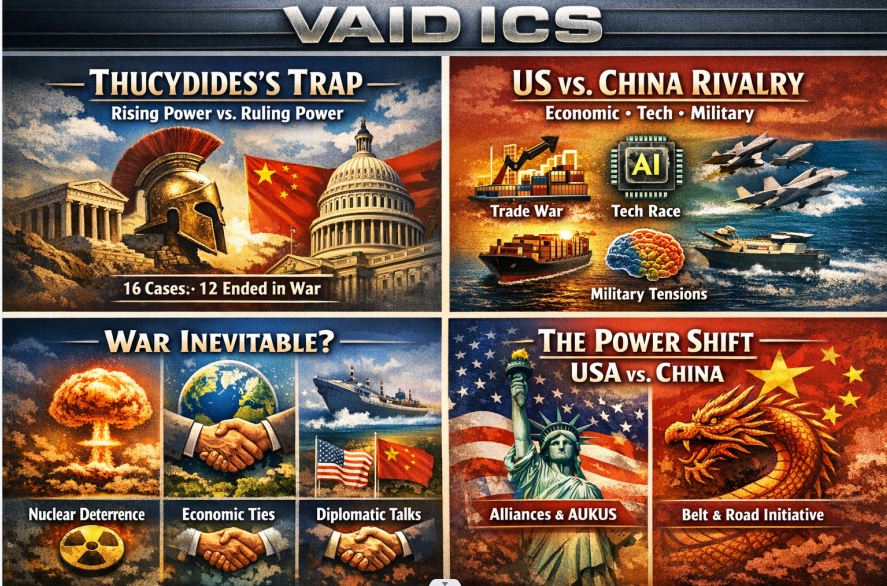
- Historical Data: Graham Allison’s Harvard study reviewed 16 historical cases where a rising power rivaled a ruling power; 12 of those 12 resulted in war.
The US-China Rivalry: Modern Friction Points:
This highlights how this ancient pattern is manifesting in the 21st century across several “battlefields.”
- Economic & Trade Competition:
- Shift in Dominance: China’s rapid GDP growth has moved it from the “world’s factory” to a direct competitor in high-value markets.
- Trade Wars: Use of tariffs and sanctions as tools to blunt the other’s economic momentum.
The Technological “Cold War”:
- Strategic Supremacy: Competition over AI, 5G, semiconductors, and quantum computing.
- Decoupling: Efforts to move supply chains away from each other to ensure national security and technological independence.
- Military Tensions (The Indo-Pacific):
- Flashpoints: Increased naval presence in the South China Sea and the status of Taiwan.
- Arms Race: Modernization of nuclear arsenals and the development of hypersonic missiles.
- Is Conflict Inevitable?
While the statistics (12 out of 16) are sobering, the theory also studies the 4 cases where war was avoided (e.g., the UK and the US in the early 20th century).
Factors for Peace:
- Nuclear Deterrence: Unlike the Greeks, both powers possess “Mutual Assured Destruction,” which raises the cost of war to an existential level.
- Economic Interdependence: The “Global Value Chain” makes war financially ruinous for both sides.
- Diplomatic Guardrails: The need for constant communication and “red lines” to prevent accidental escalation.
- The Power Shift
| Feature | The Ruling Power (USA) | The Rising Power (China) |
| Primary Goal | Maintain the “Rules-Based Order” | Regain regional/global prominence |
| Core Fear | Decline and loss of influence | Containment and suppressed growth |
| Strategy | Strengthening alliances (AUKUS, Quad) | Infrastructure & influence (Belt and Road) |

Gist of daily Article /The Hindu 17oct 2025
October 17, 2025
Daily Gist of the Hindu/Indian Express : 16 Oct 2025
October 16, 2025
Daily Gist of The Hindu/Indian Express: 6 Oct 2025
October 6, 2025
Daily Gist of Article /The Hindu /Indian Express: 24 Sep 2025
September 24, 2025

