February 12, 2026
Daily Current Affairs for UPSC : 12 Feb 2026/Civil Service (Pension) Rules, 2021:
Why is it in the news?
The book became a flashpoint during the 2026 budget session of Parliament when Leader of Opposition Rahul Gandhi attempted to quote from it in the Lok Sabha.
- The Claim: Gandhi cited excerpts allegedly describing the political leadership’s hesitation during the 2020 India-China standoff at the Line of Actual Control (LAC). He specifically quoted a message reportedly sent to the General: “Jo uchit samjho, woh karo” (Do what you think is right), arguing it showed a lack of decisive leadership from the Prime Minister.
- The Government’s Rebuttal: Defence Minister Rajnath Singh and Home Minister Amit Shah objected, stating that since the book has not been officially published or cleared by the Ministry of Defence (MoD), it cannot be cited as an authenticated document in the House.
The Key Issue: Publication vs. Clearance
The core of the dispute lies in whether the book actually “exists” in the public domain.
- The Status of the Book: Although it was listed for pre-order on Amazon in late 2023 and early 2024, the MoD withheld clearance due to sensitive content regarding the Agnipath scheme and the Galwan clash.
- The Leak: Despite no official release, a typeset PDF of the manuscript (possibly a pre-print version for reviewers) began circulating on social media and WhatsApp. This led the Delhi Police Special Cell to register an FIR for criminal conspiracy and a breach of the Official Secrets Act (OSA).
- Publisher’s Stand: Penguin Random House India (PRHI) has clarified that they hold the sole rights and have not released any copies. They warned that the circulated PDFs are a copyright violation.
Proposed Guidelines for Military Authors:
Following this row, the Defence Ministry is finalizing new, consolidated rules to bridge the gap between serving and retired personnel.
| Category | Current Framework | Proposed Changes |
| Serving Personnel | Mandatory clearance required for all literary/political work under Service Rules. | No major change; existing rules remain strict. |
| Retired Personnel | Primarily governed by the Official Secrets Act (OSA) for life; submission is often voluntary/customary. | Standardized mandatory vetting for any manuscript dealing with sensitive operations or national security. |
| Civil Servants | 2021 Pension Rules prohibit retirees from security agencies from publishing without clearance. | Military rules may be aligned with these stricter civil service standards. |
Legal “Red Lines”:
The primary legal tool used by the government is the Official Secrets Act (OSA), 1923. Unlike service-specific rules that may lapse upon retirement, the OSA applies for life. If a retired officer discloses “classified information” or “material prejudicial to the state,” they can face criminal prosecution and potential loss of pension under CCS (Pension) Rules.
About The Official Secrets Act (OSA), 1923:
The OSA is a colonial-era law designed to prevent espionage and the leak of “official secrets.” While it is over a century old, it remains the most powerful legal tool for prosecuting unauthorized disclosures.
- Key Sections:
- Section 3 (Espionage): Penalizes sharing information, sketches, or plans that could be “useful to an enemy.” Punishment can extend up to 14 years in prison.
- Section 5 (Wrongful Communication): This is the most frequently cited section. It makes it a criminal offense for anyone (serving or retired) to communicate any “secret” official code, document, or information to an unauthorized person.
- The “Lifetime” Clause: Unlike service rules that apply only while you are employed, the OSA applies to an individual for life. Even 30 years after retirement, disclosing classified information from your tenure can lead to criminal charges.
- The Defining Problem: The Act does not define what constitutes a “secret.” This gives the government broad discretion to classify almost any internal document as an official secret.
Civil Service (Pension) Rules, 2021:
In June 2021, the government introduced a major amendment to Rule 8 of the Central Civil Services (Pension) Rules. This moved the “red line” from criminal law into the territory of financial security.
The Stricter Mandate:
- Scope: It specifically targets retired officials from 26 intelligence and security organizations (like IB, RAW, CBI, and ED) listed under the Second Schedule of the RTI Act.
- Prior Clearance: These officials are now prohibited from publishing any material related to the “domain of the organization” or their personal expertise gained there without prior clearance from the head of their former organization.
- Mandatory Undertaking: Upon retirement, officials must sign a legal undertaking (Form 26) promising to follow these rules.
- The Penalty: If an officer publishes a book or column without clearance, the government can withhold or withdraw their pension (partially or fully) for life.
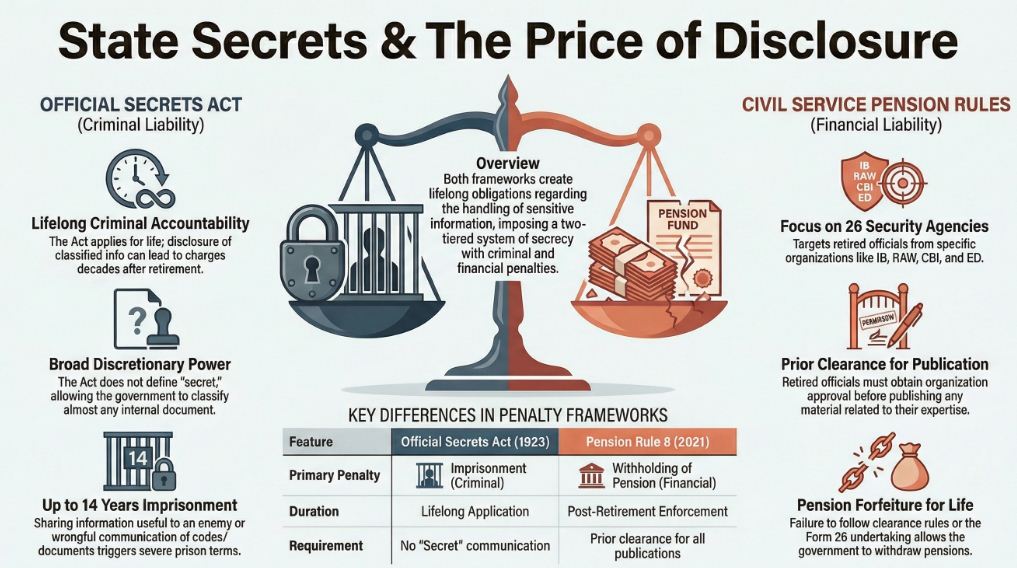
OSA vs. Pension Rules: A Comparison:
| Feature | Official Secrets Act (OSA) | CCS (Pension) Rules (2021) |
| Nature | Criminal Law | Service/Administrative Rule |
| Penalty | Imprisonment (3 to 14 years) | Withholding or Forfeiture of Pension |
| Burden of Proof | State must prove the act was “prejudicial.” | Simple violation of “good conduct” is enough. |
| Applicability | All citizens (including journalists). | Only retired government servants. |
| Trigger | Leaking actual “classified” data. | Publishing anything related to the organization without approval. |

October 17, 2025
October 16, 2025
October 6, 2025
September 24, 2025

