April 6, 2026
“Daily Assessment of responsibility’
On March 22, 2026, PM Narendra Modi became India’s longest-serving head of an elected government (8,931 days), surpassing Pawan Kumar Chamling. Unlike the US or Brazil, India has no legal limit on how many terms a Prime Minister or Chief Minister can serve.
Why did the Founders omit Term Limits?
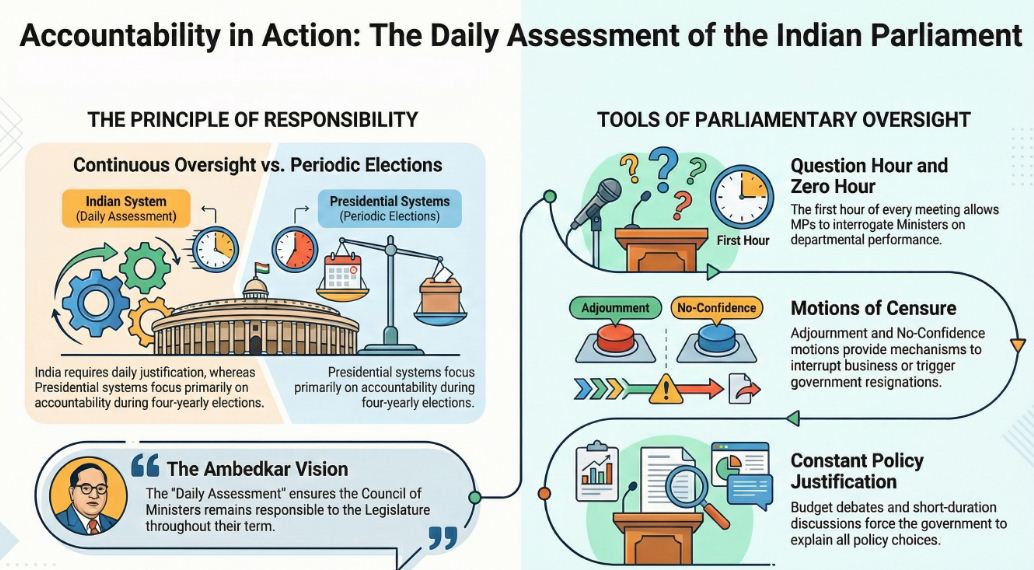
B.R. Ambedkar believed that a Parliamentary system provided “daily assessment of responsibility.” Through tools like No-Confidence Motions, the legislature could remove a PM at any time. Therefore, a fixed term limit (like the US President’s 8 years) was seen as unnecessary.
The “Broken” Mechanism (The Tenth Schedule):
The Anti-Defection Law (1985) changed everything.
- The Conflict: Legislators must now vote according to the “party whip” or lose their seats.
- The Result: A PM with a majority is no longer truly accountable to their MPs. MPs cannot vote against the leader in a No-Confidence Motion without being disqualified. This “daily accountability” is now a “dead letter.”
The Presidential Irony:
India has a convention (not a law) that the President serves only two terms, even though the role is ceremonial. However, the Prime Minister—who holds actual power—has neither a law nor a convention limiting their tenure.
The Risk of Prolonged Incumbency:
Long-term power allows a leader to influence “referee institutions” like the Judiciary, Election Commission, and regulatory bodies, making it harder for the opposition to compete fairly in the “periodic assessment” (elections).
Key Legal Benchmarks:
- Kihoto Hollohan vs. Zachillhu (1992): The SC upheld the Tenth Schedule but emphasized that it shouldn’t stifle democratic dissent. However, the reality remains that dissent leads to disqualification.
- The Jennings Test: Used to identify Constitutional Conventions:
- What are the precedents?
- Did the actors feel bound?
- Is there a reason for the rule? (Applied to the 2-term limit for Indian Presidents).
Proposed Reforms :
- Dinesh Goswami Committee/NCRWC recommendations: Limit the application of the Anti-Defection Law only to motions that threaten the stability of the government (e.g., Confidence/No-Confidence motions). Note: The text suggests the opposite—exempting these votes to allow MPs to act as a check.
- Introduction of Term Limits: Exploring a 2 or 3-term limit for PMs/CMs to prevent “institutional decay” and promote fresh leadership.
- Intra-party Democracy: Making internal party elections mandatory to prevent the “locking” of a party to a single leader.
In the Indian parliamentary system, the “Daily Assessment of Responsibility” is a constitutional concept famously articulated by Dr. B.R. Ambedkar during the Constituent Assembly debates. It describes the continuous oversight the Legislature exercises over the Executive (the Prime Minister and Council of Ministers).
Unlike a Presidential system (like in the US), where the President is primarily held accountable every four years during an election, the Indian Prime Minister must justify their actions to Parliament every single day it is in session.
How Daily Assessment Works?
The “daily” nature of this accountability is maintained through several parliamentary tools and procedures:
- Question Hour: Every day the House meets, the first hour is usually reserved for MPs to ask questions of Ministers about their department’s work. This forces the government to disclose information and defend its performance.
- Zero Hour: A period where MPs can raise matters of urgent public importance without prior notice.
- Adjournment Motions: Used to discuss a specific matter of “urgent public importance” that interrupts the regular business of the House. It carries an element of censure against the government.
- No-Confidence Motion: This is the ultimate “assessment.” If the Lok Sabha loses confidence in the government, the Council of Ministers must resign immediately.
- Debates and Discussions: Whether it is a debate on the Budget or a “Short Duration Discussion,” the government is constantly forced to explain its policy choices.

October 17, 2025
October 16, 2025
October 6, 2025
September 24, 2025

