April 1, 2026
Criminal Tribes Act (CTA) of 1871 /Denotified, Nomadic, and Semi-Nomadic Tribes (DNTs)
Demand for Census 2027 Recognition:
Why in news ? DNT communities across India are intensifying their demand for a “separate column” and a distinct code in the upcoming 2027 Census. This is seen as a move to gain political and administrative visibility.
- Ministry Recommendation: As of February 2026, the Ministry of Social Justice and Empowerment has recommended to the Office of the Registrar General of India (RGI) that DNTs be specifically included in the caste enumeration.
- Supreme Court Ruling: In March 2026, the Supreme Court declined a petition to mandate a specific DNT question in the Census forms, stating that such classifications fall under the domain of executive policy. However, the Court allowed petitioners to pursue the matter directly with the government.
- Graded Backwardness: Community leaders are advocating for sub-classification within DNTs to distinguish between “settled” and “nomadic” groups, ensuring that the most marginalized segments are not overshadowed.
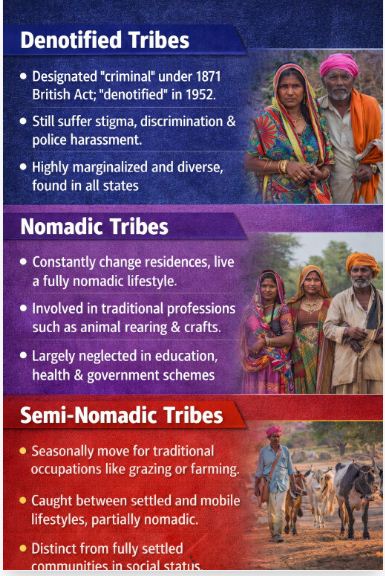
About Denotified, Nomadic and Semi-Nomadic Tribes (DNTs):
- Historical Context: DNTs are communities originally “notified” as “born criminals” under the Criminal Tribes Acts (1871–1947) by the British Raj.
- Denotification: Following Independence, the Act was repealed in 1952, and these communities were “denotified.”
- Nomadic Definition: Tribes that lack permanent land and move frequently for livelihood.
- Socio-Economic Reality: They remain among India’s most neglected groups, often lacking private land, permanent housing, and facing continued social stigma from the colonial era.
Status of DNTs in India:
- Population Estimate: Roughly 10% of the Indian population belongs to DNT categories.
- Idate Commission (2018): Identified 1,235 communities as DNTs nationwide and found that approximately 267 communities were not included in any existing SC, ST, or OBC categories.
- Administrative Oversight: The DWBDNC (Development and Welfare Board for Denotified, Nomadic, and Semi-Nomadic Communities) was established in 2019 to implement specific welfare programs.
- Historical Committees: The Renke Commission (2008) was the first major effort to identify and list these communities.
Scheme for Economic Empowerment of DNTs (SEED):
- Implementing Authority: Ministry of Social Justice and Empowerment through the DWBDNC.
- Eligibility: Families with an annual income of ₹2.50 lakh or less who are not receiving similar benefits from other schemes.
- Key Pillars:
- Education: Free coaching for competitive examinations.
- Health: Health insurance coverage.
- Housing: Financial assistance for house construction.
- Livelihood: Support for community-level small clusters and institutions
About Criminal Tribes Act (CTA) of 1871 :
The Criminal Tribes Act (CTA) of 1871 is considered one of the most draconian pieces of legislation introduced during British rule in India. It institutionalized the idea of “crime by birth,” leaving a legacy of stigma that persists today.
Historical Context:
- The Concept of “Born Criminals”: The British authorities believed that certain communities were criminals by nature and that criminal tendencies were hereditary. They argued that these groups practiced crime as an ancestral profession passed down from parents to children.
- Objective: The primary goal was to monitor and control nomadic and forest-dwelling groups that were difficult for the colonial administration to tax or track. It was also used to suppress communities that had participated in the 1857 Revolt.
Key Provisions of the Act:
- Mass Notification: The government could “notify” any tribe, gang, or class of persons as a “Criminal Tribe” if they were suspected of “systematic commission of non-bailable offenses.”
- Mandatory Registration: Every member of a notified tribe—including children—was required to register with the local magistrate.
- Restricted Movement: Members were often confined to “settlements” (which were essentially open-air prisons) or prohibited from leaving their village without a government-issued pass.
- Separation of Families: In some instances, children were forcibly separated from their parents and placed in “reformatory schools” to break the cycle of “hereditary crime.”

Gist of daily Article /The Hindu 17oct 2025
October 17, 2025
Daily Gist of the Hindu/Indian Express : 16 Oct 2025
October 16, 2025
Daily Gist of The Hindu/Indian Express: 6 Oct 2025
October 6, 2025
Daily Gist of Article /The Hindu /Indian Express: 24 Sep 2025
September 24, 2025

