September 24, 2025
Cold Start Drill: 7 Breakthrough Tests for India’s Drone Defence
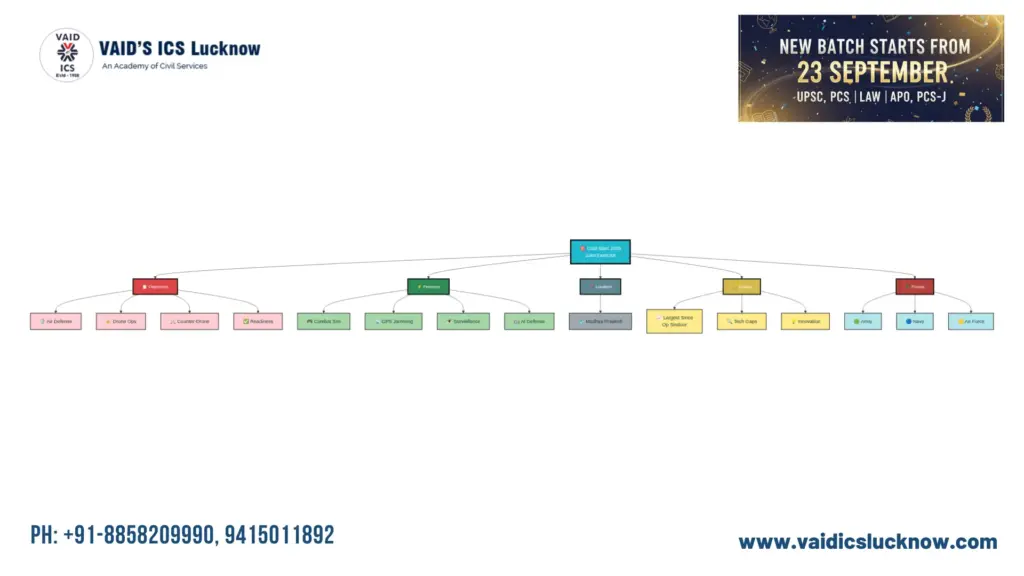
Joint Military Exercise ‘Cold Start’
The Indian Army, Navy, and Air Force are set to conduct a major joint military exercise named “Cold Start” in the first week of October 2025. This exercise will primarily focus on testing drones and counter-drone systems to enhance India’s air defense capabilities in the face of evolving aerial threats, including threats from hostile unmanned aerial vehicles (UAVs).
Key Details:
- Objective of the Exercise:
- To evaluate operational readiness of India’s armed forces against modern aerial threats, particularly drones.
- To assess the effectiveness and shortcomings of existing air defense and counter-drone systems.
- To simulate real-world combat scenarios, integrating technologies like GPS jamming, surveillance drones, and AI-driven defense systems.
- Venue:
- The exercise is expected to be held in Madhya Pradesh, which offers a large and secure testing area for such high-intensity drills.
- Significance:
- Biggest exercise since Operation Sindoor – This is the largest tri-service drill focused on drones and air defense conducted after the highly successful Operation Sindoor, which had earlier demonstrated India’s ability to neutralize enemy drone threats.
- Helps identify gaps in current technology and strategies while encouraging innovation and indigenous development.
Exercise Shatrujeet (Army)
- Type: Army-level counter-insurgency and anti-terrorism exercise.
- Purpose: To test operational readiness against insurgency and terrorist threats along the borders.
- Features: Involves live-fire drills, tactical operations, and coordination with paramilitary forces.
- Significance: Enhances combat efficiency and rapid deployment capabilities.
Exercise Vijay Prahar (Army)
- Type: Anti-terror and counter-terrorism exercise.
- Purpose: Simulates multi-front attacks and urban warfare scenarios.
- Scope: Trains troops for both conventional and asymmetric warfare.
- Significance: Strengthens quick-response capabilities against terrorist threats.
Exercise Malabar (Naval)
- Type: Multilateral naval exercise with India, the US, Japan, and Australia.
- Purpose: Enhances maritime security cooperation, anti-submarine warfare, and carrier operations.
- Features: Includes live-fire exercises, anti-piracy drills, and fleet maneuvers.
- Significance: Strengthens India’s presence in the Indo-Pacific region and promotes interoperability with allied navies.
Exercise Varuna (Navy – India & France)
- Type: Bilateral naval exercise with France.
- Purpose: Enhances strategic maritime coordination, carrier-based operations, and fleet maneuvers.
- Significance: Focuses on India-France defense cooperation in the Indian Ocean.
Exercise Konkan (Navy – India & UK)
- Type: Bilateral naval exercise with the UK.
- Purpose: Joint training for anti-submarine, surface, and aerial threat operations.
- Significance: Strengthens maritime ties and joint tactical proficiency.
Exercise Indra (Tri-service / Army & Air Force)
- Type: Bilateral exercise with Russia (India-Russia).
- Purpose: Tests joint operations between Indian forces and Russian troops.
- Scope: Includes air defense, mechanized units, and artillery coordination.
- Significance: Improves interoperability with foreign forces and modern warfare capabilities.
Exercise Gagan Shakti (Air Force)
- Type: Major Indian Air Force exercise for operational preparedness.
- Purpose: Evaluates air defense, aerial warfare, and combat readiness.
- Features: Involves live combat simulations, air-to-air and air-to-ground drills.
- Significance: Largest IAF exercise focusing on modern aerial threat response.
Exercise Cope India (Air Force – India & USA)
- Type: Bilateral air combat exercise with the US Air Force.
- Purpose: Enhances tactical aerial operations, fighter maneuvers, and electronic warfare skills.
- Significance: Strengthens air force interoperability and knowledge exchange.
Exercise Yudh Abhyas (Army – India & USA)
- Type: Annual India-US Army joint training exercise.
- Purpose: Focuses on counter-terrorism, joint tactical maneuvers, and disaster response.
- Significance: Enhances coordination between Indian and foreign forces in complex terrains.
Exercise Surya Kiran (Army – India & Nepal)
- Type: Bilateral exercise with Nepal Army.
- Purpose: Enhances cross-border cooperation, joint counter-insurgency drills, and operational readiness.
- Significance: Strengthens regional security ties and military diplomacy.
Exercise Iron Fist (Army)
- Type: Army-level mechanized warfare and firepower exercise.
- Purpose: Tests armored, artillery, and infantry coordination in simulated war scenarios.
Significance: Evaluates combat readiness and strategic planning capabilities.

Gist of daily Article /The Hindu 17oct 2025
October 17, 2025
Daily Gist of the Hindu/Indian Express : 16 Oct 2025
October 16, 2025
Daily Gist of The Hindu/Indian Express: 6 Oct 2025
October 6, 2025
Daily Gist of Article /The Hindu /Indian Express: 24 Sep 2025
September 24, 2025

