August 6, 2026
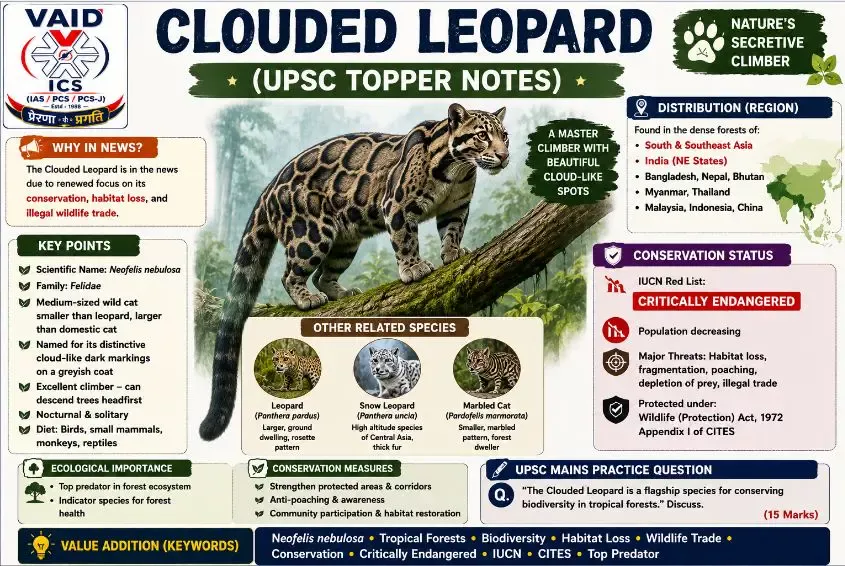
Clouded Leopard: Clouded Leopard Conservation Action Plan (CAP)
Why in News?
-
Date: August 4, 2026 (International Clouded Leopard Day).
-
Major Announcement: India officially launched the Clouded Leopard Conservation Action Plan (CAP) during the 91st Standing Committee meeting of the National Board for Wildlife (NBWL) held in Coimbatore.
-
Core Message: Recognized as an “indicator of healthy forests,” urging immediate, targeted nationwide conservation.
About the Clouded Leopard:
-
Scientific Name: Neofelis nebulosa (Mainland species).
-
Nickname: “Ghost of the Forest” due to its highly elusive, shy, and nocturnal nature.
-
Key Identifiers: Distinctive cloud-like dark blotches on the pelt; possesses the longest upper canine teeth relative to skull size among all living felines.
-
Behavior: Highly arboreal (spends most time in trees) with specialized rotating rear ankles allowing head-first descents.
-
Diet: Macaques, barking deer, wild pigs, birds, and small mammals.
IUCN Status & Protection:
-
IUCN Red List Status: Vulnerable (Population trend decreasing; over 30% decline recorded over recent decades).
-
Global Population Estimate: ~3,700 to 5,580 mature individuals.
-
Other Safeguards: * CITES Appendix I.
-
Wildlife Protection Act, 1972: Schedule I.
-
State Status: Official State Animal of Meghalaya.
-
Geographical Distribution:
-
Global Range: Himalayan foothills, South and Southeast Asia (Nepal, Bhutan, Myanmar, Thailand, Vietnam, China).
-
India Focus: Primarily Northeast India (Arunachal Pradesh, Assam, Meghalaya, Mizoram, Nagaland, Tripura, Manipur, Sikkim, and northern West Bengal).
-
Important Note: A second distinct species exists—the Sunda Clouded Leopard (Neofelis diardi), found natively on the islands of Borneo and Sumatra.
Similar Species Example:
-
Snow Leopard: Also listed as Vulnerable and acts as a high-altitude mountain ecosystem indicator, facing similar threats of habitat fragmentation and poaching.
Recent Steps Taken (Clouded Leopard CAP 2026):
-
Initiative Source: Formulated under a joint Government of India – GEF – UNDP collaboration.
-
14 Priority Landscapes: Delineates 14 critical conservation zones across Northeast India for landscape-scale habitat restoration and forest corridor connectivity.
-
Advanced Monitoring: Utilizes M-STrIPES smart application tracking, camera traps, genetic surveys, and environmental DNA (eDNA).
-
Species Recovery Programme: Included as part of the central Integrated Development of Wildlife Habitats (IDWH) scheme, backed technically by the Wildlife Institute of India (WII).
What is the IUCN (International Union for Conservation of Nature)?
-
Overview: Founded in 1948, the IUCN is the world’s premier global environmental network dedicated to nature conservation and the sustainable use of natural resources. It is headquartered in Gland, Switzerland.
-
Unique Composition: It is a unique hybrid union consisting of both government and civil society organizations. It has more than 1,400 member organizations, including states, government agencies, and non-governmental organizations (NGOs).
-
Core Functions:
-
The IUCN Red List of Threatened Species: Established in 1964, it is the world’s most comprehensive information source on the global conservation status of animal, fungus, and plant species. It classifies species into categories ranging from Least Concern to Extinct.
-
Scientific Assessments: Conducts field research, data analysis, and risk assessments to evaluate biodiversity loss and ecological health.
-
Policy Advice: Advises international conventions (like CITES and the Convention on Biological Diversity) and governments on environmental policy, conservation planning, and protected area management.
-
IUCN Red List Categories:
Species are categorized based on criteria such as rate of decline, population size, area of geographic distribution, and degree of population and distribution fragmentation:
-
Extinct (EX): No reasonable doubt that the last individual has died.
-
Extinct in the Wild (EW): Known only to survive in cultivation, captivity, or as a naturalized population well outside its past range.
-
Critically Endangered (CR): Facing an extremely high risk of extinction in the wild.
-
Endangered (EN): Facing a very high risk of extinction in the wild.
-
Vulnerable (VU): Facing a high risk of extinction in زاthe wild (e.g., the Clouded Leopard and Snow Leopard).
-
Near Threatened (NT): Close to qualifying for or likely to qualify for a threatened category in the near future.
-
Least Concern (LC): Widespread and abundant; lowest risk.
-
Data Deficient (DD) & Not Evaluated (NE): Insufficient information to assess risk, or not yet evaluated.
The Wild Life (Protection) Act, 1972 (India):
-
Overview: Enacted by the Parliament of India on September 9, 1972, this landmark legislation provides for the protection of wild animals, birds, and plants, and for matters connected therewith or ancillary or incidental thereto. It extends across the whole of India.
-
Core Objectives:
-
To safeguard the ecological and environmental security of the country.
-
To establish a network of ecologically important protected areas (National Parks, Wildlife Sanctuaries, Conservation Reserves, and Community Reserves).
-
To strictly regulate and prohibit the trade in wild animals, animal articles, and trophies.
-
Key Schedules of the Wild Life (Protection) Act, 1972:
The Act divides flora and fauna into different schedules based on the level of protection they receive:
-
Schedule I: * Level of Protection: Absolute highest level of protection.
-
Penalties: Maximum legal penalties for hunting, poaching, or trading.
-
Examples: Tiger, Lion, Elephant, Snow Leopard, and Clouded Leopard.
-
-
Schedule II: * Level of Protection: High protection, though slightly lesser penalties than Schedule I.
-
Examples: Assamese macaque, common langur, wild pig.
-
-
Schedules III & IV: * Level of Protection: Animals that are not considered endangered but still require protection (e.g., hyenas, barking deer, certain snakes and birds). Penalties are lower.
-
Schedule V: * Level of Protection: Vermin animals. Species listed here (such as common crows, mice, or fruit bats in certain contexts) can be hunted if declared dangerous to human life or property.
-
Schedule VI: * Level of Protection: Prohibits the cultivation, collection, extraction, trade, and possession of specified endangered plants (e.g., Beddome’s cycad, blue vanda, pitcher plant).
समाचार में क्यों:
-
तारीख: 4 अगस्त 2026 (अंतर्राष्ट्रीय क्लाouded लेपर्ड दिवस)।
-
प्रमुख घोषणा: भारत सरकार ने कोयंबटूर में वन्यजीव राष्ट्रीय बोर्ड (NBWL) की 91वीं स्थायी समिति की बैठक के दौरान आधिकारिक तौर पर क्लाउडेड लेपर्ड कंजर्वेशन एक्शन प्लान (CAP) लॉन्च किया।
-
मुख्य संदेश: इसे “स्वस्थ जंगलों का संकेतक” माना गया है, और देश भर में इसके तत्काल और लक्षित संरक्षण की आवश्यकता पर जोर दिया गया है।
क्लाउडेड लेपर्ड के बारे में:
-
वैज्ञानिक नाम: Neofelis nebulosa (मुख्यभूमि प्रजाति)।
-
उपनाम: इसके बेहद शर्मीले, निशाचर और छिपने वाले स्वभाव के कारण इसे “घोस्ट ऑफ द फॉरेस्ट” (जंगल का भूत) कहा जाता है।
-
मुख्य पहचान: शरीर पर बादलों जैसे विशिष्ट गहरे धब्बे; सभी जीवित बिल्लियों में खोपड़ी के आकार के अनुपात में सबसे लंबे ऊपरी कैनाइन (नुकीले) दांत होते हैं।
-
व्यवहार: अत्यधिक वृक्षवासी (ज्यादातर पेड़ों पर रहने वाला) और विशेष मुड़ने वाले पिछले टखनों से लैस, जिससे यह सिर के बल पेड़ों से नीचे उतर सकता है।
-
आहार: मकाक, बार्किंग डीअर (भौंकने वाले हिरण), जंगली सूअर, पक्षी और छोटे स्तनधारी।
IUCN स्थिति और संरक्षण:
-
IUCN रेड लिस्ट स्थिति: सुभेद्य (Vulnerable) (आबादी घट रही है; पिछले कुछ दशकों में 30% से अधिक की गिरावट दर्ज की गई है)।
-
वैश्विक आबादी का अनुमान: लगभग 3,700 से 5,580 वयस्क जीव बचे हैं।
-
अन्य सुरक्षा उपाय: * CITES परिशिष्ट I (Appendix I)।
-
वन्यजीव (संरक्षण) अधिनियम, 1972: अनुसूची I।
-
राजकीय दर्जा: मेघालय का आधिकारिक राजकीय पशु।
-
भौगोलिक वितरण:
-
वैश्विक विस्तार: हिमालय की तलहटी, दक्षिण और दक्षिण-पूर्व एशिया (नेपाल, भूटान, म्यांमार, थाईलैंड, वियतनाम, चीन)।
-
भारत का क्षेत्र: मुख्य रूप से पूर्वोत्तर भारत (अरुणाचल प्रदेश, असम, मेघालय, मिजोरम, नागालैंड, त्रिपुरा, मणिपुर, सिक्किम और उत्तरी पश्चिम बंगाल)।
-
महत्वपूर्ण नोट: एक दूसरी अलग प्रजाति भी मौजूद है—सुंडा क्लाउडेड लेपर्ड (Neofelis diardi), जो मूल रूप से बोर्नियो और सुमात्रा के द्वीपों पर पाई जाती है।
समान प्रजाति का उदाहरण:
-
स्नो लेपर्ड (हिम तेंदुआ): इसे भी Vulnerable के रूप में सूचीबद्ध किया गया है और यह उच्च-तुंगता वाले पर्वतीय पारिस्थितिकी तंत्र के संकेतक के रूप में कार्य करता है, जिसे आवास के टुकड़े-टुकड़े होने और शिकार जैसी समान चुनौतियों का सामना करना पड़ता है।
हाल ही में उठाए गए कदम (क्लाउडेड लेपर्ड CAP 2026):
-
पहल का स्रोत: भारत सरकार, GEF और UNDP के संयुक्त सहयोग से तैयार किया गया।
-
14 प्राथमिकता वाले परिदृश्य: पूर्वोत्तर भारत में परिदृश्य-स्तर पर आवास की बहाली और वन गलियारे की कनेक्टिविटी के लिए 14 महत्वपूर्ण संरक्षण क्षेत्रों को रेखांकित करता है।
-
उन्नत निगरानी: एम-स्ट्राइप्स (M-STrIPES) स्मार्ट एप्लिकेशन ट्रैकिंग, कैमरा ट्रैप, जेनेटिक सर्वे और पर्यावरण डीएनए (eDNA) का उपयोग करता है।
-
प्रजाति पुनर्प्राप्ति कार्यक्रम: भारतीय वन्यजीव संस्थान (WII) द्वारा तकनीकी रूप से समर्थित, केंद्रीय वन्यजीव आवास विकास (IDWH) योजना के हिस्से के रूप में शामिल किया गया।
IUCN (प्रकृति के संरक्षण के लिए अंतर्राष्ट्रीय संघ) क्या है?
-
अवलोकन: 1948 में स्थापित, IUCN प्रकृति संरक्षण और प्राकृतिक संसाधनों के सतत उपयोग के लिए समर्पित दुनिया का प्रमुख वैश्विक पर्यावरण नेटवर्क है। इसका मुख्यालय ग्लाइंड, स्विट्जरलैंड में है।
-
अद्वितीय संरचना: यह सरकारों और नागरिक समाज संगठनों दोनों से मिलकर बना एक अनूठा हाइब्रिड संघ है। इसके पास 1,400 से अधिक सदस्य संगठन हैं, जिनमें राज्य, सरकारी एजेंसियां और गैर-सरकारी संगठन (NGO) शामिल हैं।
-
मुख्य कार्य:
-
IUCN रेड लिस्ट: 1964 में स्थापित, यह पशुओं, कवक और पौधों की प्रजातियों की वैश्विक संरक्षण स्थिति पर दुनिया का सबसे व्यापक सूचना स्रोत है। यह प्रजातियों को ‘कम चिंता’ से लेकर ‘विलुप्त’ तक की श्रेणियों में वर्गीकृत करता है।
-
वैज्ञानिक आकलन: जैव विविधता के नुकसान और पारिस्थितिक स्वास्थ्य का मूल्यांकन करने के लिए क्षेत्रीय अनुसंधान, डेटा विश्लेषण और जोखिम आकलन का संचालन करता है।
-
नीतिगत सलाह: अंतरराष्ट्रीय सम्मेलनों (जैसे CITES और कन्वेंशन ऑन बायोलॉजिकल डायवर्सिटी) और सरकारों को पर्यावरण नीति, संरक्षण योजना और संरक्षित क्षेत्र प्रबंधन पर सलाह देता है।
-
IUCN रेड लिस्ट श्रेणियां:
गिरावट की दर, आबादी के आकार, भौगोलिक वितरण क्षेत्र और वितरण के विखंडन के आधार पर प्रजातियों को वर्गीकृत किया गया है:
-
विलुप्त (Extinct – EX): इस बात का कोई उचित संदेह नहीं है कि अंतिम व्यक्ति की मृत्यु हो चुकी है।
-
जंगल में विलुप्त (Extinct in the Wild – EW): केवल खेती, कैद में या अपने पिछले दायरे से बाहर एक प्राकृतिक आबादी के रूप में जीवित रहने के लिए जाना जाता है।
-
गंभीर रूप से संकटग्रस्त (Critically Endangered – CR): जंगल में विलुप्त होने के अत्यधिक उच्च जोखिम का सामना करना पड़ रहा है।
-
संकटग्रस्त (Endangered – EN): जंगल में विलुप्त होने के बहुत उच्च जोखिम का सामना करना पड़ रहा है।
-
सुभेद्य (Vulnerable – VU): जंगल में विलुप्त होने के उच्च जोखिम का सामना करना पड़ रहा है (जैसे क्लाउडेड लेपर्ड और स्नो लेपर्ड)।
-
संकट के करीब (Near Threatened – NT): निकट भविष्य में खतरे की श्रेणी के योग्य होने के करीब।
-
न्यूनतम चिंता (Least Concern – LC): व्यापक और प्रचुर मात्रा में; सबसे कम जोखिम।
-
डेटा की कमी और मूल्यांकन नहीं किया गया (DD & NE): जोखिम का आकलन करने के लिए अपर्याप्त जानकारी, या अभी तक मूल्यांकन नहीं किया गया है।
वन्यजीव (संरक्षण) अधिनियम, 1972 (भारत):
-
अवलोकन: भारत की संसद द्वारा 9 सितंबर 1972 को अधिनियमित, यह ऐतिहासिक कानून जंगली जानवरों, पक्षियों और पौधों की सुरक्षा के लिए और उससे जुड़े मामलों के लिए प्रावधान करता है। यह पूरे भारत में लागू होता है।
-
मुख्य उद्देश्य:
-
देश की पारिस्थितिक और पर्यावरणीय सुरक्षा को सुरक्षित करना।
-
पारिस्थितिक रूप से महत्वपूर्ण संरक्षित क्षेत्रों (राष्ट्रीय उद्यान, वन्यजीव अभयारण्य, संरक्षण रिजर्व और सामुदायिक रिजर्व) का एक नेटवर्क स्थापित करना।
-
जंगली जानवरों, पशु लेखों और ट्राफियों के व्यापार को सख्ती से विनियमित करना और प्रतिबंधित करना।
-
वन्यजीव (संरक्षण) अधिनियम, 1972 की मुख्य अनुसूचियां:
यह अधिनियम प्राप्त सुरक्षा स्तर के आधार पर वनस्पतियों और जीवों को विभिन्न अनुसूचियों में विभाजित करता है:
-
अनुसूची I: * सुरक्षा का स्तर: पूर्ण उच्चतम स्तर की सुरक्षा।
-
दंड: शिकार, अवैध शिकार या व्यापार के लिए अधिकतम कानूनी दंड।
-
उदाहरण: बाघ, शेर, हाथी, हिम तेंदुआ और क्लाउडेड लेपर्ड।
-
-
अनुसूची II: * सुरक्षा का स्तर: उच्च सुरक्षा, हालांकि अनुसूची I से थोड़ा कम दंड।
-
उदाहरण: असमिया मकाक, सामान्य लंगूर, जंगली सूअर।
-
-
अनुसूची III और IV: * सुरक्षा का स्तर: ऐसे जानवर जिन्हें लुप्तप्राय नहीं माना जाता है लेकिन फिर भी सुरक्षा की आवश्यकता होती है (जैसे लकड़बग्घा, बार्किंग डीअर, कुछ सांप और पक्षी)। दंड कम हैं।
-
अनुसूची V: * सुरक्षा का स्तर: वर्मिन (हानिकारक) जानवर। यहां सूचीबद्ध प्रजातियों (जैसे सामान्य कौवे, चूहे, या कुछ संदर्भों में चमगादड़) का शिकार किया जा सकता है यदि उन्हें मानव जीवन या संपत्ति के लिए खतरनाक घोषित किया जाता है।
-
अनुसूची VI: * सुरक्षा का स्तर: निर्दिष्ट लुप्तप्राय पौधों (जैसे बेडडोम साइकैड, ब्लू वांडा, पिचर प्लांट) की खेती, संग्रह, निष्कर्षण, व्यापार और कब्जे पर प्रतिबंध लगाता है।

May 19, 2026
October 17, 2025
October 16, 2025
October 6, 2025

