July 6, 2026
Climate Change Impact on Milk Production in the Gangetic Plains
Overview
A study published in Scientific Reports highlights that climate change is causing a significant decline in bovine milk production in India, particularly within the trans-Gangetic plains (Haryana). As the world’s largest milk producer, this trend poses a critical risk to national food security and the livelihoods of 80 million smallholder farmers.
Key Mechanisms of Impact:
The study assessed climate variables (temperature, humidity, rainfall, evapotranspiration) from 2004–2019.
-
-
Physiological Stress: High temperatures (>38°C) combined with high humidity (>70%) force animals to divert energy from milk production to regulate body temperature (homeostasis).
-
Yield Decline: * General decline of 20–30% in milk yield during heat stress.
-
For buffaloes specifically, a unit increase in potential evapotranspiration reduces milk yield by approximately 1.4 litres/day.
-
-
Systemic Failures: Rising temperatures negatively impact the broader dairy ecosystem:
-
Reduced quantity, quality, and availability of fodder and feed.
-
Increased water scarcity.
-
Higher incidence of pests and diseases.
-
Compromised animal immune systems.
-
-
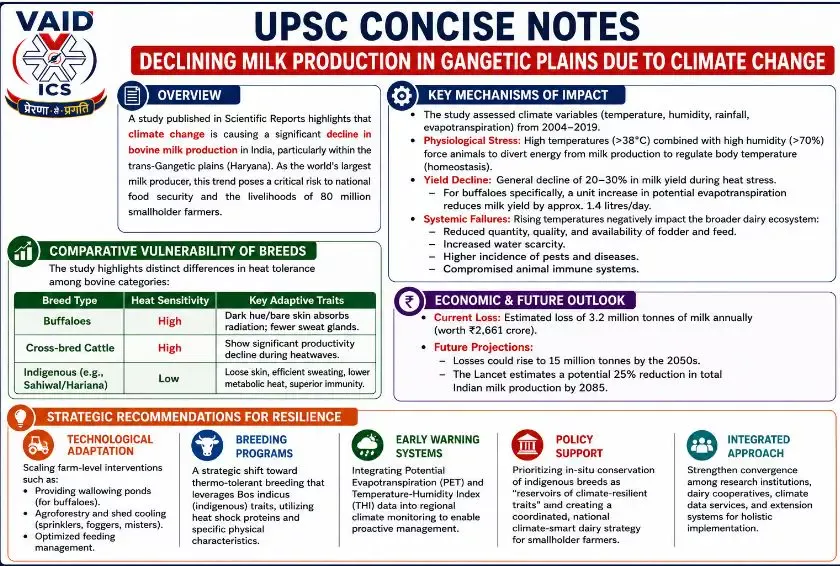
Comparative Vulnerability of Breeds:
The study highlights distinct differences in heat tolerance among bovine categories:
| Breed Type | Heat Sensitivity | Key Adaptive Traits |
| Buffaloes | High | Dark hue/bare skin absorbs radiation; fewer sweat glands. |
| Cross-bred Cattle | High | Show significant productivity decline during heatwaves. |
| Indigenous (e.g., Sahiwal/Hariana) | Low | Loose skin, efficient sweating, lower metabolic heat, superior immunity. |
Economic & Future Outlook:
-
Current Loss: Estimated loss of 3.2 million tonnes of milk annually (worth ₹2,661 crore).
-
Future Projections: * Losses could rise to 15 million tonnes by the 2050s.
-
The Lancet estimates a potential 25% reduction in total Indian milk production by 2085.
-
Strategic Recommendations for Resilience:
-
Technological Adaptation: Scaling farm-level interventions such as:
-
Providing wallowing ponds (for buffaloes).
-
Agroforestry and shed cooling (sprinklers, foggers, misters).
-
Optimized feeding management.
-
-
Breeding Programs: A strategic shift toward thermo-tolerant breeding that leverages Bos indicus (indigenous) traits, utilizing heat shock proteins and specific physical characteristics.
-
Early Warning Systems: Integrating Potential Evapotranspiration (PET) and Temperature-Humidity Index (THI) data into regional climate monitoring to enable proactive management.
-
Policy Support: Prioritizing in-situ conservation of indigenous breeds as “reservoirs of climate-resilient traits” and creating a coordinated, national climate-smart dairy strategy for smallholder farmers.
गंगा के मैदानी इलाकों में दूध उत्पादन पर जलवायु परिवर्तन का प्रभाव:
अवलोकन:
साइंटिफिक रिपोर्ट्स (Scientific Reports) में प्रकाशित एक अध्ययन के अनुसार, जलवायु परिवर्तन के कारण भारत, विशेष रूप से ट्रांस-गंगा के मैदानी इलाकों (हरियाणा) में दूध उत्पादन में भारी गिरावट आई है। भारत दुनिया का सबसे बड़ा दूध उत्पादक देश है, इसलिए यह प्रवृत्ति खाद्य सुरक्षा और 8 करोड़ छोटे डेयरी किसानों की आजीविका के लिए एक बड़ा खतरा है।
प्रभाव के मुख्य कारण:
अध्ययन में 2004 से 2019 तक जलवायु कारकों (तापमान, आर्द्रता, वर्षा, वाष्पोत्सर्जन) का विश्लेषण किया गया:
-
शारीरिक तनाव: 38°C से अधिक तापमान और 70% से अधिक आर्द्रता के कारण पशुओं को अपने शरीर का तापमान नियंत्रित करने के लिए ऊर्जा लगानी पड़ती है, जिससे दूध उत्पादन की ऊर्जा कम हो जाती है।
-
उत्पादन में गिरावट: * हीट स्ट्रेस के दौरान दूध उत्पादन में 20-30% की कमी आती है।
-
विशेष रूप से भैंसों में, ‘संभावित वाष्पोत्सर्जन’ (Potential Evapotranspiration) में एक इकाई की वृद्धि से दूध उत्पादन में लगभग 1.4 लीटर प्रति दिन की कमी आती है।
-
-
प्रणालीगत विफलता: बढ़ते तापमान का असर पूरे डेयरी पारिस्थितिकी तंत्र पर पड़ रहा है:
-
चारे की गुणवत्ता और उपलब्धता में कमी।
-
पानी की बढ़ती कमी।
-
कीटों और बीमारियों का प्रकोप।
-
पशुओं की प्रतिरक्षा प्रणाली (Immune System) का कमजोर होना।
-
विभिन्न नस्लों की संवेदनशीलता (तुलनात्मक चार्ट):
| नस्ल का प्रकार | ताप संवेदनशीलता | अनुकूलन विशेषताएँ |
| भैंस | अधिक | गहरे रंग और कम पसीने वाली ग्रंथियों के कारण अधिक गर्मी सोखती हैं। |
| संकर नस्ल (Cross-bred) | अधिक | हीटवेव के दौरान उत्पादन में भारी गिरावट। |
| स्वदेशी (जैसे साहीवाल/हरियाणवी) | कम | ढीली त्वचा, प्रभावी पसीना और कम चयापचय गर्मी; गर्मी के प्रति अधिक प्रतिरोधी। |
आर्थिक प्रभाव और भविष्य की चुनौतियाँ:
-
वर्तमान नुकसान: हर साल 3.2 मिलियन टन दूध का नुकसान, जिसका मूल्य ₹2,661 करोड़ है।
-
भविष्य का अनुमान: 2050 के दशक तक यह नुकसान 15 मिलियन टन तक पहुंच सकता है। द लैंसेट के अनुसार, 2085 तक भारत के दूध उत्पादन में 25% की कमी आ सकती है।
लचीलापन (Resilience) के लिए रणनीतिक सुझाव:
-
तकनीकी अनुकूलन: किसानों को निम्नलिखित अपनाना चाहिए:
-
भैंसों के लिए तालाब (wallowing ponds) और शेड में स्प्रिंकलर/फोगर का उपयोग।
-
एग्रोफोरेस्ट्री (कृषि वानिकी) और उन्नत चारा प्रबंधन।
-
-
प्रजनन कार्यक्रम: बोस इंडिकस (स्वदेशी) गुणों का लाभ उठाते हुए ‘थर्मो-टोलरेंट’ (गर्मी सहने वाली) नस्लों को बढ़ावा देना।
-
अर्ली वार्निंग सिस्टम: क्षेत्रीय स्तर पर तापमान-आर्द्रता सूचकांक (THI) के आधार पर पूर्व चेतावनी प्रणाली विकसित करना।
-
नीतिगत समर्थन: स्वदेशी नस्लों के संरक्षण को प्राथमिकता देना और छोटे किसानों के लिए एक समन्वित ‘क्लाइमेट-स्मार्ट डेयरी रणनीति’ तैयार करना।

May 19, 2026
October 17, 2025
October 16, 2025
October 6, 2025

