January 2, 2026
Central Excise (Amendment) Act, 2025
The Union Finance Ministry has issued a series of notifications that will give effect to the new taxation regime for tobacco products from February 1.
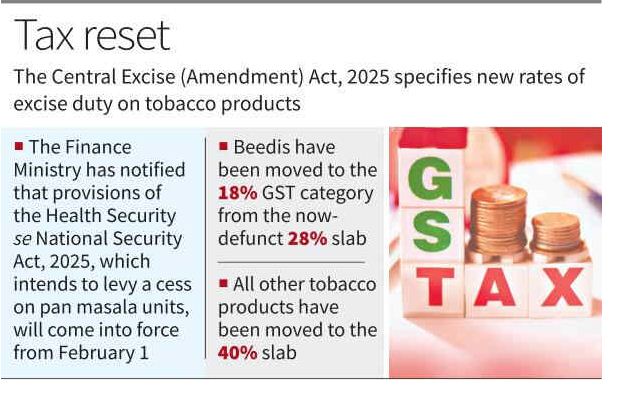
The Central Excise (Amendment) Act, 2025, passed in the recently concluded Winter Session of Parliament, specifies new rates of excise duty on tobacco products.
Levy on pan units:
The Finance Ministry also notified that provisions of the Health Security se National Security Act, 2025, which intends to levy a cess on pan masala units, will come into force from February 1.
In an accompanying FAQ note, the Ministry explained that under the Goods and Services Tax (GST) regime, the excise duty on cigarettes had so far been rendered a nominal amount of a “fraction of a paisa” per cigarette stick, and the GST compensation cess rate on tobacco products had not been increased since it was implemented in July 2017.
- “For India, affordability has either stagnated or increased in the past decade, meaning cigarettes have not become more expensive relative to consumers’ purchasing power,” the note said.
- “This is contrary to global public health guidance, which emphasises annual increases in specific excise duties to ensure that real cigarette prices rise faster than incomes,” the note added.
- At the same time, the Ministry notified February 1 as the date from which the GST compensation cess would cease to exist.
- The cess was originally introduced for a period of five years to compensate States for any loss arising out of the implementation of GST.
Tax slabs:
The Finance Ministry also notified the new GST rates for tobacco products.
Beedis have been moved to the 18% category from the now-defunct 28% slab. All other tobacco products have been moved to the 40% slab. These new rates will be effective from February 1.
- The GST compensation cess was to end in 2022. However, due to the COVID-19 pandemic, the cess collections were not enough to compensate the States and so the Centre borrowed money to compensate them.
- Hence, it was extended until 2026, with the proceeds being used to repay the loan.
- With the impending end of the loan, the government on September 22, 2025, removed the incidence of the cess on most items except on tobacco products. From February 1, 2026, the cess will no longer apply on these items either, effectively ending it.
- Finally, the Ministry introduced a new valuation mechanism for tobacco products such as chewing tobacco, filter khaini, jarda, scented tobacco, and gutkha, whereby the GST value would be determined based on the retail sale price declared on the package.
Need for dedicated cess
- Regarding the Health Security seNational Security Act, 2025, the Ministry justified the inclusion of the national security aspect by saying that conventional tax revenues cannot always guarantee funding for national security functions, and so a dedicated cess is needed for the purpose.
- “General tax revenues are subject to competing developmental priorities and cannot always guarantee sustained long-term funding for core national security functions,” the FAQ note said.
- “A dedicated purpose-specific cess enables the Union to create a non-lapsable, predictable financial stream that supports multi-year security preparedness, technological upgradation, capacity creation, and advanced equipment procurement — without increasing the tax burden on the general population or raising broad-based rates such as GST.”

October 17, 2025
October 16, 2025
October 6, 2025
September 24, 2025
