March 19, 2026
Bharat Audyogik Vikas Yojna (BHAVYA)
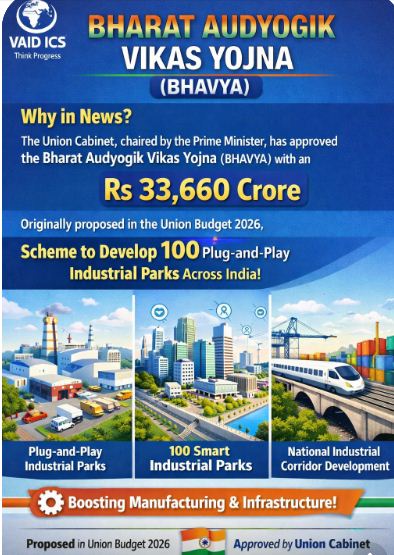
Why in News ? The Union Cabinet, chaired by the Prime Minister, has approved the Bharat Audyogik Vikas Yojna (BHAVYA) with an allocation of Rs 33,660 crore. Originally proposed in the Union Budget 2026, the scheme aims to develop 100 plug-and-play industrial parks across India, building on the success of the Industrial Smart Cities developed under the National Industrial Corridor Development Programme (NICDP).
Core Objectives and Vision:
The scheme is designed to transform India’s manufacturing landscape by providing world-class infrastructure that is ready for immediate use.
- Investment-Ready Facilities: The government will facilitate approximately 34,000 acres of “plug-and-play” industrial land at competitive rates.
- Reducing Entry Barriers: With pre-approved land and integrated services, the scheme helps investors move from “intent to production” with high speed and legal certainty.
- Boosting Manufacturing: It seeks to unlock India’s manufacturing potential and drive large-scale economic growth.
Financial Support and Eligibility:
The Central Government provides significant fiscal incentives to ensure the viability of these projects:
- Grant Amount: Support of up to Rs 1 crore per acre for a duration of 6 years (FY 2026-27 to 2031-32).
- Park Scale: Industrial parks must have a minimum area of 100 acres, with a maximum limit of 1,000 acres.
- External Connectivity: The Centre will also provide support for external infrastructure up to 25% of the total project cost to ensure seamless integration with national networks.
Selection Criteria and Design Principles:
Projects will be selected in a challenge mode based on their adherence to modern industrial standards. The key design principles include:
- PM GatiShakti Principles: Alignment with multimodal connectivity for efficient logistics and last-mile access.
- Underground Utility Corridors: Integrated corridors for power, water, and ICT to enable a “no-dig” environment, ensuring uninterrupted operations and easy maintenance.
- Green Energy: A focus on sustainable resource use and eco-friendly industrial ecosystems.
- Ease of Doing Business: Implementation of regulatory reforms to simplify industrial operations.
Infrastructure Classification:
The funding will cover three primary types of infrastructure within the parks:
- Core Infrastructure: Internal roads, drainage, common effluent treatment plants (CETP), and digital administrative systems.
- Value-Added Infrastructure: Ready-built factory sheds, testing laboratories, and specialized warehousing.
- Social Infrastructure: Housing for workers and essential support amenities to create a holistic ecosystem.
What is Plug-and-Play Industrial Park?
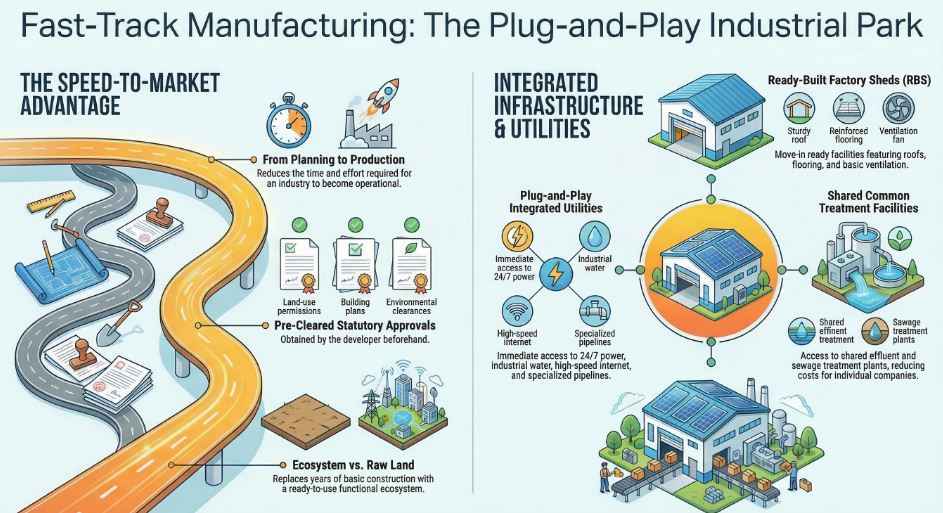
A Plug-and-Play Industrial Park is a modern industrial infrastructure model designed to reduce the time and effort required for an industry to go from “planning” to “production.”
- Instead of a company buying raw land and spent years building roads, electricity connections, and getting environmental clearances, they move into a facility where the entire ecosystem is already functional.
Core Concept: “Ready-to-Use”:
- The term “plug-and-play” is borrowed from the technology world. Just as you plug a USB drive into a computer and it works immediately, an industrialist can “plug” their machinery into the park’s infrastructure and start manufacturing almost instantly.
Key Features of Plug-and-Play Parks:
These parks are characterized by high-quality, pre-integrated services:
- Pre-Cleared Land: All statutory approvals, such as environmental clearances, land-use permissions, and building plan approvals, are obtained by the park developer beforehand.
- Ready-Built Factory Sheds: Instead of constructing a factory from scratch, companies can rent or buy “Ready-Built Sheds” (RBS) or “Plug-and-Play Flatted Factories” which come with roofs, flooring, and basic ventilation.
- Integrated Utilities: Reliable 24/7 power, industrial-grade water supply, high-speed internet, and specialized gas pipelines are already connected to each unit.
- Common Treatment Facilities: Shared infrastructure like Common Effluent Treatment Plants (CETP) and sewage treatment plants (STP), which are often too expensive for individual MSMEs to build.
- Logistics & Connectivity: These parks are usually aligned with Multimodal Logistics Parks (MMLPs) or major highways (like the PM GatiShakti framework) to ensure easy movement of goods.

October 17, 2025
October 16, 2025
October 6, 2025
September 24, 2025

