March 11, 2026
Aviation Turbine Fuel (ATF):Fuel Types in Aviation and Helicopters:
Why in News ? The Air India group recently announced a phased increase in fuel surcharges across its domestic and international network, citing a sharp rise in jet fuel prices driven by the conflict in West Asia.
Aviation Turbine Fuel (ATF):
ATF is a specialized petroleum-based fuel used to power aircraft gas turbine engines (jet engines).
- In India, ATF accounts for roughly 40% of an airline’s total operating expenditure (OPEX).
Key Characteristics:
- Composition: It is essentially a highly refined form of Kerosene.
- Appearance: Typically colorless or straw-colored.
- Freezing Point: Aircraft fly at high altitudes (35,000+ ft) where temperatures can drop below -40°C. ATF has a very low freezing point to ensure it remains liquid during flight.
- Flash Point: It has a high flash point (the temperature at which it can ignite) to minimize the risk of fire in the event of an accident.
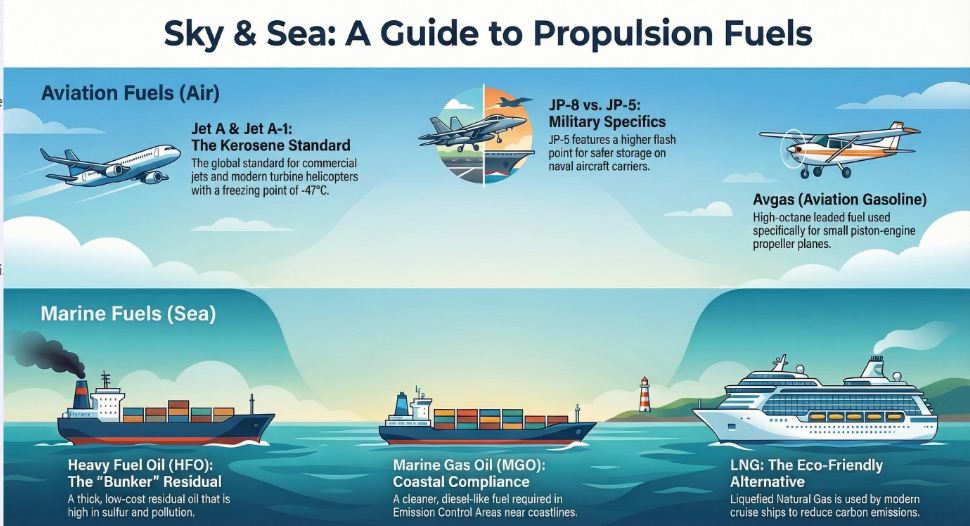
Fuel Types in Aviation and Helicopters:
The aviation industry primarily uses two categories of fuels depending on the engine type:
| Vehicle Type | Fuel Used | Description |
| Commercial/Military Jets | Jet A / Jet A-1 | Kerosene-based. Jet A-1 is the global standard with a freezing point of -47°C. |
| Military (Naval/Air Force) | JP-8 / JP-5 | JP-8 is the Air Force standard. JP-5 is used on Aircraft Carriers because its higher flash point makes it safer for storage on ships. |
| Turbine Helicopters | ATF (Jet A-1) | Modern helicopters use turbine engines and consume the same fuel as large commercial jets. |
| Small Propeller Planes | Avgas (Aviation Gasoline) | Used in piston engines. It is similar to high-octane motor gasoline but often contains Lead to prevent engine knocking. |
Fuel Types in Marine Vessels (Ships):
Marine engines are massive and designed to burn much thicker, heavier fuels than aircraft.
- Heavy Fuel Oil (HFO): Also known as “Bunker Fuel.” It is the residual, thick oil left after the refining process. It is cheap but high in sulfur and highly polluting.
- Marine Gas Oil (MGO): Similar to diesel. It is used in “Emission Control Areas” (ECAs) near coasts because it burns cleaner than HFO.
- LNG (Liquefied Natural Gas): A modern, eco-friendly alternative. Many new cruise ships and cargo vessels use LNG to reduce carbon and sulfur emissions.
Conclusion:
Rising fuel prices don’t just hurt airline profits—they make air travel less accessible for the general public. To mitigate this, the industry is moving toward Sustainable Aviation Fuel (SAF), made from waste oils and agricultural residue, to meet “Net Zero” targets by 2050.

October 17, 2025
October 16, 2025
October 6, 2025
September 24, 2025

