September 28, 2026
Arctic Region: Geopolitics, Major Initiatives & India’s Interests
Why in News?
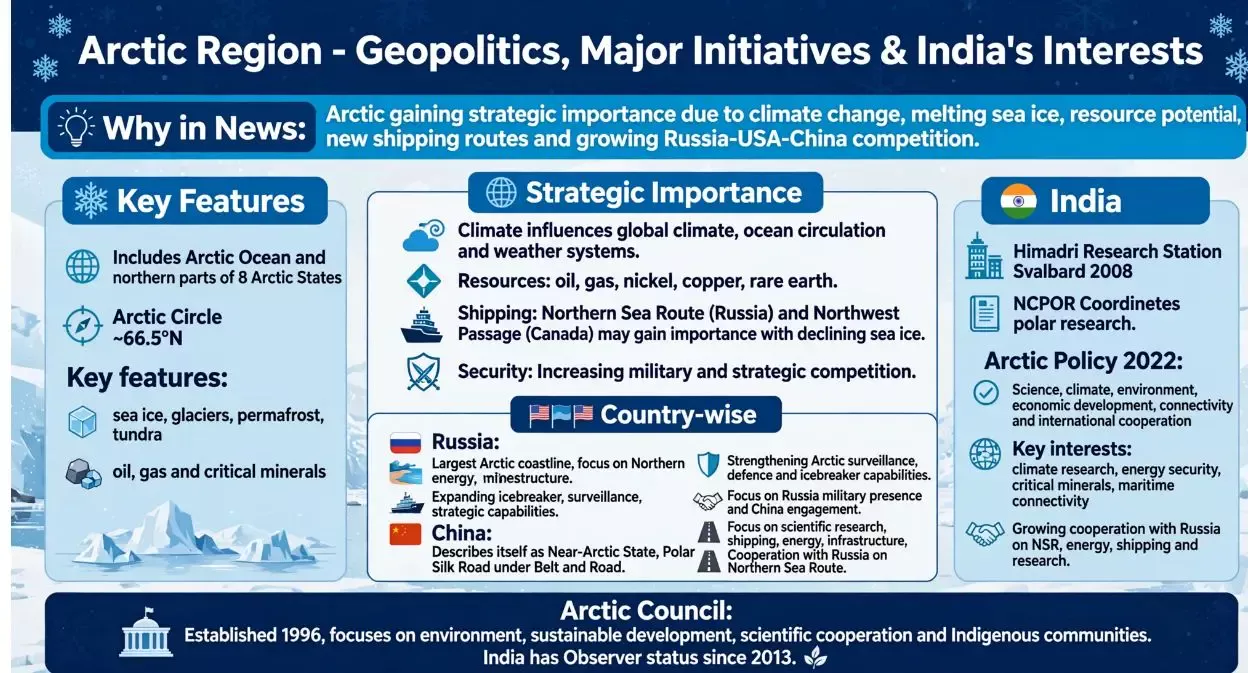
The Arctic Region is emerging as an important zone of climate change, resource competition, maritime connectivity and strategic rivalry. Rapid warming is reducing sea-ice cover and increasing the accessibility of Arctic resources and shipping routes, attracting greater attention from the USA, Russia, China and India.
Arctic Region: Geographical Significance
-
The Arctic is the region surrounding the North Pole, broadly covering the Arctic Ocean and the northern parts of eight Arctic States:
Russia, USA, Canada, Denmark (Greenland), Norway, Sweden, Finland and Iceland. -
The Arctic Circle is located at approximately 66.5° N latitude.
-
It contains:
-
Arctic Ocean and surrounding seas
-
Permafrost
-
Sea ice and glaciers
-
Tundra ecosystems
-
Major deposits of oil, natural gas and minerals
-
-
The region is highly important for global climate regulation.
Why is the Arctic Strategically Important?
Climate Change:
Arctic warming → Sea-ice decline → Greater accessibility → New economic & strategic opportunities
-
Arctic warming is occurring much faster than the global average.
-
Melting sea ice affects global ocean circulation, sea level and weather patterns.
-
Thawing permafrost can release greenhouse gases such as methane and carbon dioxide.
Natural Resources:
The Arctic possesses significant potential reserves of:
-
Oil and natural gas
-
Nickel and copper
-
Rare earth elements
-
Other critical minerals
Emerging Shipping Routes:
-
Northern Sea Route (NSR): Along Russia’s Arctic coast.
-
Northwest Passage: Through the Canadian Arctic.
-
Reduced sea ice could make Arctic routes increasingly relevant for Europe–Asia maritime connectivity.
Russia: Arctic Strategy
Russia has the largest Arctic coastline and regards the Arctic as a major component of its economic and strategic policy.
Major Initiatives:
-
Development of the Northern Sea Route (NSR).
-
Expansion of Arctic ports and infrastructure.
-
Development of oil, gas and mineral resources.
-
Investment in icebreakers and Arctic-capable vessels.
-
Development of Arctic settlements and transport infrastructure.
-
Strengthening military and surveillance capabilities in the region.
Russia’s Core Interests:
Energy + Shipping + Minerals + Strategic Security
USA: Arctic Strategy
The United States views the Arctic as increasingly important for national security, climate policy, resources and competition with Russia and China.
Major Initiatives:
-
Strengthening presence in Alaska.
-
Expansion of Arctic surveillance and defence capabilities.
-
Development of icebreaker capacity.
-
Cooperation with NATO allies and Arctic partners.
-
Protection of critical infrastructure and maritime routes.
-
Greater attention to critical minerals and energy resources.
Key Concern:
Growing Russian military presence and increasing Chinese economic and strategic engagement in the Arctic.
China: Arctic Strategy
China is not an Arctic State, but considers itself a “Near-Arctic State” and seeks a greater role in Arctic affairs.
Major Initiatives:
-
Polar Silk Road: Arctic component of the Belt and Road Initiative.
-
Investment in Arctic infrastructure and resource projects.
-
Scientific research through polar expeditions.
-
Development of Arctic shipping interests.
-
Cooperation with Russia in energy and the Northern Sea Route.
-
Interest in critical minerals and energy resources.
China’s Approach:
Research + Infrastructure + Resources + Shipping + Strategic Partnerships
India: Arctic Policy & Interests
India’s engagement with the Arctic is primarily linked to climate science, scientific research, energy security and strategic connectivity.
India’s Major Initiatives:
Arctic Research Station:
India established Himadri at Ny-Ålesund, Svalbard, Norway, in 2008.
-
India’s first permanent Arctic research station.
-
Focuses on climate, atmospheric and environmental research.
Polar Research:
India undertakes scientific expeditions to study:
-
Climate change
-
Arctic atmosphere
-
Glaciers and sea ice
-
Marine ecosystems
-
Polar biology
National Centre for Polar and Ocean Research:
NCPOR coordinates India’s polar research activities.
India’s Arctic Policy: 2022
India’s Arctic Policy focuses on:
-
Science and research
-
Climate and environmental protection
-
Economic and human development
-
Transportation and connectivity
-
Governance and international cooperation
-
National capacity building
India’s Strategic Interests:
Climate Security + Scientific Research + Energy Security + Connectivity + Critical Minerals
India–Russia Arctic Cooperation:
The Arctic has growing importance in India–Russia relations.
Key areas include:
-
Northern Sea Route
-
Energy cooperation
-
Arctic shipping
-
Scientific research
-
Ports and logistics
-
Training of personnel for Arctic navigation
The NSR can potentially provide an alternative maritime connectivity route between Europe and Asia.
Arctic Council: Key Institution
The Arctic Council, established in 1996, is the principal intergovernmental forum for Arctic cooperation.
Eight Arctic States:
Canada, Denmark, Finland, Iceland, Norway, Russia, Sweden and USA
Important Feature:
The Council primarily focuses on:
-
Environmental protection
-
Sustainable development
-
Scientific cooperation
-
Indigenous peoples and communities
India became an Arctic Council Observer in 2013.
Major Challenges
Geopolitical Rivalry:
Russia–West tensions + USA–Russia rivalry + China’s growing presence
The Arctic is increasingly linked with broader global strategic competition.
Militarisation:
-
Expansion of military infrastructure
-
Increased naval and air surveillance
-
Competition over strategic Arctic waters
Environmental Risks:
-
Oil spills
-
Industrial pollution
-
Habitat destruction
-
Permafrost thaw
-
Biodiversity loss
Indigenous Communities:
Infrastructure and resource extraction can affect the livelihoods, culture and traditional rights of Arctic Indigenous peoples.
Governance:
Increasing commercial activity raises questions regarding:
-
Maritime jurisdiction
-
Resource exploitation
-
Environmental standards
-
Freedom of navigation
-
Rights of Arctic and non-Arctic states
Arctic Geopolitics: Key Actors at a Glance
Russia: Arctic sovereignty + NSR + energy + military presence
USA: Alaska + national security + NATO cooperation + resources
China: Polar Silk Road + research + resources + NSR
India: Research + climate science + energy + connectivity + cooperation
Way Forward:
-
Strengthen Arctic scientific cooperation.
-
Ensure sustainable and environmentally responsible resource extraction.
-
Protect Indigenous communities and biodiversity.
-
Maintain freedom of navigation in accordance with UNCLOS.
-
Promote Arctic governance through multilateral cooperation.
-
Prevent the region from becoming an uncontrolled arena of geopolitical confrontation.
UPSC Mains Question:
“The Arctic is evolving from a primarily environmental region into a zone of strategic, economic and geopolitical significance.” Discuss the interests and initiatives of Russia, the USA, China and India in the Arctic.
आर्कटिक क्षेत्र: भू-राजनीति, प्रमुख पहल एवं भारत के हित
चर्चा में क्यों?
जलवायु परिवर्तन, प्राकृतिक संसाधनों, नए समुद्री मार्गों तथा रूस–अमेरिका–चीन के बीच बढ़ती रणनीतिक प्रतिस्पर्धा के कारण आर्कटिक क्षेत्र का महत्व तेजी से बढ़ रहा है।
आर्कटिक क्षेत्र का भौगोलिक परिचय:
-
आर्कटिक क्षेत्र में आर्कटिक महासागर तथा इसके आसपास के उत्तरी भू-भाग शामिल हैं।
-
आर्कटिक वृत्त लगभग 66.5° उत्तरी अक्षांश पर स्थित है।
-
आठ आर्कटिक राज्य हैं: रूस, अमेरिका, कनाडा, डेनमार्क (ग्रीनलैंड), नॉर्वे, स्वीडन, फिनलैंड और आइसलैंड।
-
प्रमुख विशेषताएँ: समुद्री बर्फ, हिमनद, पर्माफ्रॉस्ट, टुंड्रा वनस्पति तथा तेल-गैस एवं खनिज संसाधन।
आर्कटिक का रणनीतिक महत्व:
जलवायु महत्व:
-
आर्कटिक वैश्विक जलवायु प्रणाली को नियंत्रित करने में महत्वपूर्ण भूमिका निभाता है।
-
समुद्री बर्फ के पिघलने से महासागरीय परिसंचरण, समुद्र-स्तर तथा वैश्विक मौसम प्रणालियों पर प्रभाव पड़ सकता है।
-
पर्माफ्रॉस्ट के पिघलने से CO₂ एवं मीथेन का उत्सर्जन बढ़ सकता है।
प्राकृतिक संसाधन:
-
क्षेत्र में तेल, प्राकृतिक गैस, निकेल, तांबा, दुर्लभ मृदा तत्व तथा अन्य महत्वपूर्ण खनिजों की पर्याप्त संभावनाएँ हैं।
समुद्री परिवहन:
-
Northern Sea Route (NSR) रूस के आर्कटिक तट के साथ स्थित महत्वपूर्ण समुद्री मार्ग है।
-
Northwest Passage कनाडाई आर्कटिक से होकर गुजरता है।
-
समुद्री बर्फ में कमी से यूरोप–एशिया समुद्री संपर्क के नए अवसर उत्पन्न हो सकते हैं।
रूस की प्रमुख पहल एवं हित:
-
रूस के पास सबसे लंबी आर्कटिक तटरेखा है।
-
Northern Sea Route के विकास को प्राथमिकता।
-
बंदरगाहों, ऊर्जा अवसंरचना तथा आर्कटिक बस्तियों का विकास।
-
तेल, गैस एवं खनिज संसाधनों का दोहन।
-
आइसब्रेकर बेड़े तथा समुद्री निगरानी क्षमता का विस्तार।
-
आर्कटिक को ऊर्जा, परिवहन और राष्ट्रीय सुरक्षा के दृष्टिकोण से महत्वपूर्ण मानता है।
अमेरिका की प्रमुख पहल एवं हित:
-
अमेरिका का आर्कटिक क्षेत्र मुख्यतः अलास्का से जुड़ा है।
-
आर्कटिक में राष्ट्रीय सुरक्षा, निगरानी एवं रक्षा क्षमताओं को मजबूत करना।
-
रूस की सैन्य गतिविधियों तथा चीन की बढ़ती उपस्थिति पर रणनीतिक ध्यान।
-
महत्वपूर्ण खनिजों एवं ऊर्जा संसाधनों की संभावनाओं पर जोर।
-
आर्कटिक समुद्री क्षेत्र में आइसब्रेकर एवं अवसंरचना क्षमता बढ़ाने पर ध्यान।
-
NATO सहयोगियों के साथ आर्कटिक सुरक्षा सहयोग महत्वपूर्ण।
चीन की प्रमुख पहल एवं हित:
-
चीन स्वयं “Near-Arctic State” के रूप में अपनी भूमिका प्रस्तुत करता है।
-
Polar Silk Road के माध्यम से आर्कटिक में व्यापार एवं अवसंरचना सहयोग।
-
ध्रुवीय वैज्ञानिक अनुसंधान एवं अभियानों में सक्रिय भागीदारी।
-
रूस के साथ Northern Sea Route, ऊर्जा एवं परिवहन सहयोग।
-
आर्कटिक के खनिज संसाधनों तथा नए समुद्री व्यापार मार्गों में रुचि।
-
वैज्ञानिक अनुसंधान, निवेश और अंतरराष्ट्रीय साझेदारी के माध्यम से अपनी उपस्थिति बढ़ाना।
भारत की प्रमुख पहल एवं हित:
वैज्ञानिक अनुसंधान:
-
भारत ने 2008 में नॉर्वे के स्वालबार्ड स्थित Ny-Ålesund में ‘हिमाद्री’ अनुसंधान केंद्र स्थापित किया।
-
National Centre for Polar and Ocean Research (NCPOR) भारत के ध्रुवीय अनुसंधान का समन्वय करता है।
भारत की आर्कटिक नीति, 2022:
-
वैज्ञानिक अनुसंधान एवं जलवायु अध्ययन।
-
पर्यावरण संरक्षण एवं जलवायु परिवर्तन।
-
आर्थिक एवं मानव विकास।
-
परिवहन एवं कनेक्टिविटी।
-
आर्कटिक शासन एवं अंतरराष्ट्रीय सहयोग।
-
क्षमता निर्माण।
भारत के प्रमुख हित:
-
जलवायु सुरक्षा एवं मानसून संबंधी अनुसंधान।
-
ऊर्जा सुरक्षा।
-
महत्वपूर्ण खनिजों तक संभावित पहुँच।
-
समुद्री परिवहन एवं कनेक्टिविटी।
-
रूस के साथ आर्कटिक ऊर्जा एवं Northern Sea Route सहयोग।
भारत–रूस आर्कटिक सहयोग:
-
Northern Sea Route के विकास में सहयोग।
-
ऊर्जा एवं खनिज संसाधन।
-
समुद्री परिवहन एवं लॉजिस्टिक्स।
-
बंदरगाह एवं अवसंरचना विकास।
-
ध्रुवीय वैज्ञानिक अनुसंधान एवं प्रशिक्षण।
आर्कटिक परिषद:
-
1996 में स्थापित प्रमुख अंतर-सरकारी मंच।
-
आठ आर्कटिक राज्यों की भागीदारी।
-
प्रमुख क्षेत्र: पर्यावरण संरक्षण, सतत विकास, वैज्ञानिक सहयोग तथा स्वदेशी समुदायों के हित।
-
भारत 2013 से Observer State है।
प्रमुख चुनौतियाँ:
भू-राजनीतिक प्रतिस्पर्धा:
-
रूस, अमेरिका और चीन के बीच बढ़ती रणनीतिक प्रतिस्पर्धा।
-
रूस–पश्चिम तनाव का आर्कटिक सहयोग पर प्रभाव।
सैन्यीकरण:
-
सैन्य अवसंरचना, निगरानी एवं सुरक्षा गतिविधियों में वृद्धि।
पर्यावरणीय जोखिम:
-
समुद्री बर्फ का पिघलना।
-
पर्माफ्रॉस्ट का क्षरण।
-
तेल रिसाव एवं प्रदूषण।
-
जैव-विविधता एवं पारिस्थितिक तंत्र पर दबाव।
स्वदेशी समुदायों के हित:
-
पारंपरिक आजीविका, संस्कृति एवं संसाधनों पर प्रभाव।
शासन संबंधी चुनौतियाँ:
-
समुद्री सीमाएँ एवं अधिकार क्षेत्र।
-
संसाधनों का दोहन।
-
नौवहन अधिकार।
-
पर्यावरणीय मानक एवं गैर-आर्कटिक देशों की भूमिका।
भारत के लिए आगे की राह:
-
जलवायु विज्ञान एवं ध्रुवीय अनुसंधान में निवेश बढ़ाना।
-
आर्कटिक संसाधनों के सतत एवं पर्यावरण-अनुकूल उपयोग पर जोर।
-
UNCLOS आधारित समुद्री शासन का समर्थन।
-
स्वदेशी समुदायों एवं जैव-विविधता के संरक्षण को प्राथमिकता।
-
रूस, अमेरिका, यूरोपीय देशों तथा अन्य साझेदारों के साथ वैज्ञानिक एवं बहुपक्षीय सहयोग मजबूत करना।
-
आर्कटिक को केवल भू-राजनीतिक प्रतिस्पर्धा का क्षेत्र न बनाकर वैज्ञानिक सहयोग एवं सतत विकास का क्षेत्र बनाए रखना।
UPSC Mains Focus:
“आर्कटिक क्षेत्र पर्यावरणीय महत्व के क्षेत्र से आगे बढ़कर रणनीतिक, आर्थिक एवं भू-राजनीतिक प्रतिस्पर्धा का केंद्र बन रहा है। रूस, अमेरिका, चीन और भारत के हितों एवं पहलों के संदर्भ में चर्चा कीजिए।”

May 19, 2026
October 17, 2025
October 16, 2025
October 6, 2025

