September 26, 2026
Alternatives to SWIFT: What is Project mBridge?
Why in News?
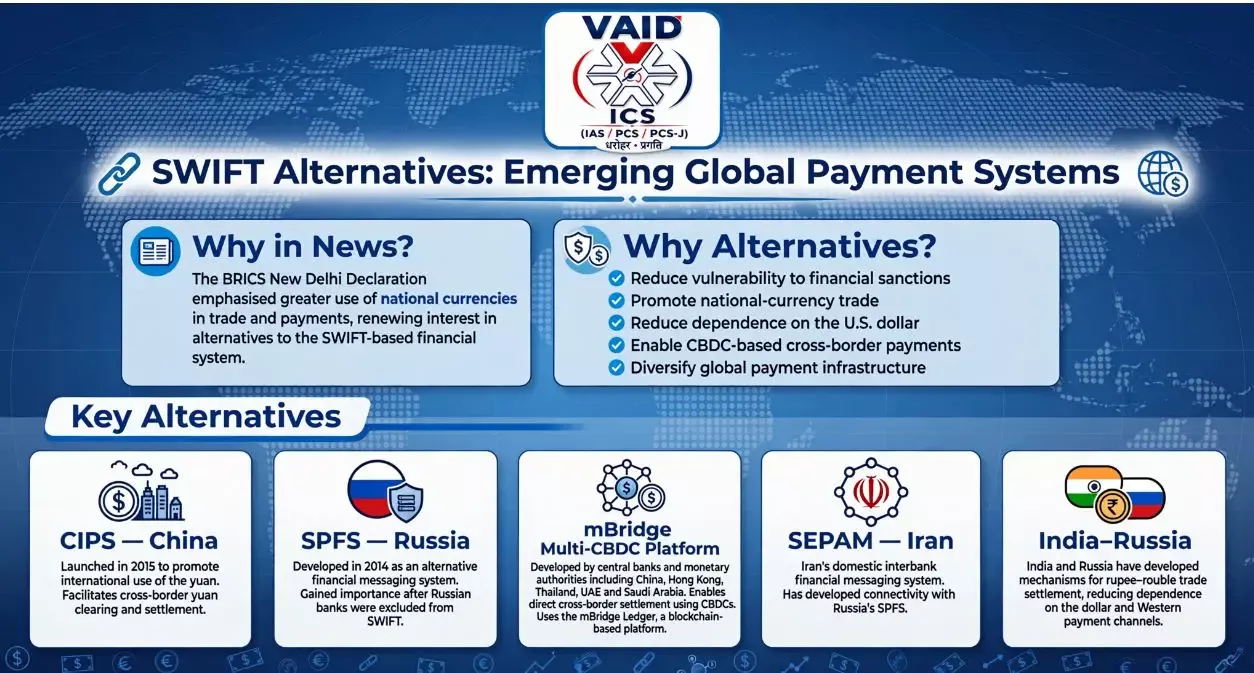
The BRICS New Delhi Declaration emphasised increasing trade in national currencies. This has renewed discussion on alternatives to SWIFT, particularly amid concerns over the use of financial sanctions and the dominance of the U.S. dollar in international payments.
What is SWIFT?
SWIFT — Society for Worldwide Interbank Financial Telecommunication — is a global messaging network that enables financial institutions to securely exchange information about cross-border payments.
Important: SWIFT does not itself transfer money; it facilitates the secure exchange of payment instructions between financial institutions.
Major Alternatives to SWIFT:
CIPS — Cross-Border Interbank Payment System:
-
Developed by China and launched in 2015.
-
Promotes international use of the Chinese yuan (renminbi).
-
Enables banks to process cross-border yuan transactions through China’s domestic clearing infrastructure.
-
Has expanded its international participation, including several countries associated with BRICS.
SPFS — System for Transfer of Financial Messages:
-
Developed by Russia in 2014.
-
Designed to provide an alternative financial messaging channel and reduce dependence on Western financial infrastructure.
-
Became particularly important after Russian banks were disconnected from SWIFT following the Ukraine conflict.
-
Russia has expanded participation by domestic and foreign entities.
Project mBridge:
-
A multi-CBDC cross-border payment platform involving institutions from China, Hong Kong, Thailand, the UAE and Saudi Arabia.
-
Designed to enable direct peer-to-peer settlement using central bank digital currencies (CBDCs).
-
Uses the mBridge Ledger, a blockchain-based distributed ledger developed specifically for cross-border CBDC payments.
-
Seeks to reduce dependence on traditional correspondent banking arrangements.
SEPAM:
-
Iran’s domestic interbank financial messaging system.
-
Provides an alternative channel for Iranian banks and has been linked with Russia’s SPFS for cross-border financial communication.
How Are These Alternatives Performing?
-
CIPS: Has expanded considerably but remains smaller than established global payment networks. Its growth is closely linked to the internationalisation of the yuan.
-
SPFS: Expanded rapidly after Russia faced restrictions on access to SWIFT. It has increasingly included non-resident participants.
-
mBridge: Reached a minimum viable product stage in 2024, demonstrating the potential of CBDCs for direct cross-border settlement.
-
SEPAM: Helps Iran maintain financial connectivity despite Western sanctions.
India–Russia Payments: A Practical Example:
India and Russia have developed mechanisms for settling bilateral trade using rupees and roubles, reducing dependence on the U.S. dollar and Western payment channels.
-
Indian and Russian banks facilitate bilateral trade settlements.
-
This demonstrates how local-currency settlement mechanisms can function alongside the existing international financial system.
Why Are Countries Exploring Alternatives?
-
Financial sanctions: Sanctions can restrict countries’ access to established payment networks.
-
Dollar dependence: Heavy reliance on the U.S. dollar creates concerns about financial vulnerability.
-
Geopolitical risks: Wars and strategic rivalry are encouraging countries to diversify payment infrastructure.
-
CBDC potential: Central bank digital currencies can enable faster and more direct cross-border settlement.
-
De-dollarisation: Some countries seek greater use of national currencies in international trade.
Key Challenges:
-
Limited global acceptance
-
Different technical standards
-
Interoperability issues
-
Liquidity constraints
-
Trust and regulatory concerns
-
Dominance of existing global payment infrastructure
UPSC Takeaway
SWIFT alternatives represent an emerging shift from a predominantly dollar-centric and correspondent-banking-based system towards greater use of national currencies, CBDCs and alternative financial messaging networks.
SWIFT के विकल्प: उभरती वैश्विक भुगतान प्रणालियाँ
चर्चा में क्यों?
BRICS नई दिल्ली घोषणा में सदस्य देशों के बीच राष्ट्रीय मुद्राओं में व्यापार एवं भुगतान को बढ़ावा देने पर जोर दिया गया। इसके साथ ही SWIFT पर निर्भरता कम करने तथा वैकल्पिक सीमा-पार भुगतान प्रणालियों की आवश्यकता पर चर्चा तेज हुई है।
SWIFT क्या है?
SWIFT (Society for Worldwide Interbank Financial Telecommunication) एक वैश्विक वित्तीय संदेश प्रणाली है, जो बैंकों एवं वित्तीय संस्थानों के बीच सीमा-पार भुगतान संबंधी सूचनाओं का सुरक्षित आदान-प्रदान करती है।
महत्त्वपूर्ण: SWIFT स्वयं धन का हस्तांतरण नहीं करता; यह भुगतान निर्देशों के आदान-प्रदान की सुविधा प्रदान करता है।
SWIFT के प्रमुख विकल्प:
CIPS — Cross-Border Interbank Payment System:
-
चीन द्वारा 2015 में शुरू किया गया।
-
अंतरराष्ट्रीय लेन-देन में चीनी युआन के उपयोग को बढ़ावा देता है।
-
सीमा-पार युआन लेन-देन के लिए चीन की घरेलू समाशोधन अवसंरचना का उपयोग करता है।
SPFS — System for Transfer of Financial Messages:
-
रूस द्वारा 2014 में विकसित किया गया।
-
पश्चिमी वित्तीय अवसंरचना पर निर्भरता कम करने के उद्देश्य से विकसित।
-
2022 में रूसी बैंकों को SWIFT से हटाए जाने के बाद इसका महत्त्व बढ़ा।
-
इसमें रूसी संस्थाओं के साथ विदेशी संस्थाएँ भी शामिल हुई हैं।
Project mBridge:
-
एक बहु-CBDC सीमा-पार भुगतान मंच है।
-
इसमें चीन, हांगकांग, थाईलैंड, UAE और सऊदी अरब से संबंधित संस्थाएँ शामिल रही हैं।
-
इसका उद्देश्य केंद्रीय बैंक डिजिटल मुद्राओं (CBDCs) के माध्यम से प्रत्यक्ष सीमा-पार निपटान को सक्षम बनाना है।
-
इसके लिए mBridge Ledger नामक ब्लॉकचेन-आधारित तकनीक विकसित की गई है।
SEPAM:
-
ईरान की घरेलू अंतर-बैंक वित्तीय संदेश प्रणाली है।
-
यह ईरानी बैंकों को वित्तीय संचार के लिए वैकल्पिक माध्यम प्रदान करती है।
-
इसका रूस की SPFS प्रणाली के साथ भी संपर्क विकसित हुआ है।
ये प्रणालियाँ कितनी प्रभावी हैं?
-
CIPS: अंतरराष्ट्रीय स्तर पर तेजी से विस्तारित हुआ है, लेकिन अभी भी स्थापित वैश्विक भुगतान प्रणालियों की तुलना में छोटा है।
-
SPFS: रूस पर लगाए गए वित्तीय प्रतिबंधों के बाद इसका उपयोग और सदस्यता बढ़ी है।
-
mBridge: 2024 में Minimum Viable Product चरण तक पहुँचा, जिससे बहु-CBDC सीमा-पार भुगतान की व्यवहार्यता प्रदर्शित हुई।
-
SEPAM: प्रतिबंधों के बीच ईरान की वित्तीय कनेक्टिविटी बनाए रखने में सहायक है।
भारत–रूस भुगतान व्यवस्था:
भारत और रूस ने रुपये एवं रूबल में व्यापार निपटान के लिए वैकल्पिक भुगतान तंत्र विकसित किए हैं।
-
दोनों देशों के बैंक द्विपक्षीय व्यापार के निपटान में भूमिका निभाते हैं।
-
यह व्यवस्था स्थानीय मुद्राओं में व्यापार निपटान की व्यवहारिक संभावना को दर्शाती है।
-
इससे प्रत्येक लेन-देन में अमेरिकी डॉलर तथा पश्चिमी भुगतान अवसंरचना पर निर्भरता कम की जा सकती है।
देश SWIFT के विकल्प क्यों तलाश रहे हैं?
-
वित्तीय प्रतिबंधों का जोखिम
-
अमेरिकी डॉलर पर अत्यधिक निर्भरता
-
भूराजनीतिक तनाव
-
राष्ट्रीय मुद्राओं में व्यापार को बढ़ावा
-
CBDC आधारित सीमा-पार भुगतान की संभावनाएँ
-
वैश्विक भुगतान अवसंरचना में विविधीकरण
प्रमुख चुनौतियाँ:
-
सीमित वैश्विक स्वीकार्यता
-
विभिन्न प्रणालियों के बीच तकनीकी अंतर
-
अंतर-संचालनीयता (Interoperability) की समस्या
-
पर्याप्त तरलता का अभाव
-
नियामकीय एवं सुरक्षा संबंधी चिंताएँ
-
मौजूदा वैश्विक भुगतान प्रणालियों का मजबूत नेटवर्क प्रभाव
UPSC Takeaway:
SWIFT के विकल्प वैश्विक भुगतान व्यवस्था में संभावित विविधीकरण को दर्शाते हैं, जहाँ राष्ट्रीय मुद्राओं, CBDCs और वैकल्पिक वित्तीय संदेश प्रणालियों का उपयोग बढ़ रहा है।

May 19, 2026
October 17, 2025
October 16, 2025
October 6, 2025

