February 11, 2026
About Clean Arctic Alliance (CAA:) What is Heavy Fuel Oil (HFO)?
The environmental groups and several nations (Denmark, France, Germany, and the Solomon Islands) are lobbying the International Maritime Organization (IMO) to mandate cleaner fuels for ships. They argue that as ice melts and shipping routes open up, the “soot” from vessels is creating a dangerous warming loop that is being ignored due to political tensions.
Key Terms Used :
Black Carbon (Soot):
- What it is: A “short-lived climate pollutant” consisting of dark particles produced by the incomplete combustion of fossil fuels (like ship engines).
- Why it’s in the news: Unlike $CO_2$, which stays in the atmosphere for centuries, black carbon only stays for a few weeks. However, it is 1,600 times more powerful at warming the planet over a 20-year period.
Albedo Effect:
- The Concept: This refers to the ability of a surface to reflect sunlight. White snow and ice have high albedo (reflecting heat), while dark water or land has low albedo (absorbing heat).
- The Problem: When black carbon falls on Arctic ice, it turns the surface dark. This reduces the albedo, causing the ice to absorb more solar radiation and melt much faster.
Polar Fuels:
- The Proposal: These are cleaner, lighter marine distillate fuels that emit significantly less soot than traditional shipping fuels.
- The Goal: Regulators want to make these mandatory for all ships traveling north of the 60th parallel to immediately cut black carbon emissions.
Heavy Fuel Oil (HFO):
- What it is: The “bottom of the barrel” sludge traditionally used by large ships because it is cheap. It is highly toxic and produces massive amounts of black carbon.
- Current Status: While a ban was supposed to start in 2024, many “loopholes” and “waivers” allow ships to keep using it until 2029.
Northern Sea Route:
- The Location: A shipping lane along Russia’s Arctic coast.
- The Context: As sea ice disappears, this route becomes a shortcut between Europe and Asia. However, more traffic here means more pollution in a delicate ecosystem.
About Clean Arctic Alliance (CAA:
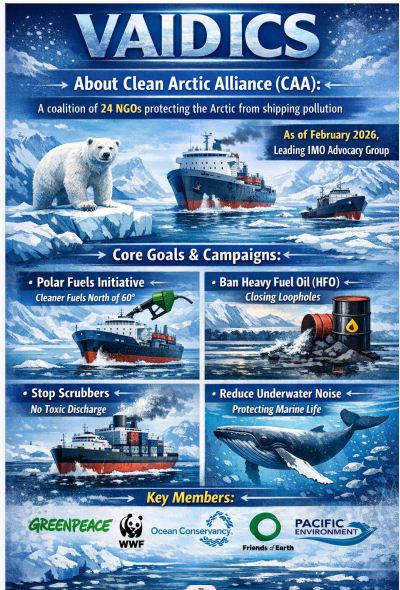
The Clean Arctic Alliance (CAA) is an international coalition of 24 non-profit organizations dedicated to protecting the Arctic ecosystem from the negative impacts of global shipping.
As of February 2026, they are the primary advocacy group pushing the International Maritime Organization (IMO) to pass stricter laws on ship pollution.
Core Goals & Campaigns:
The Alliance focuses on several specific “missions” to safeguard the region:
- The “Polar Fuels” Initiative: Their current flagship campaign (February 2026) urges the IMO to mandate that all ships north of the 60th parallel switch to cleaner, low-emission fuels to reduce soot.
- Banning Heavy Fuel Oil (HFO): They were the primary force behind the initial IMO ban on HFO. They are now working to close “loopholes” that allow some ships to continue using this dirty fuel until 2029.
- Stopping “Scrubbers”: They advocate for a ban on exhaust gas cleaning systems (scrubbers), which “wash” pollution out of ship smoke but then dump the toxic, acidic wastewater directly into the Arctic Ocean.
- Reducing Underwater Noise: They campaign for ships to slow down or use quieter technology, as noise pollution disrupts the communication and migration of whales and other marine life.
Key Members:
The coalition includes some of the world’s most recognizable environmental groups, such as:
- Greenpeace
- WWF (World Wildlife Fund)
- Ocean Conservancy
- Friends of the Earth
- Pacific Environment

October 17, 2025
October 16, 2025
October 6, 2025
September 24, 2025

