October 13, 2026
A Common Language for Justice: Supreme Court
Why in News?
On September 25, 2026, a Public Interest Litigation (PIL) was filed in the Supreme Court of India, seeking a directive for the Union Government to establish a commission to recommend Hindi as the official language of the apex court.
A Supreme Court bench, led by Chief Justice of India Surya Kant, addressed the petition by highlighting existing constitutional provisions, the imperative to preserve linguistic diversity, and ongoing administrative reforms driven by AI translation tools to enhance judicial accessibility.
Key Highlights of the Supreme Court Ruling:
- Constitutional Limitations: The Court clarified that changing the official language regime of the apex court requires a constitutional amendment by Parliament, which falls outside the judicial domain.
- Separation of Powers: Adhering to the doctrine of separation of powers, the judiciary cannot compel Parliament to enact or amend laws regarding official languages.
- Administrative Reforms: The Bench noted that multi-lingual accessibility is already being actively expanded through administrative measures rather than rigid legislative mandates.
- Linguistic Diversity: To promote inclusivity, the Supreme Court emphasized publishing brief summaries of its reports in Hindi, with plans to extend this practice to other scheduled regional languages.
Constitutional and Statutory Provisions
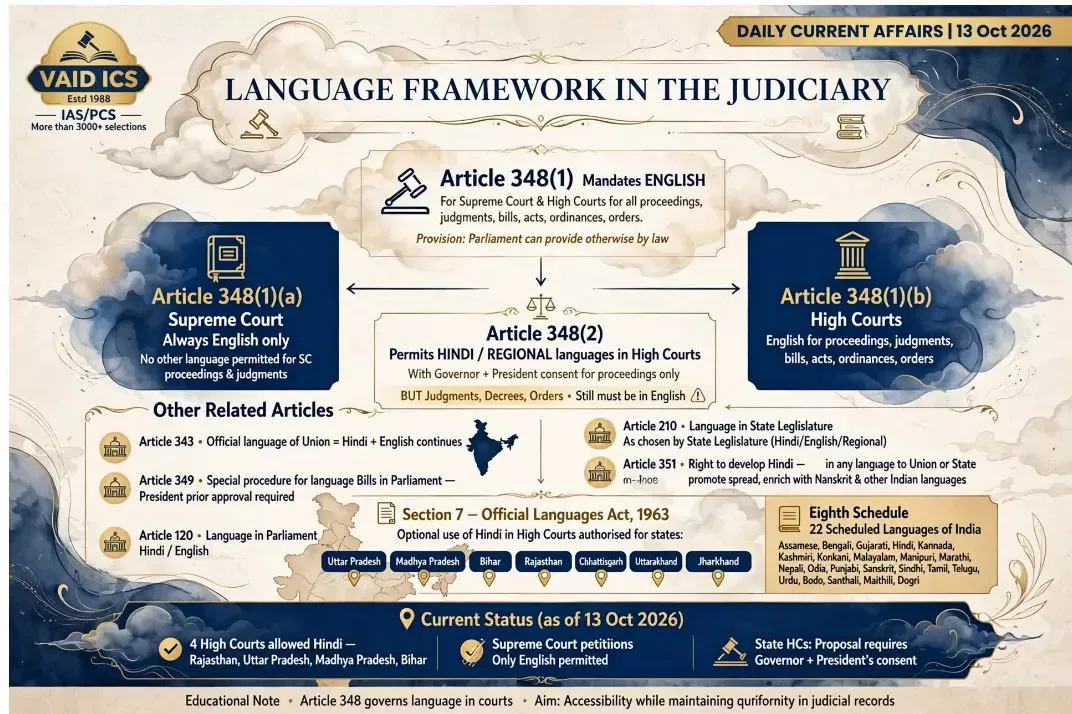
- Article 348(1)(a): Explicitly mandates that all proceedings in the Supreme Court and every High Court shall be conducted in the English language until Parliament legislates otherwise.
- Article 348(2): Allows the Governor of a State, with the prior consent of the President of India, to authorize the use of Hindi or any other official language in High Court proceedings. However, this clause excludes judgments, decrees, and orders.
- Section 7 of the Official Languages Act, 1963: Extends Article 348(2) by permitting state High Courts to issue judgments, decrees, or orders in Hindi or state official languages, provided they are accompanied by an authoritative English translation.
- State Practices: States such as Rajasthan, Uttar Pradesh, Madhya Pradesh, and Bihar have already implemented these provisions to permit Hindi in their respective High Courts.
Judicial Precedents & AI-Driven Accessibility
- Madhu Limaye v. Ved Murti (1970): The Supreme Court affirmed English as the primary language of record and proceedings, emphasizing the practical necessity of a uniform language for pan-India judicial coherence.
- SUVAS Integration: Launched in November 2019, SUVAS (Supreme Court Vidhik Anuvaad Software) is an AI-powered translation tool designed to translate judicial documents and orders into 16 to 19 regional languages, drastically enhancing public access to justice while maintaining English for official proceedings.
Key Concepts Involved
- Public Interest Litigation (PIL): A constitutional tool allowing citizens or civil groups to approach the higher judiciary to safeguard public rights, particularly for marginalized communities.
- Article 348 of the Constitution: The legal framework defining the mandatory use of language in Parliament, State Legislatures, the Supreme Court, and High Courts.
- Official Languages Act, 1963: Statutory framework governing the operational transition and permitted usage of Hindi and English across administrative and judicial functions.
- Separation of Powers: A core constitutional doctrine preventing judicial overreach into policy-making and legislative domains reserved exclusively for Parliament.
न्याय की एक साझा भाषा: उच्चतम न्यायालय ने आधिकारिक भाषा के रूप में हिंदी हेतु दायर जनहित याचिका पर विचार किया
चर्चा में क्यों?
25 सितंबर, 2026 को भारत के उच्चतम न्यायालय में एक जनहित याचिका (PIL) दायर की गई, जिसमें केंद्र सरकार को शीर्ष अदालत की आधिकारिक भाषा के रूप में हिंदी की सिफारिश करने हेतु एक आयोग गठित करने का निर्देश देने की मांग की गई थी।
भारत के मुख्य न्यायाधीश सूर्यकांत की अध्यक्षता वाली पीठ ने संवैधानिक प्रावधानों, भाषाई विविधता के संरक्षण और एआई (AI) अनुवाद उपकरणों के माध्यम से न्यायिक पहुंच बढ़ाने के लिए जारी प्रशासनिक सुधारों का उल्लेख करते हुए याचिका का निस्तारण किया।
उच्चतम न्यायालय के फैसले के मुख्य बिंदु
-
संवैधानिक सीमाएँ: न्यायालय ने स्पष्ट किया कि शीर्ष अदालत की आधिकारिक भाषा व्यवस्था को बदलने के लिए संसद द्वारा संवैधानिक संशोधन की आवश्यकता होगी, जो न्यायिक अधिकार क्षेत्र से बाहर है।
-
शक्तियों का पृथक्करण: शक्तियों के पृथक्करण के सिद्धांत का पालन करते हुए न्यायपालिका आधिकारिक भाषाओं के संबंध में कानून बनाने या संशोधन करने के लिए संसद को बाध्य नहीं कर सकती।
-
प्रशासनिक सुधार: पीठ ने रेखांकित किया कि कठोर विधायी निर्देशों के बजाय प्रशासनिक उपायों के माध्यम से बहुभाषी पहुंच का विस्तार किया जा रहा है।
-
भाषाई विविधता: समावेशिता को बढ़ावा देने के लिए उच्चतम न्यायालय ने अपनी रिपोर्टों का संक्षिप्त विवरण हिंदी में उपलब्ध कराने पर बल दिया, जिसे अन्य अनुसूचित क्षेत्रीय भाषाओं में भी विस्तारित करने की योजना है।
संवैधानिक और वैधानिक प्रावधान
-
अनुच्छेद 348(1)(a): स्पष्ट रूप से अनिवार्य करता है कि जब तक संसद कानून द्वारा अन्यथा प्रावधान न करे, उच्चतम न्यायालय और प्रत्येक उच्च न्यायालय की सभी कार्यवाहियाँ अंग्रेजी भाषा में ही आयोजित की जाएंगी।
-
अनुच्छेद 348(2): किसी राज्य के राज्यपाल को राष्ट्रपति की पूर्व सहमति से उच्च न्यायालय की कार्यवाहियों में हिंदी या किसी अन्य आधिकारिक भाषा के प्रयोग को अधिकृत करने की अनुमति देता है। हालांकि, यह निर्णय, डिक्री या आदेशों पर लागू नहीं होता है।
-
राजभाषा अधिनियम, 1963 की धारा 7: अनुच्छेद 348(2) का विस्तार करते हुए राज्य उच्च न्यायालयों को हिंदी या राज्य की राजभाषा में निर्णय, डिक्री या आदेश पारित करने की अनुमति देती है, बशर्ते उनके साथ प्राधिकृत अंग्रेजी अनुवाद संलग्न हो।
-
राज्यों का अभ्यास: राजस्थान, उत्तर प्रदेश, मध्य प्रदेश और बिहार जैसे राज्यों ने अपने संबंधित उच्च न्यायालयों में हिंदी के प्रयोग की अनुमति देने के लिए इन प्रावधानों को लागू किया है।
न्यायिक मिसालें और एआई-संचालित पहुंच
-
मधु लिमये बनाम वेद मूर्ति (1970): उच्चतम न्यायालय ने पूरे भारत में न्यायिक सुसंगतता के लिए एक साझा भाषा की व्यावहारिक आवश्यकता पर बल देते हुए अंग्रेजी को न्यायालय की प्राथमिक भाषा के रूप में पुष्ट किया था।
-
सुवास (SUVAS) का एकीकरण: नवंबर 2019 में शुरू किया गया सुवास (सुप्रीम कोर्ट विधिक अनुवाद सॉफ्टवेयर) एक एआई-आधारित अनुवाद उपकरण है। यह आधिकारिक अभिलेखों के लिए अंग्रेजी को मुख्य भाषा बनाए रखते हुए न्यायिक दस्तावेजों और आदेशों का 16 से 19 क्षेत्रीय भाषाओं में अनुवाद करता है।
प्रमुख संबंधित अवधारणाएँ
-
जनहित याचिका (PIL): एक कानूनी तंत्र जो नागरिकों या नागरिक समूहों को सार्वजनिक हितों, विशेष रूप से वंचित वर्गों के अधिकारों की सुरक्षा के लिए उच्च न्यायपालिका का रुख करने की अनुमति देता है।
-
संविधान का अनुच्छेद 348: संसद, राज्य विधानमंडलों, उच्चतम न्यायालय और उच्च न्यायालयों में प्रयोग की जाने वाली भाषा को निर्दिष्ट करने वाला संवैधानिक प्रावधान।
-
राजभाषा अधिनियम, 1963: संसद का एक अधिनियम जो प्रशासनिक और न्यायिक कार्यों में हिंदी और अंग्रेजी के उपयोग को विनियमित करता है।
-
शक्तियों का पृथक्करण: एक मौलिक संवैधानिक सिद्धांत जो न्यायपालिका को संसद के अनन्य नीति-निर्माण और विधायी क्षेत्र में अतिक्रमण करने से रोकता है।

May 19, 2026
October 17, 2025
October 16, 2025
October 6, 2025

