November 2, 2026
𝐑𝐔𝐏𝐄𝐄 𝐃𝐄𝐏𝐑𝐄𝐂𝐈𝐀𝐓𝐈𝐎𝐍 𝐀𝐍𝐃 𝐋𝐈𝐁𝐄𝐑𝐀𝐋𝐈𝐒𝐄𝐃 𝐑𝐄𝐌𝐈𝐓𝐓𝐀𝐍𝐂𝐄 𝐒𝐂𝐇𝐄𝐌𝐄 (𝐋𝐑𝐒)
𝐖𝐡𝐲 𝐢𝐧 𝐍𝐞𝐰𝐬?
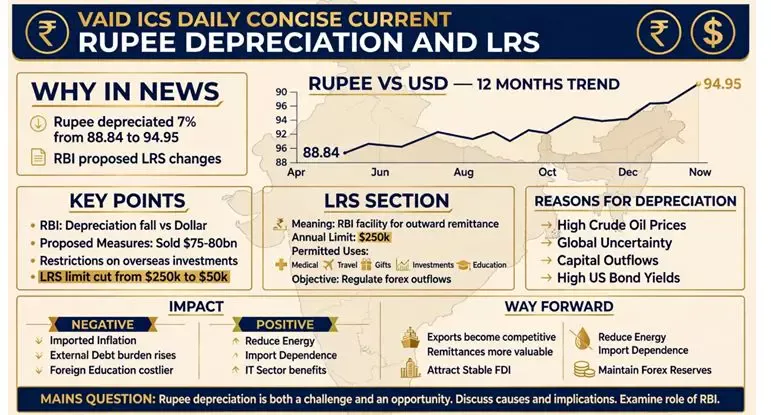
The Indian Rupee depreciated by nearly 7% in 12 months, falling from ₹88.84 to ₹94.95 against the US dollar. The Reserve Bank of India (RBI) proposed restrictions under the Liberalised Remittance Scheme (LRS) to reduce the outflow of foreign exchange.
𝐊𝐞𝐲 𝐏𝐨𝐢𝐧𝐭𝐬:
𝐑𝐮𝐩𝐞𝐞 𝐃𝐞𝐩𝐫𝐞𝐜𝐢𝐚𝐭𝐢𝐨𝐧: The value of the Indian Rupee has fallen against the US dollar.
𝐑𝐁𝐈 𝐈𝐧𝐭𝐞𝐫𝐯𝐞𝐧𝐭𝐢𝐨𝐧: The RBI reportedly sold around $75–80 billion in the foreign exchange market to support the rupee.
𝐏𝐫𝐨𝐩𝐨𝐬𝐞𝐝 𝐋𝐑𝐒 𝐂𝐡𝐚𝐧𝐠𝐞𝐬: Restrictions were proposed on certain overseas investments, along with reducing the annual remittance limit from $250,000 to $50,000.
𝐆𝐨𝐯𝐞𝐫𝐧𝐦𝐞𝐧𝐭 𝐀𝐝𝐯𝐢𝐜𝐞: Citizens were encouraged to reduce fuel consumption, avoid unnecessary gold purchases and postpone non-essential foreign travel to save foreign exchange.
𝐖𝐡𝐚𝐭 𝐢𝐬 𝐋𝐑𝐒 (𝐋𝐢𝐛𝐞𝐫𝐚𝐥𝐢𝐬𝐞𝐝 𝐑𝐞𝐦𝐢𝐭𝐭𝐚𝐧𝐜𝐞 𝐒𝐜𝐡𝐞𝐦𝐞)?
𝐌𝐞𝐚𝐧𝐢𝐧𝐠: LRS is a facility provided by the RBI that allows Indian residents to send money abroad for permitted purposes.
𝐋𝐢𝐦𝐢𝐭: Under the existing general framework, a resident individual can remit up to US$250,000 per financial year.
𝐏𝐮𝐫𝐩𝐨𝐬𝐞𝐬: Money can be sent abroad for:
-
Foreign Education: Paying university fees and living expenses.
-
Medical Treatment: Meeting medical expenses abroad.
-
Travel: Foreign holidays and business travel.
-
Investment: Purchasing permitted foreign shares and other financial assets.
-
Gifts: Sending money to relatives or other persons abroad.
𝐖𝐡𝐨 𝐂𝐚𝐧 𝐔𝐬𝐞 𝐈𝐭? Resident individuals, including minors through their legal guardians, subject to applicable rules.
𝐈𝐦𝐩𝐨𝐫𝐭𝐚𝐧𝐭: LRS is not available to companies, partnership firms, HUFs or trusts.
𝐑𝐞𝐚𝐬𝐨𝐧𝐬 𝐟𝐨𝐫 𝐑𝐮𝐩𝐞𝐞 𝐃𝐞𝐩𝐫𝐞𝐜𝐢𝐚𝐭𝐢𝐨𝐧:
𝐇𝐢𝐠𝐡 𝐂𝐫𝐮𝐝𝐞 𝐎𝐢𝐥 𝐏𝐫𝐢𝐜𝐞𝐬: India imports a large quantity of crude oil. Higher prices increase demand for dollars.
𝐆𝐞𝐨𝐩𝐨𝐥𝐢𝐭𝐢𝐜𝐚𝐥 𝐂𝐨𝐧𝐟𝐥𝐢𝐜𝐭𝐬: Global tensions increase demand for the US dollar as a safe-haven currency.
𝐇𝐢𝐠𝐡 𝐔𝐒 𝐈𝐧𝐭𝐞𝐫𝐞𝐬𝐭 𝐑𝐚𝐭𝐞𝐬: Higher returns on US financial assets attract foreign investors.
𝐂𝐚𝐩𝐢𝐭𝐚𝐥 𝐎𝐮𝐭𝐟𝐥𝐨𝐰𝐬: Foreign investors withdrawing money from Indian markets increase demand for dollars.
𝐈𝐦𝐩𝐚𝐜𝐭 𝐨𝐟 𝐑𝐮𝐩𝐞𝐞 𝐃𝐞𝐩𝐫𝐞𝐜𝐢𝐚𝐭𝐢𝐨𝐧:
𝐍𝐞𝐠𝐚𝐭𝐢𝐯𝐞 𝐈𝐦𝐩𝐚𝐜𝐭𝐬:
-
Costlier Imports: Crude oil, gold and electronic goods become expensive.
-
Imported Inflation: Higher import costs may increase prices in India.
-
Foreign Education: Studying abroad becomes more expensive.
-
External Debt: Repayment of foreign currency loans becomes costlier.
𝐏𝐨𝐬𝐢𝐭𝐢𝐯𝐞 𝐈𝐦𝐩𝐚𝐜𝐭𝐬:
-
Exports: Indian products may become cheaper for foreign buyers.
-
IT Sector: IT companies earning dollars may receive more rupees.
-
Remittances: Families receiving money from abroad get more rupees for the same dollar amount.
𝐊𝐞𝐲 𝐄𝐜𝐨𝐧𝐨𝐦𝐢𝐜 𝐂𝐨𝐧𝐜𝐞𝐩𝐭𝐬:
𝐅𝐨𝐫𝐞𝐢𝐠𝐧 𝐄𝐱𝐜𝐡𝐚𝐧𝐠𝐞 𝐑𝐞𝐬𝐞𝐫𝐯𝐞𝐬: Foreign currency assets, gold, SDRs and reserve position with the IMF held by the RBI to meet external payment needs and manage currency volatility.
𝐅𝐃𝐈 (𝐅𝐨𝐫𝐞𝐢𝐠𝐧 𝐃𝐢𝐫𝐞𝐜𝐭 𝐈𝐧𝐯𝐞𝐬𝐭𝐦𝐞𝐧𝐭): Investment by a foreign company or individual in a business in another country, generally with a lasting interest and significant influence.
𝐅𝐏𝐈 (𝐅𝐨𝐫𝐞𝐢𝐠𝐧 𝐏𝐨𝐫𝐭𝐟𝐨𝐥𝐢𝐨 𝐈𝐧𝐯𝐞𝐬𝐭𝐦𝐞𝐧𝐭): Investment by foreign investors in shares and bonds of another country without seeking management control.
𝐖𝐚𝐲 𝐅𝐨𝐫𝐰𝐚𝐫𝐝:
India should strengthen exports, attract stable foreign investment, reduce dependence on imported energy and maintain adequate foreign exchange reserves to ensure currency stability.
रुपये का अवमूल्यन और उदारीकृत प्रेषण योजना (एलआरएस):
समाचार में क्यों:
भारतीय रुपये का मूल्य 12 महीनों में लगभग 7% गिर गया है। यह ₹88.84 से घटकर ₹94.95 प्रति अमेरिकी डॉलर हो गया। भारतीय रिजर्व बैंक (आरबीआई) ने विदेशी मुद्रा के बहिर्वाह को कम करने के लिए उदारीकृत प्रेषण योजना (एलआरएस) के अंतर्गत कुछ प्रतिबंध प्रस्तावित किए हैं।
प्रमुख बिंदु:
- रुपये का अवमूल्यन: भारतीय रुपये का मूल्य अमेरिकी डॉलर के मुकाबले गिरा है।
- आरबीआई का हस्तक्षेप: आरबीआई ने रुपये को सहारा देने के लिए विदेशी मुद्रा बाजार में लगभग 75–80 बिलियन डॉलर बेचे।
- प्रस्तावित एलआरएस परिवर्तन: कुछ विदेशी निवेशों पर प्रतिबंध लगाने तथा वार्षिक प्रेषण सीमा को 2,50,000 डॉलर से घटाकर 50,000 डॉलर करने का प्रस्ताव किया गया।
- सरकार की सलाह: नागरिकों से ईंधन की खपत कम करने, अनावश्यक सोने की खरीद से बचने और गैर-आवश्यक विदेशी यात्रा को टालने का आग्रह किया गया, ताकि विदेशी मुद्रा की बचत हो सके।
उदारीकृत प्रेषण योजना (एलआरएस) क्या है:
अर्थ: एलआरएस आरबीआई द्वारा प्रदान की गई एक सुविधा है, जिसके तहत भारतीय निवासी अनुमत उद्देश्यों के लिए विदेश में धन भेज सकते हैं।
सीमा: वर्तमान सामान्य ढांचे के अंतर्गत कोई निवासी व्यक्ति प्रति वित्तीय वर्ष अधिकतम 2,50,000 अमेरिकी डॉलर तक प्रेषण कर सकता है।
उद्देश्य: विदेश में धन निम्नलिखित कार्यों के लिए भेजा जा सकता है –
- विदेशी शिक्षा: विश्वविद्यालय शुल्क और रहने-खाने के खर्च।
- चिकित्सा उपचार: विदेश में चिकित्सा व्यय।
- यात्रा: विदेशी पर्यटन और व्यापारिक यात्रा।
- निवेश: अनुमत विदेशी शेयर और अन्य वित्तीय परिसंपत्तियाँ खरीदना।
- उपहार: विदेश में रिश्तेदारों या अन्य व्यक्तियों को धन भेजना।
कौन उपयोग कर सकता है: निवासी व्यक्ति (अवयस्क अपने कानूनी अभिभावक के माध्यम से), लागू नियमों के अधीन।
महत्वपूर्ण: एलआरएस कंपनियों, साझेदारी फर्मों, हिंदू अविभक्त परिवार (एचयूएफ) या ट्रस्टों के लिए उपलब्ध नहीं है।
रुपये के अवमूल्यन के कारण:
- उच्च कच्चे तेल की कीमतें: भारत बड़ी मात्रा में कच्चा तेल आयात करता है। कीमतें बढ़ने से डॉलर की माँग बढ़ जाती है।
- भू-राजनीतिक संघर्ष: वैश्विक तनाव अमेरिकी डॉलर को सुरक्षित मुद्रा के रूप में आकर्षित करते हैं।
- उच्च अमेरिकी ब्याज दरें: अमेरिकी वित्तीय परिसंपत्तियों पर उच्च प्रतिफल विदेशी निवेशकों को आकर्षित करता है।
- पूंजी बहिर्वाह: विदेशी निवेशकों द्वारा भारतीय बाजारों से धन निकालने से डॉलर की माँग बढ़ती है।
रुपये के अवमूल्यन का प्रभाव:
नकारात्मक प्रभाव:
- आयात महँगा होना: कच्चा तेल, सोना और इलेक्ट्रॉनिक वस्तुएँ महँगी हो जाती हैं।
- आयातित मुद्रास्फीति: आयात लागत बढ़ने से भारत में कीमतें बढ़ सकती हैं।
- विदेशी शिक्षा: विदेश में पढ़ाई महँगी हो जाती है।
- बाह्य ऋण: विदेशी मुद्रा में लिए गए ऋणों का भुगतान महँगा हो जाता है।
सकारात्मक प्रभाव:
- निर्यात: भारतीय उत्पाद विदेशी खरीदारों के लिए सस्ते हो सकते हैं।
- आईटी क्षेत्र: डॉलर कमाने वाली आईटी कंपनियों को अधिक रुपये मिल सकते हैं।
- प्रेषण: विदेश से धन प्राप्त करने वाले परिवारों को समान डॉलर राशि पर अधिक रुपये मिलते हैं।
प्रमुख आर्थिक अवधारणाएँ:
- विदेशी मुद्रा भंडार: आरबीआई द्वारा धारित विदेशी मुद्रा परिसंपत्तियाँ, सोना, एसडीआर और आईएमएफ के साथ आरक्षित स्थिति, जो बाहरी भुगतान आवश्यकताओं को पूरा करने और मुद्रा अस्थिरता को प्रबंधित करने के लिए रखी जाती हैं।
- एफडीआई (प्रत्यक्ष विदेशी निवेश): किसी विदेशी कंपनी या व्यक्ति द्वारा दूसरे देश में व्यवसाय में किया गया निवेश, जिसमें दीर्घकालिक हित और महत्वपूर्ण प्रभाव शामिल होता है।
- एफपीआई (विदेशी पोर्टफोलियो निवेश): विदेशी निवेशकों द्वारा दूसरे देश के शेयरों और बॉन्डों में किया गया निवेश, जिसमें प्रबंधन नियंत्रण का उद्देश्य नहीं होता।
आगे का रास्ता:
भारत को निर्यात को मजबूत करना चाहिए, स्थिर विदेशी निवेश आकर्षित करना चाहिए, आयातित ऊर्जा पर निर्भरता कम करनी चाहिए और मुद्रा स्थिरता सुनिश्चित करने के लिए पर्याप्त विदेशी मुद्रा भंडार बनाए रखना चाहिए।

May 19, 2026
October 17, 2025
October 16, 2025
October 6, 2025

