October 28, 2026
𝐂𝐋𝐄𝐀𝐍 𝐀𝐈𝐑 𝐍𝐄𝐄𝐃𝐒 𝐓𝐀𝐑𝐆𝐄𝐓𝐒, 𝐓𝐈𝐌𝐄𝐋𝐈𝐍𝐄𝐒 𝐀𝐍𝐃 𝐀𝐂𝐂𝐎𝐔𝐍𝐓𝐀𝐁𝐈𝐋𝐈𝐓𝐘
𝐖𝐡𝐲 𝐢𝐧 𝐍𝐞𝐰𝐬?
An article highlights the limitations of India’s National Clean Air Programme (NCAP) and calls for measurable targets, fixed timelines and accountability to achieve actual reductions in air pollution and human exposure.
𝐏𝐨𝐥𝐢𝐜𝐲 𝐏𝐚𝐫𝐚𝐝𝐨𝐱 𝐢𝐧 𝐀𝐢𝐫 𝐐𝐮𝐚𝐥𝐢𝐭𝐲:
- Seasonal approach: Air pollution is often treated as a seasonal problem rather than a continuous public health emergency.
- Administrative focus: Swachh Vayu Sarvekshan rankings reward activities such as road sweeping, waste management and action-plan preparation.
- Measurement gap: According to the article, actual particulate-matter reduction accounts for only 10% of the total score.
- Key concern: Administrative achievements may not translate into cleaner air for citizens.
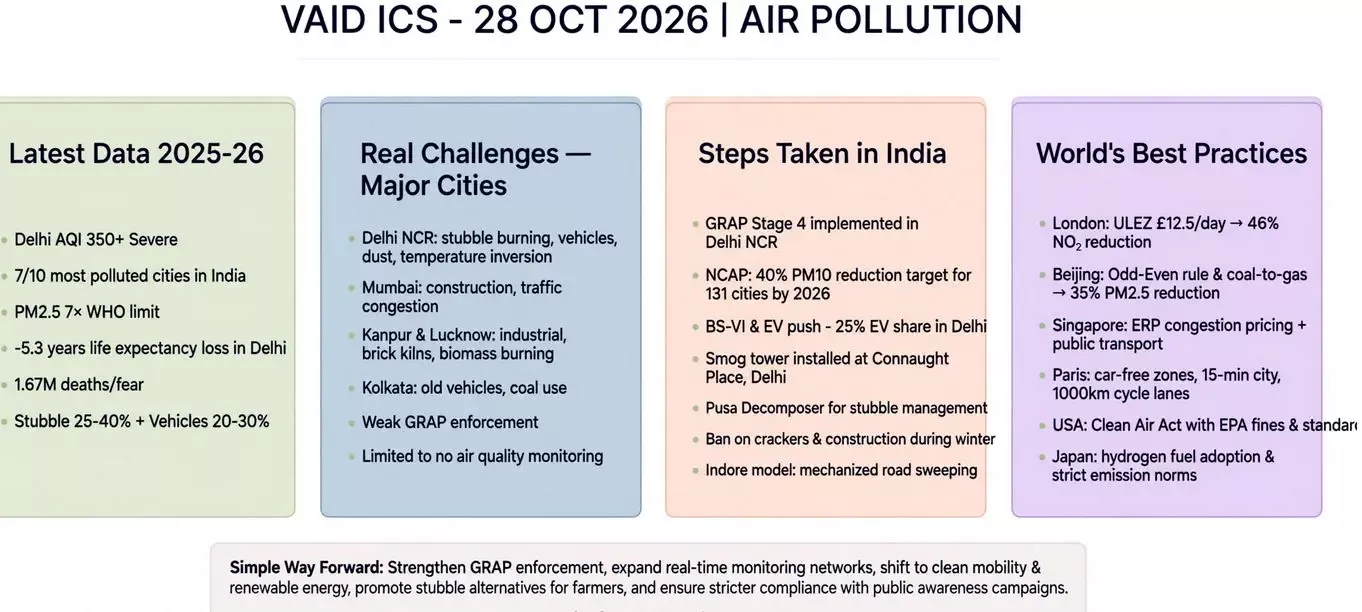
𝐂𝐢𝐭𝐲-𝐋𝐞𝐯𝐞𝐥 𝐄𝐯𝐢𝐝𝐞𝐧𝐜𝐞:
- Lucknow: Annual average PM₁₀ levels reportedly declined from 253 µg/m³ in 2017–18 to around 135 µg/m³. However, this remains above the national standard of 60 µg/m³.
- Delhi-NCR: Despite emergency measures under the Graded Response Action Plan (GRAP), the article reports limited improvement in annual air quality over the preceding four years.
𝐄𝐜𝐨𝐧𝐨𝐦𝐢𝐜 𝐂𝐨𝐬𝐭 𝐨𝐟 𝐀𝐢𝐫 𝐏𝐨𝐥𝐥𝐮𝐭𝐢𝐨𝐧:
- Economic losses: A UNEP–CCAC report, Hidden Assets, highlights the substantial economic burden of air pollution in South Asia.
- High returns: The report estimates that every 1 invested in a package of 25 climate and clean-air measures can generate approximately 21 in economic and health benefits.
- Cost of delay: Delayed action increases healthcare expenditure, reduces productivity and prolongs harmful exposure. Future interventions cannot reverse all health damage already suffered.
𝐈𝐧𝐬𝐭𝐢𝐭𝐮𝐭𝐢𝐨𝐧𝐚𝐥 𝐂𝐡𝐚𝐥𝐥𝐞𝐧𝐠𝐞𝐬:
- Pollution originates from transport, industries, power generation, agriculture, waste management and household cooking.
- Multiple ministries and agencies share responsibility, often resulting in poor coordination and diluted accountability.
- Environment departments cannot control pollution effectively without cooperation across sectors.
𝐖𝐚𝐲 𝐅𝐨𝐫𝐰𝐚𝐫𝐝 — 𝐍𝐂𝐀𝐏 𝟐.𝟎:
- Outcome-based assessment: Prioritise reductions in pollution exposure and improvements in public health over procedural compliance.
- Clear targets: Establish measurable pollution-reduction targets with fixed deadlines.
- Financial incentives: Link grants and fiscal transfers to sustained improvements in air quality.
- Accountability: Assign clear responsibilities to agencies and review progress regularly.
- Coordinated action: Integrate transport, energy, industry, agriculture and urban waste policies.
- Effective implementation: Apply lessons from programmes such as Ujjwala Yojana and solar-energy expansion, particularly their emphasis on clear targets and large-scale implementation.
𝐂𝐨𝐧𝐜𝐥𝐮𝐬𝐢𝐨𝐧:
India must shift from administrative compliance to measurable improvements in air quality and human health. Effective clean-air governance requires clear targets, time-bound implementation, inter-agency coordination and enforceable accountability.
स्वच्छ वायु के लिए लक्ष्य, समयसीमा एवं जवाबदेही आवश्यक:
समाचार में क्यों:
एक लेख में भारत के राष्ट्रीय स्वच्छ वायु कार्यक्रम (NCAP) की सीमाओं पर प्रकाश डाला गया है तथा वायु प्रदूषण एवं मानव संपर्क में वास्तविक कमी हासिल करने के लिए मापनीय लक्ष्य, निश्चित समयसीमा एवं जवाबदेही की मांग की गई है।
वायु गुणवत्ता में नीतिगत विरोधाभास:
- मौसमी दृष्टिकोण: वायु प्रदूषण को निरंतर सार्वजनिक स्वास्थ्य आपात स्थिति के बजाय प्रायः मौसमी समस्या के रूप में देखा जाता है।
- प्रशासनिक फोकस: स्वच्छ वायु सर्वेक्षण रैंकिंग सड़क सफाई, अपशिष्ट प्रबंधन एवं कार्य-योजना तैयार करने जैसी गतिविधियों को पुरस्कृत करती है।
- मापन अंतर: लेख के अनुसार, वास्तविक पार्टिकुलेट-मैटर कमी कुल अंक का केवल 10% है।
- प्रमुख चिंता: प्रशासनिक उपलब्धियाँ नागरिकों के लिए स्वच्छ हवा में परिवर्तित नहीं हो सकतीं।
शहर-स्तरीय साक्ष्य:
- लखनऊ: वार्षिक औसत PM₁₀ स्तर 2017–18 में 253 µg/m³ से घटकर लगभग 135 µg/m³ रह गया बताया जाता है। तथापि, यह राष्ट्रीय मानक 60 µg/m³ से ऊपर बना हुआ है।
- दिल्ली-एनसीआर: ग्रेडेड रिस्पॉन्स एक्शन प्लान (GRAP) के अंतर्गत आपात उपायों के बावजूद, लेख में पिछले चार वर्षों में वार्षिक वायु गुणवत्ता में सीमित सुधार की रिपोर्ट की गई है।
वायु प्रदूषण की आर्थिक लागत:
- आर्थिक नुकसान: UNEP–CCAC रिपोर्ट Hidden Assets दक्षिण एशिया में वायु प्रदूषण के पर्याप्त आर्थिक बोझ पर प्रकाश डालती है।
- उच्च प्रतिफल: रिपोर्ट का अनुमान है कि 25 जलवायु एवं स्वच्छ-वायु उपायों के पैकेज में निवेश किए गए प्रत्येक ₹1 से लगभग ₹21 का आर्थिक एवं स्वास्थ्य लाभ उत्पन्न हो सकता है।
- देरी की लागत: विलंबित कार्रवाई स्वास्थ्य व्यय बढ़ाती है, उत्पादकता घटाती है तथा हानिकारक संपर्क को लंबा करती है। भविष्य के हस्तक्षेप पहले से हुए स्वास्थ्य नुकसान को पूरी तरह उलट नहीं सकते।
संस्थागत चुनौतियाँ:
- प्रदूषण परिवहन, उद्योग, बिजली उत्पादन, कृषि, अपशिष्ट प्रबंधन एवं घरेलू खाना पकाने से उत्पन्न होता है।
- कई मंत्रालयों एवं एजेंसियों की साझा जिम्मेदारी प्रायः खराब समन्वय एवं कमजोर जवाबदेही का परिणाम होती है।
- पर्यावरण विभाग क्षेत्रों के सहयोग के बिना प्रदूषण को प्रभावी रूप से नियंत्रित नहीं कर सकते।
आगे का मार्ग — NCAP 2.0:
- परिणाम-आधारित मूल्यांकन: प्रक्रियात्मक अनुपालन के बजाय प्रदूषण संपर्क में कमी एवं सार्वजनिक स्वास्थ्य में सुधार को प्राथमिकता देना।
- स्पष्ट लक्ष्य: निश्चित समयसीमा के साथ मापनीय प्रदूषण-कमी लक्ष्य स्थापित करना।
- वित्तीय प्रोत्साहन: अनुदान एवं राजकोषीय हस्तांतरण को वायु गुणवत्ता में सतत सुधार से जोड़ना।
- जवाबदेही: एजेंसियों को स्पष्ट जिम्मेदारियाँ सौंपना तथा प्रगति की नियमित समीक्षा करना।
- समन्वित कार्रवाई: परिवहन, ऊर्जा, उद्योग, कृषि एवं शहरी अपशिष्ट नीतियों को एकीकृत करना।
- प्रभावी कार्यान्वयन: उज्ज्वला योजना एवं सौर-ऊर्जा विस्तार जैसे कार्यक्रमों से सबक लेना, विशेषकर स्पष्ट लक्ष्य एवं बड़े पैमाने पर कार्यान्वयन पर उनके जोर से।
निष्कर्ष:
भारत को प्रशासनिक अनुपालन से वायु गुणवत्ता एवं मानव स्वास्थ्य में मापनीय सुधार की ओर स्थानांतरित होना चाहिए। प्रभावी स्वच्छ-वायु शासन के लिए स्पष्ट लक्ष्य, समयबद्ध कार्यान्वयन, अंतर-एजेंसी समन्वय एवं प्रवर्तनीय जवाबदेही आवश्यक है।

May 19, 2026
October 17, 2025
October 16, 2025
October 6, 2025

