May 23, 2026
सैंपल रजिस्ट्रेशन System (SRS) रिपोर्ट 2024:Sample Registration System (SRS) Report
Sample Registration System (SRS) Report: Key Demographic Trends
1. Total Fertility Rate (TFR):
The Total Fertility Rate represents the average number of children born to a woman during her reproductive years.
-
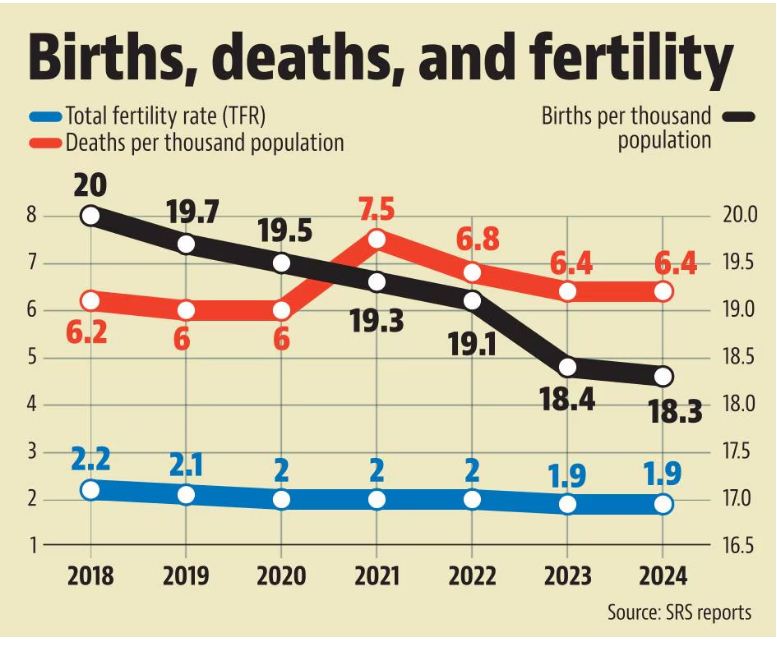
Below Replacement Level: India’s TFR has remained stable at 1.9 for the fifth consecutive year, well below the replacement level of 2.1.
-
Note: A TFR of 2.1 is the population replacement level at which a population exactly replaces itself from one generation to the next without migration. India is now firmly on a trajectory toward population stabilization.
-
-
Rural vs. Urban Divide:
-
Rural India: The TFR is steady at 2.1 (exactly at the replacement level).
-
Urban India: The TFR has dropped to a low of 1.5. Urban fertility has consistently lagged below the replacement threshold since 2005.
-
2. Birth Rate & Sex Ratio:
-
Crude Birth Rate (CBR): The number of live births per 1,000 population witnessed a marginal decline from 18.4 in the previous assessment cycle to 18.3.
-
Rural: Declined from 20.3 to 20.2.
-
Urban: Declined from 14.9 to 14.7.
-
-
Sex Ratio at Birth: The number of female births per 1,000 male births (based on a three-year moving average) showed a slight improvement, ticking up from 917 (2021-23) to 918.
3. Mortality Rates & Critical Shifts:
-
Crude Death Rate (CDR): The number of deaths per 1,000 population remains stagnant at 6.4 (6.8 in rural sectors and dropping slightly from 5.6 to 5.5 in urban centers).
-
The Post-COVID Anomaly (Area of Concern): The overall death rate (6.4) remains notably higher than pre-pandemic baselines observed in 2019 and 2020, where it stood at 6.0. While significantly down from the pandemic peak of 7.5 in 2021, the failure to return to pre-COVID levels points to lingering public health vulnerabilities.
-
Infant Mortality Rate (IMR): The number of infant deaths under one year of age per 1,000 live births continues its slow, steady decline, dropping from 25 to 24.
4. Major Causes of Death (Epidemiological Transition):
The report highlights a significant shift in the disease burden and causes of mortality across India:
A. Respiratory Infections
-
Deaths attributed to respiratory infections stood at 5.7% (three-year average). While this marks a steep decline from the peak pandemic years (where it touched 10% in 2020-22), it remains significantly elevated compared to the pre-pandemic rate of 3.6% (2017-19).
B. Non-Communicable Diseases (NCDs) & Cardiovascular Issues
-
Cardiovascular Diseases (CVDs): Heart disease remains the leading cause of death in India, with its share growing from 31% to 32.1%. Health experts attribute this to long-term post-COVID morbidity, which has aggravated cardiac issues across demographic segments.
-
NCD Dominance: As acute pandemic infections faded, the cumulative share of deaths caused by Non-Communicable Diseases—including cancers, diabetes, and cardiovascular failures—rose from 56.7% to 60.1%.
C. External Causes: Accidents and Mental Health
-
Motor Vehicle Accidents: The share of deaths resulting from road accidents increased from 2.9% to 3.2%.
-
Suicides: Deaths by suicide grew as a proportion of total mortalities, rising from 2.5% to 2.8%.
-
Corroborative Data: This upward trend matches recent findings from the National Crime Records Bureau’s (NCRB) Accidental Deaths & Suicides in India (ADSI) report, highlighting growing socio-economic stress and road safety challenges.
-
Key Policy Takeaways for Mains Analysis:
-
Irreversible Demographic Transition: Maintaining a TFR below 2.1 for half a decade confirms that India has peaked in terms of explosive population growth. Policy focus must transition from “population control” to managing an aging workforce and optimizing the tail-end of the demographic dividend.
-
The “Long COVID” Footprint: The persistent elevation of death rates above pre-pandemic baselines, coupled with rising cardiac and respiratory mortalities, indicates that the long-term health aftermath of COVID-19 is still actively impacting public health.
-
Restructuring Health Infrastructure: With NCDs now accounting for over 60% of all mortalities, India’s public healthcare system requires a structural shift. Resources must pivot from traditional infectious disease management to preventive healthcare, primary diagnostic screening, and lifestyle disease management.
सैंपल रजिस्ट्रेशन System (SRS) रिपोर्ट 2024:
1. कुल प्रजनन दर (Total Fertility Rate – TFR):
कुल प्रजनन दर का तात्पर्य एक महिला द्वारा अपने संपूर्ण प्रजनन काल में पैदा किए जाने वाले बच्चों की औसत संख्या से है।
-
प्रतिस्थापन स्तर से नीचे (Below Replacement Level): भारत की टीएफआर लगातार पांचवें वर्ष प्रतिस्थापन स्तर (Replacement Level – 2.1) से नीचे 1.9 पर स्थिर बनी हुई है।
-
नोट: यदि टीएफआर 2.1 (स्थिर जनसंख्या स्तर) पर बनी रहे, तो जनसंख्या न तो बढ़ती है और न ही घटती है। भारत अब इससे नीचे आ चुका है।
-
-
शहरी बनाम ग्रामीण विभाजन:
-
ग्रामीण भारत: टीएफआर 2.1 पर स्थिर है (सटीक प्रतिस्थापन स्तर पर)।
-
शहरी भारत: टीएफआर 1.5 के बेहद निचले स्तर पर है। शहरी क्षेत्रों में यह दर वर्ष 2005 के बाद से ही लगातार प्रतिस्थापन स्तर से नीचे बनी हुई है।
-
2. जन्म दर और लिंग अनुपात (Birth Rate & Sex Ratio):
-
सकल जन्म दर (Crude Birth Rate – CBR): प्रति हजार जनसंख्या पर जन्म लेने वाले बच्चों की संख्या वर्ष 2023 के 18.4 से मामूली रूप से घटकर 2024 में 18.3 रह गई है।
-
ग्रामीण: 20.3 से घटकर 20.2 हुई।
-
शहरी: 14.9 से घटकर 14.7 हुई।
-
-
जन्म के समय लिंग अनुपात (Sex Ratio at Birth): प्रति हजार बालकों पर जन्म लेने वाली बालिकाओं की संख्या (तीन वर्षीय औसत) में मामूली सुधार देखा गया है। यह 2021-23 के 917 से बढ़कर 2022-24 में 918 हो गया है।
3. मृत्यु दर और चिंताजनक रुझान (Mortality Rates & Trends):
-
सकल मृत्यु दर (Crude Death Rate – CDR): प्रति हजार जनसंख्या पर मौतों की संख्या 6.4 पर स्थिर है (ग्रामीण क्षेत्रों में 6.8 तथा शहरी क्षेत्रों में 5.6 से घटकर 5.5)।
-
कोविड-19 से पूर्व की स्थिति से तुलना (चिंता का विषय): वर्तमान मृत्यु दर (6.4) अभी भी कोविड महामारी से ठीक पहले के वर्षों (2019 और 2020) के स्तर (6.0) से ऊपर बनी हुई है। हालांकि यह महामारी के सबसे घातक वर्ष 2021 (7.5) से बहुत कम है, लेकिन प्री-कोविड स्तर पर वापस न आना सार्वजनिक स्वास्थ्य के लिए चिंताजनक है।
-
शिशु मृत्यु दर (Infant Mortality Rate – IMR): प्रति हजार जीवित जन्मों पर एक वर्ष से कम उम्र के बच्चों की मृत्यु दर में धीमी गति से सुधार जारी है। यह 2023 के 25 से घटकर 2024 में 24 पर आ गई है।
4. मृत्यु के प्रमुख कारण (Causes of Death):
रिपोर्ट में मौतों के कारणों के बदलते स्वरूप (Epidemiological Transition) को भी रेखांकित किया गया है:
अ. श्वसन संबंधी संक्रमण (Respiratory Infections)
-
श्वसन संक्रमण से होने वाली मौतों का अनुपात (तीन वर्षीय औसत) 2022-24 में 5.7% रहा। हालांकि यह महामारी के चरम दौर (2020-22 के 10%) से कम है, लेकिन कोविड-पूर्व स्तर (2017-19 के 3.6%) से अभी भी काफी अधिक है।
ब. गैर-संचारी रोग और हृदय रोग (NCDs & Cardiovascular Diseases)
-
हृदय रोग (Cardiovascular Diseases): यह भारत में होने वाली मौतों का सबसे बड़ा कारण है। कुल मौतों में इसकी हिस्सेदारी 31% से बढ़कर 32.1% हो गई है। विशेषज्ञों के अनुसार, कोविड-19 के कारण हृदय रोगों से जुड़ी बीमारियाँ (Morbidity) दीर्घकालिक रूप से बढ़ी हैं।
-
गैर-संचारी रोग (NCDs): श्वसन संक्रमण में कमी आने के साथ ही कैंसर, मधुमेह और हृदय रोग जैसे गैर-संचारी रोगों से होने वाली मौतों का कुल प्रतिशत 56.7% से बढ़कर 60.1% हो गया है।
स. दुर्घटनाएं और आत्महत्या (Accidents and Suicides)
-
सड़क दुर्घटनाएं (Motor Vehicle Accidents): कुल मौतों में इनकी हिस्सेदारी 2.9% से बढ़कर 3.2% हो गई है।
-
आत्महत्या (Suicide): आत्महत्या से होने वाली मौतों का हिस्सा 2.5% से बढ़कर 2.8% हो गया है।
-
सहायक डेटा: नेशनल क्राइम रिकॉर्ड्स ब्यूरो (NCRB) की ‘एक्सीडेंटल डेथ्स एंड सुसाइड्स इन इंडिया’ (ADSI) 2024 रिपोर्ट भी देश में सड़क दुर्घटनाओं और आत्महत्याओं के बढ़ते मामलों की पुष्टि करती है।
-
मुख्य नीतिगत निष्कर्ष (Key Takeaways for Mains)
-
जनसंख्या स्थिरीकरण की ओर अग्रसर: लगातार 5 वर्षों तक TFR का 2.1 से नीचे रहना यह दर्शाता है कि भारत की जनसंख्या अब स्थिरीकरण (Stabilization) और भविष्य में क्रमिक गिरावट की ओर बढ़ रही है।
-
दीर्घकालिक ‘कोविड प्रभाव’: कोविड-19 महामारी के समाप्त होने के बाद भी हृदय रोगों और श्वसन संबंधी समस्याओं के कारण मृत्यु दर का प्री-कोविड स्तर से अधिक होना यह संकेत देता है कि महामारी के दीर्घकालिक स्वास्थ्य प्रभाव (Long COVID) अभी भी मौजूद हैं।
-
गैर-संचारी रोगों (NCDs) की चुनौती: भारत में 60% से अधिक मौतें अब गैर-संचारी रोगों के कारण हो रही हैं, जिसके लिए स्वास्थ्य बुनियादी ढांचे को प्राथमिक संक्रामक रोगों के नियंत्रण से हटाकर जीवनशैली जनित बीमारियों की रोकथाम की ओर मोड़ने की आवश्यकता है।

May 19, 2026
October 17, 2025
October 16, 2025
October 6, 2025

