November 23, 2026
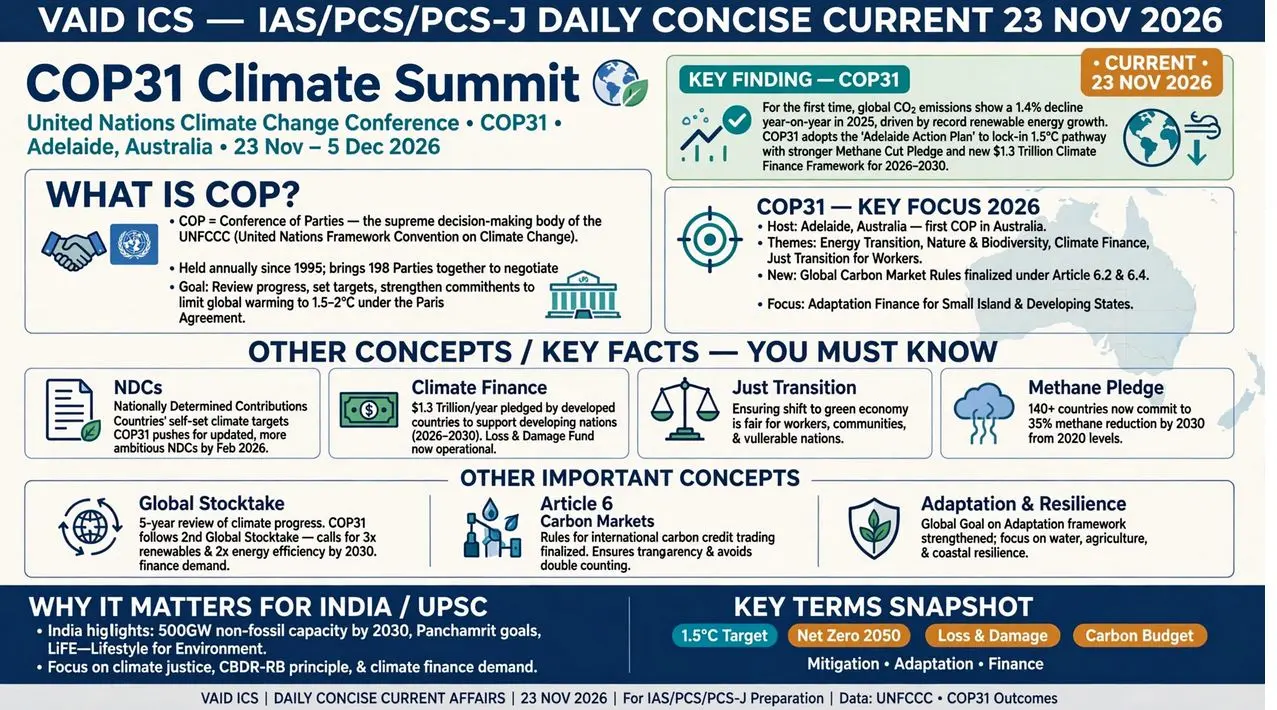
COP31 Climate Summit:/सीओपी-31 जलवायु सम्मेलन: 2026
Why in News? The COP31 Climate Summit, held in Antalya, Türkiye, ended without a unanimous final declaration.
-
Negotiations continued for 48 hours beyond the scheduled time, but countries failed to reach an agreement on the future of fossil fuels.
-
The European Union, supported by around 130 countries, rejected the draft declaration because it did not include clear commitments to gradually reduce the use of fossil fuels.
-
On the other hand, India, China and Saudi Arabia, along with other members of the Like-Minded Developing Countries (LMDC) group, supported the draft, emphasising energy security and national circumstances.
What is COP?
-
COP stands for Conference of the Parties.
-
It is the supreme decision-making body of the United Nations Framework Convention on Climate Change (UNFCCC).
-
Member countries meet to discuss policies, targets, climate finance and technological cooperation to address climate change.
-
It is generally held every year.
-
Its main objectives are to limit global temperature rise, reduce greenhouse gas emissions and help countries deal with the impacts of climate change.
Major Disagreements at the Summit:
Fossil Fuel Issue:
-
Fossil fuels include coal, petroleum and natural gas.
-
Burning fossil fuels releases greenhouse gases, particularly carbon dioxide, which contribute to global warming.
-
The European Union and its supporters demanded clear commitments to gradually reduce fossil fuel consumption.
-
India and other developing countries emphasised energy security, economic development and national circumstances.
Developed vs Developing Countries:
-
Developed countries emphasised the need for rapid reductions in greenhouse gas emissions.
-
Developing countries argued that developed nations have historically contributed more to global emissions and consumed a larger share of the global carbon budget.
-
Therefore, the burden of climate action should not be equal for all countries.
-
Developing countries also demanded adequate financial and technological support to achieve climate targets.
India’s Position:
India maintained that setting ambitious emission-reduction targets alone is not sufficient. Countries must also receive the necessary Means of Implementation.
India emphasised the following:
-
Climate Finance: Adequate financial support for developing countries to promote clean energy and climate adaptation.
-
Technology Transfer: Affordable access to clean energy and low-emission technologies.
-
Capacity Building: Strengthening the technical, institutional and administrative capabilities of developing countries.
-
Energy Security: Every country should have the freedom to frame its energy policies according to its own needs and development priorities.
Major Groups and Institutions:
Like-Minded Developing Countries (LMDC):
-
It is a negotiating group of developing countries under the UN climate negotiations.
-
It includes countries such as India, China and Saudi Arabia.
-
It advocates climate justice, equity, historical responsibility and financial support.
-
The group argues that developed countries should take greater responsibility because of their historical emissions.
United Nations Framework Convention on Climate Change (UNFCCC):
-
It was established during the 1992 Rio Earth Summit.
-
It provides the international framework for cooperation on climate change.
-
Its main objective is to stabilise greenhouse gas concentrations in the atmosphere at a level that prevents dangerous human interference with the climate system.
-
The Kyoto Protocol (1997) and the Paris Agreement (2015) are major agreements under this framework.
Key Principles and Concepts:
Common but Differentiated Responsibilities and Respective Capabilities (CBDR-RC):
-
It recognises that all countries have a shared responsibility to address climate change, but their responsibilities are not equal.
-
Developed countries have historically emitted more greenhouse gases and possess greater financial and technological capabilities.
-
Therefore, they should take greater responsibility for climate action.
-
It is an important principle of the UNFCCC and the Paris Agreement.
Carbon Budget:
-
Carbon budget refers to the total amount of carbon dioxide that can be emitted while keeping global temperature rise within a specified limit.
-
Once this limit is exceeded, controlling global warming becomes more difficult.
-
Developing countries argue that developed nations have historically used a disproportionately large share of the global carbon budget.
Carbon Capture, Utilisation and Storage (CCUS):
-
It is a technology used to capture carbon dioxide released from industrial units and power plants.
-
The captured carbon dioxide can either be used for industrial purposes or stored underground.
-
Small island and climate-vulnerable countries are concerned that excessive dependence on CCUS may allow continued fossil fuel production.
-
They argue that this technology should not become a substitute for reducing fossil fuel consumption.
Paris Agreement (2015):
-
It was adopted at COP21.
-
Its objective is to keep the rise in global average temperature well below 2°C above pre-industrial levels and pursue efforts to limit it to 1.5°C.
-
Under this agreement, every country submits its Nationally Determined Contributions (NDCs).
-
It focuses on climate mitigation, adaptation, climate finance and technological cooperation.
Importance of the 1.5°C Temperature Limit:
-
A rise of more than 1.5°C in global average temperature increases the risks of sea-level rise, extreme heat, droughts, floods and extreme weather events.
-
Small island states and developing countries are particularly vulnerable to these impacts.
-
UN assessments indicate that current global efforts are insufficient to limit global warming to 1.5°C.
Consensus Rule:
-
Consensus plays an important role in the decision-making process under the UNFCCC.
-
It requires broad agreement among member countries before decisions are adopted.
-
A formal objection by a country can prevent or delay the adoption of a decision.
-
This makes it difficult to reach agreements when countries have conflicting interests.
Major Reasons for the Deadlock at COP31:
-
Historical Responsibility: Differences between developed and developing countries over responsibility for past emissions.
-
Climate Finance: Insufficient financial support for developing countries.
-
Energy Security: Growing energy requirements and economic development needs of developing countries.
-
Fossil Fuels: Disagreement over the timeline for gradually reducing fossil fuel use.
-
Technological Options: Differences over the role and limitations of technologies such as CCUS.
-
National Sovereignty: Developing countries’ demand for the freedom to determine their energy policies according to national circumstances.
Significance for India:
-
India’s growing energy demand makes energy security an important national priority.
-
India supports the transition towards clean energy but emphasises the need for adequate financial and technological assistance.
-
India’s position is based on the principles of climate justice and equity.
-
India must maintain a balance between economic development and environmental protection.
Way Forward:
-
Climate Finance: Developed countries should provide adequate and accessible financial support to developing countries.
-
Technology Cooperation: Affordable transfer of clean energy technologies should be ensured.
-
Climate Justice: Historical emissions and the different capabilities of countries must be taken into account.
-
Energy Transition: A fair and gradual strategy should be adopted to reduce dependence on fossil fuels.
-
Global Cooperation: Countries should respect national circumstances while working towards common climate goals.
Conclusion:
The deadlock at COP31 highlights the continuing tensions between climate justice, energy security and emission reduction in global climate negotiations. Effective climate action requires not only ambitious targets but also adequate financial support, technology transfer and respect for the development needs of developing countries.
सीओपी-31 जलवायु सम्मेलन: जीवाश्म ईंधन पर वैश्विक मतभेद और वार्ता में गतिरोध
चर्चा में क्यों:
-
तुर्किये के अंताल्या में आयोजित सीओपी-31 (COP31) जलवायु सम्मेलन बिना किसी सर्वसम्मत अंतिम घोषणा के समाप्त हुआ।
-
सम्मेलन की वार्ता निर्धारित समय से 48 घंटे अधिक चली, लेकिन सदस्य देशों के बीच जीवाश्म ईंधन के भविष्य को लेकर सहमति नहीं बन सकी।
-
यूरोपीय संघ के नेतृत्व में लगभग 130 देशों ने उस मसौदा घोषणा का विरोध किया, जिसमें जीवाश्म ईंधन के उपयोग में चरणबद्ध कमी लाने की स्पष्ट प्रतिबद्धता शामिल नहीं थी।
-
दूसरी ओर, भारत, चीन और सऊदी अरब सहित समान विचारधारा वाले विकासशील देशों के समूह (LMDC) ने ऊर्जा सुरक्षा और राष्ट्रीय परिस्थितियों को ध्यान में रखते हुए मसौदे का समर्थन किया।
सीओपी (COP) क्या है?
-
COP का पूरा नाम Conference of the Parties है, अर्थात पक्षकारों का सम्मेलन।
-
यह संयुक्त राष्ट्र जलवायु परिवर्तन रूपरेखा अभिसमय (UNFCCC) का सर्वोच्च निर्णय लेने वाला निकाय है।
-
इसमें सदस्य देश जलवायु परिवर्तन से निपटने के लिए नीतियों, लक्ष्यों, वित्तीय सहायता और तकनीकी सहयोग पर चर्चा करते हैं।
-
इसका आयोजन सामान्यतः प्रतिवर्ष किया जाता है।
-
प्रमुख उद्देश्य वैश्विक तापमान वृद्धि को सीमित करना, ग्रीनहाउस गैस उत्सर्जन कम करना तथा जलवायु परिवर्तन के प्रभावों से निपटने में देशों की सहायता करना है।
सम्मेलन में प्रमुख मतभेद:
जीवाश्म ईंधन का मुद्दा:
-
जीवाश्म ईंधन में कोयला, पेट्रोलियम और प्राकृतिक गैस शामिल हैं।
-
इनके जलने से कार्बन डाइऑक्साइड सहित ग्रीनहाउस गैसों का उत्सर्जन होता है, जो वैश्विक तापमान वृद्धि का प्रमुख कारण है।
-
यूरोपीय संघ और उसके समर्थक देशों ने जीवाश्म ईंधन के उपयोग में चरणबद्ध कमी के लिए स्पष्ट प्रतिबद्धता की मांग की।
-
भारत और अन्य विकासशील देशों ने ऊर्जा सुरक्षा, आर्थिक विकास तथा राष्ट्रीय परिस्थितियों को ध्यान में रखने पर जोर दिया।
विकसित और विकासशील देशों के बीच मतभेद:
-
विकसित देशों ने उत्सर्जन में तेजी से कमी लाने की आवश्यकता पर जोर दिया।
-
विकासशील देशों का तर्क है कि विकसित देशों ने औद्योगिकीकरण के दौरान वैश्विक कार्बन बजट का अधिक हिस्सा उपयोग किया है।
-
इसलिए जलवायु कार्रवाई का समान बोझ सभी देशों पर नहीं डाला जाना चाहिए।
-
विकासशील देशों के अनुसार, उत्सर्जन में कमी के लक्ष्य तभी प्रभावी होंगे जब उन्हें पर्याप्त वित्तीय और तकनीकी सहायता मिलेगी।
भारत का पक्ष:
भारत ने स्पष्ट किया कि जलवायु परिवर्तन से निपटने के लिए केवल उत्सर्जन कम करने के लक्ष्य निर्धारित करना पर्याप्त नहीं है। इसके साथ कार्यान्वयन के साधन (Means of Implementation) भी उपलब्ध होने चाहिए।
भारत ने मुख्य रूप से निम्नलिखित आवश्यकताओं पर जोर दिया:
-
जलवायु वित्त: विकासशील देशों को स्वच्छ ऊर्जा और जलवायु अनुकूलन के लिए पर्याप्त वित्तीय सहायता।
-
प्रौद्योगिकी हस्तांतरण: स्वच्छ ऊर्जा और कम उत्सर्जन वाली तकनीकों तक सस्ती एवं आसान पहुंच।
-
क्षमता निर्माण: विकासशील देशों की संस्थागत, तकनीकी और प्रशासनिक क्षमताओं को मजबूत करना।
-
ऊर्जा सुरक्षा: प्रत्येक देश को अपनी ऊर्जा आवश्यकताओं और विकास की परिस्थितियों के अनुसार नीतियां बनाने की स्वतंत्रता।
प्रमुख समूह और संस्थाएँ:
समान विचारधारा वाले विकासशील देशों का समूह (LMDC):
-
यह संयुक्त राष्ट्र जलवायु वार्ताओं में विकासशील देशों का एक वार्ताकार समूह है।
-
इसमें भारत, चीन और सऊदी अरब सहित कई देश शामिल हैं।
-
यह समूह जलवायु न्याय, समानता, ऐतिहासिक जिम्मेदारी और वित्तीय सहायता पर जोर देता है।
-
इसका मानना है कि विकसित देशों को अपने ऐतिहासिक उत्सर्जन के अनुपात में अधिक जिम्मेदारी निभानी चाहिए।
संयुक्त राष्ट्र जलवायु परिवर्तन रूपरेखा अभिसमय (UNFCCC):
-
इसकी स्थापना 1992 के रियो पृथ्वी सम्मेलन के दौरान हुई थी।
-
यह जलवायु परिवर्तन से निपटने के लिए अंतरराष्ट्रीय सहयोग का प्रमुख ढांचा है।
-
इसका प्रमुख उद्देश्य वायुमंडल में ग्रीनहाउस गैसों की सांद्रता को ऐसे स्तर पर स्थिर करना है, जिससे जलवायु प्रणाली में खतरनाक मानवीय हस्तक्षेप रोका जा सके।
-
क्योटो प्रोटोकॉल (1997) और पेरिस समझौता (2015) इसी ढांचे के अंतर्गत अपनाए गए प्रमुख समझौते हैं।
प्रमुख सिद्धांत और अवधारणाएँ:
समान लेकिन विभेदित जिम्मेदारियाँ एवं संबंधित क्षमताएँ (CBDR-RC):
-
यह सिद्धांत मानता है कि जलवायु परिवर्तन से निपटना सभी देशों की साझा जिम्मेदारी है, लेकिन सभी देशों की जिम्मेदारी समान नहीं है।
-
विकसित देशों ने ऐतिहासिक रूप से अधिक ग्रीनहाउस गैसों का उत्सर्जन किया है और उनके पास अधिक वित्तीय एवं तकनीकी क्षमता है।
-
इसलिए उन्हें जलवायु कार्रवाई में अधिक जिम्मेदारी निभानी चाहिए।
-
यह सिद्धांत UNFCCC और पेरिस समझौते के महत्वपूर्ण आधारों में से एक है।
कार्बन बजट (Carbon Budget):
-
कार्बन बजट से आशय कार्बन डाइऑक्साइड की उस कुल मात्रा से है, जिसे वैश्विक तापमान वृद्धि को किसी निर्धारित सीमा के भीतर रखने के लिए उत्सर्जित किया जा सकता है।
-
यदि यह सीमा पार हो जाती है, तो तापमान वृद्धि को सीमित करना कठिन हो जाता है।
-
विकासशील देशों का तर्क है कि विकसित देशों ने ऐतिहासिक रूप से इस बजट का असमान रूप से अधिक उपयोग किया है।
कार्बन कैप्चर, उपयोग एवं भंडारण (CCUS):
-
यह ऐसी तकनीक है, जिसके माध्यम से औद्योगिक इकाइयों और बिजली संयंत्रों से निकलने वाली कार्बन डाइऑक्साइड को पकड़ा जाता है।
-
पकड़ी गई कार्बन डाइऑक्साइड का उपयोग औद्योगिक कार्यों में किया जा सकता है या इसे भूमिगत भंडारित किया जा सकता है।
-
छोटे द्वीपीय और जलवायु-संवेदनशील देशों को आशंका है कि CCUS पर अत्यधिक निर्भरता जीवाश्म ईंधन के उपयोग को लंबे समय तक जारी रखने का माध्यम बन सकती है।
-
उनका मानना है कि इस तकनीक को जीवाश्म ईंधन से दूर जाने के विकल्प के रूप में नहीं देखा जाना चाहिए।
पेरिस समझौता (2015):
-
इसे COP-21 में अपनाया गया था।
-
इसका उद्देश्य वैश्विक औसत तापमान वृद्धि को औद्योगिक क्रांति-पूर्व स्तर की तुलना में 2°C से काफी नीचे रखना तथा इसे 1.5°C तक सीमित करने के प्रयास करना है।
-
इसके अंतर्गत प्रत्येक देश अपने राष्ट्रीय स्तर पर निर्धारित योगदान (NDCs) प्रस्तुत करता है।
-
इसमें जलवायु शमन, अनुकूलन, वित्तीय सहायता और तकनीकी सहयोग पर जोर दिया गया है।
1.5°C तापमान सीमा का महत्व:
-
वैश्विक औसत तापमान में 1.5°C से अधिक वृद्धि होने पर समुद्र-स्तर में वृद्धि, अत्यधिक गर्मी, सूखा, बाढ़ और चरम मौसमी घटनाओं का खतरा बढ़ सकता है।
-
छोटे द्वीपीय देश और विकासशील देश इन प्रभावों के प्रति विशेष रूप से संवेदनशील हैं।
-
संयुक्त राष्ट्र के आकलनों के अनुसार, वर्तमान वैश्विक प्रयास तापमान वृद्धि को 1.5°C तक सीमित रखने के लिए पर्याप्त नहीं हैं।
सर्वसम्मति का नियम (Consensus Rule):
-
UNFCCC की निर्णय प्रक्रिया में सर्वसम्मति को प्रमुख महत्व दिया जाता है।
-
इसका अर्थ है कि सदस्य देशों के बीच किसी निर्णय पर व्यापक सहमति होनी चाहिए।
-
यदि कोई देश औपचारिक आपत्ति करता है, तो निर्णय को अपनाने में बाधा उत्पन्न हो सकती है।
-
इस कारण जलवायु वार्ताओं में विभिन्न देशों के हितों के बीच सहमति बनाना चुनौतीपूर्ण हो जाता है।
सीओपी-31 में गतिरोध के प्रमुख कारण:
-
ऐतिहासिक जिम्मेदारी: विकसित और विकासशील देशों के बीच उत्सर्जन की ऐतिहासिक जिम्मेदारी को लेकर मतभेद।
-
जलवायु वित्त: विकासशील देशों को आवश्यक वित्तीय सहायता उपलब्ध कराने में कमी।
-
ऊर्जा सुरक्षा: विकासशील देशों की बढ़ती ऊर्जा आवश्यकताओं और आर्थिक विकास की जरूरतें।
-
जीवाश्म ईंधन: इसके उपयोग को चरणबद्ध तरीके से कम करने की समय-सीमा पर असहमति।
-
तकनीकी विकल्प: CCUS जैसी तकनीकों की भूमिका और सीमाओं पर मतभेद।
-
राष्ट्रीय संप्रभुता: देशों की ऊर्जा नीतियों को अंतरराष्ट्रीय स्तर पर निर्धारित करने के बजाय राष्ट्रीय परिस्थितियों के अनुसार तय करने की मांग।
भारत के लिए महत्त्व:
-
भारत की बढ़ती ऊर्जा मांग और विकास आवश्यकताओं को देखते हुए ऊर्जा सुरक्षा अत्यंत महत्त्वपूर्ण है।
-
भारत स्वच्छ ऊर्जा की ओर संक्रमण का समर्थन करता है, लेकिन इसके लिए पर्याप्त वित्तीय एवं तकनीकी सहायता आवश्यक मानता है।
-
भारत का पक्ष जलवायु न्याय और समानता के सिद्धांतों पर आधारित है।
-
भारत को विकास और पर्यावरण संरक्षण के बीच संतुलन बनाए रखना होगा।
आगे की राह:
-
जलवायु वित्त: विकसित देशों द्वारा विकासशील देशों को पर्याप्त और सुलभ वित्तीय सहायता उपलब्ध कराना।
-
तकनीकी सहयोग: स्वच्छ ऊर्जा तकनीकों का किफायती हस्तांतरण सुनिश्चित करना।
-
जलवायु न्याय: ऐतिहासिक उत्सर्जन और देशों की अलग-अलग क्षमताओं को ध्यान में रखना।
-
ऊर्जा संक्रमण: जीवाश्म ईंधन पर निर्भरता कम करने के लिए न्यायसंगत और चरणबद्ध रणनीति अपनाना।
-
वैश्विक सहयोग: राष्ट्रीय परिस्थितियों का सम्मान करते हुए साझा जलवायु लक्ष्यों पर सहमति बनाना।
निष्कर्ष:
सीओपी-31 का गतिरोध वैश्विक जलवायु वार्ताओं में जलवायु न्याय, ऊर्जा सुरक्षा और उत्सर्जन में कमी के बीच मौजूद तनाव को दर्शाता है। प्रभावी जलवायु कार्रवाई के लिए केवल महत्वाकांक्षी लक्ष्य पर्याप्त नहीं हैं; इसके साथ वित्तीय सहायता, प्रौद्योगिकी हस्तांतरण और विकासशील देशों की परिस्थितियों का सम्मान भी आवश्यक है।

May 19, 2026
October 17, 2025
October 16, 2025
October 6, 2025

