May 30, 2026
भारत का सेमीकंडक्टर रोडमैप (2026-2035)/India’s Semiconductor Roadmap (2026–2035)
NITI Aayog’s Frontier Tech Hub has released India’s first comprehensive 10-year roadmap. The vision is to transform India from a country with high import dependence into a critical node in the global semiconductor value chain, targeting a USD 120–150 billion value chain by 2035.
Five Strategic Pillars of the Roadmap:
The roadmap is built around five mutually reinforcing pillars to ensure self-reliance and global integration:
-
Frontier R&D and Design IP: Focusing on creating indigenous Intellectual Property (IP) and advanced chip design capabilities.
-
Policy and Investment: Mobilizing long-horizon capital to support high-risk, high-reward semiconductor projects.
-
Production Focus: Prioritizing Advanced Packaging, Compound Semiconductors, and Wide-bandgap materials (essential for AI and green energy).
-
Talent Pyramid: Developing a specialized workforce across all levels of the semiconductor lifecycle, from research to fabrication.
-
Global Partnerships: Integrating with trusted nations to secure supply chains and gain access to frontier technology.
Strategic Objectives:
-
Ecosystem Deepening: Moving beyond basic capacity building to achieving “strategic depth” in design, materials, and R&D.
-
Global Hub for OSAT: Positioning India as a leading destination for Outsourced Semiconductor Assembly and Test (OSAT) and advanced packaging.
-
ISM 2.0 Integration: Aligning directly with the priorities of the India Semiconductor Mission 2.0 (announced in Union Budget 2026).
-
Design Leadership: Creating over 100 advanced semiconductor design IPs to ensure domestic innovations can be scaled locally.
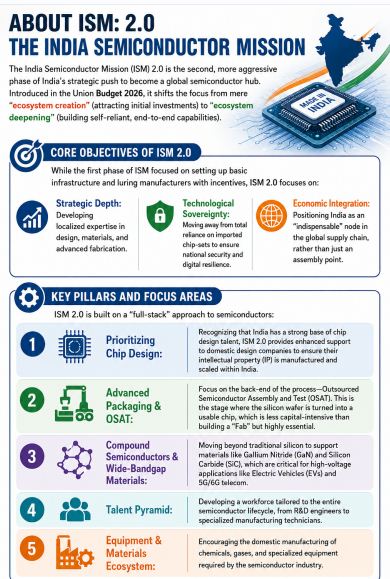
Why Semiconductors Matter for India?
-
National Security: Ensuring hardware trust in defense systems and critical infrastructure.
-
Digital Sovereignty: Reducing reliance on foreign-controlled technology to maintain strategic autonomy.
-
Economic Resilience: Powering the “Viksit Bharat 2047” vision by providing the foundational hardware for AI, electric mobility, telecommunications, and advanced manufacturing.
Way Forward:
-
Long-Cycle Planning: Recognizing that the semiconductor sector requires long-term commitment. Capabilities for 2035 must be planned and built today.
-
Prioritizing Design: Supporting Indian design companies to ensure that local innovations drive the manufacturing sector.
-
Strategic Autonomy: Reducing the risk associated with technology controlled by others by building domestic infrastructure.
Conclusion:
The roadmap represents a transition from India being a major consumer of chips to becoming an indispensable participant in the global value chain. As the Finance Minister and IT Minister highlighted, this is a 20-year journey toward technological sovereignty, where early planning and consistent investment will determine India’s position as a frontier-technology nation.
NITI Aayog के ‘फ्रंटियर टेक हब’ ने भारत का पहला व्यापक 10-वर्षीय रोडमैप जारी किया है। इसका उद्देश्य भारत को आयात-निर्भरता से निकालकर 2035 तक USD 120–150 बिलियन का सेमीकंडक्टर वैल्यू चेन हब बनाना है।
रोडमैप के 5 प्रमुख स्तंभ (5 Pillars):
यह रोडमैप निम्नलिखित पाँच परस्पर सुदृढ़ स्तंभों पर आधारित है:
-
अग्रणी R&D और डिज़ाइन IP: स्वदेशी बौद्धिक संपदा (Design IP) का विकास और नवाचार को बढ़ावा देना।
-
नीति और निवेश: दीर्घकालिक (Long-horizon) पूंजी जुटाने के लिए अनुकूल निवेश वातावरण।
-
उत्पादन पर ध्यान: एडवांस पैकेजिंग, कंपाउंड सेमीकंडक्टर और वाइड-बैंडगैप (Wide-bandgap) सामग्रियों पर विशेष जोर।
-
प्रतिभा विकास (Talent Pyramid): सेमीकंडक्टर क्षेत्र की संपूर्ण श्रृंखला के लिए कुशल कार्यबल का निर्माण।
-
साझेदारी (Partnerships): विश्वसनीय राष्ट्रों और वैश्विक उद्योग के साथ रणनीतिक सहयोग।
महत्वपूर्ण लक्ष्य (Key Goals):
-
इकोसिस्टम का गहरा होना: भारत अब केवल निवेश आकर्षित करने (Ecosystem creation) से आगे बढ़कर गहरी क्षमताओं (Ecosystem deepening) के विकास पर ध्यान केंद्रित करेगा।
-
रणनीतिक स्थिति: भारत को ‘एडवांस्ड पैकेजिंग’ (OSAT) के लिए वैश्विक गंतव्य के रूप में स्थापित करना।
-
AI-नेटिव डिज़ाइन: 100 से अधिक एडवांस सेमीकंडक्टर डिज़ाइन IPs का निर्माण।
-
ISM 2.0 के साथ तालमेल: यूनियन बजट 2026 में घोषित इंडिया सेमीकंडक्टर मिशन 2.0 की प्राथमिकताओं को सुदृढ़ करना।
सेमीकंडक्टर क्यों महत्वपूर्ण हैं?
-
राष्ट्रीय सुरक्षा: रक्षा प्रणालियों के लिए अनिवार्य।
-
डिजिटल संप्रभुता: अन्य देशों पर तकनीकी निर्भरता को कम करना।
-
आर्थिक लचीलापन: AI, टेलीकॉम, ऑटोमोबाइल, और स्वास्थ्य सेवा जैसे भविष्य के उद्योगों का आधार।
-
रणनीतिक स्वायत्तता: ‘विकसित भारत 2047’ के लक्ष्य को प्राप्त करने के लिए तकनीकी आधारभूत संरचना।
भारत के लिए आगे की राह (Way Forward):
-
दीर्घकालिक दृष्टिकोण: सेमीकंडक्टर उद्योग एक ‘लॉन्ग-साइकिल’ उद्योग है, जिसके लिए निरंतर निवेश और धैर्यपूर्ण क्षमता निर्माण की आवश्यकता है।
-
डिजाइन पर प्राथमिकता: जैसा कि इलेक्ट्रॉनिक्स और IT मंत्री ने कहा, डिज़ाइन भारत की पहली प्राथमिकता है ताकि घरेलू नवाचार को यहीं मैन्युफैक्चर और स्केल किया जा सके।
-
तकनीकी संप्रभुता: बुनियादी ढांचा स्तर (Infrastructure layer) पर आत्मनिर्भरता प्राप्त करना ताकि भविष्य के आर्थिक और तकनीकी नेतृत्व को सुरक्षित किया जा सके।
निष्कर्ष:
यह रोडमैप भारत की ‘उपभोक्ता से उत्पादक’ बनने की महत्वाकांक्षा का एक स्पष्ट घोषणापत्र है। यदि भारत समय रहते सही निवेश करता है और वैश्विक वैल्यू चेन में खुद को एक ‘विश्वसनीय भागीदार’ (Trusted Partner) के रूप में स्थापित करता है, तो 2035 तक भारत वैश्विक सेमीकंडक्टर परिदृश्य का एक अपरिहार्य (Indispensable) हिस्सा बन जाएगा।

May 19, 2026
October 17, 2025
October 16, 2025
October 6, 2025

