November 23, 2026
Daily UPSC Current : 23 NOV 2026/INDIA–NEPAL RELATIONS: KEY INITIATIVES AND CHALLENGES
Why in News?
Nepal Prime Minister Balen Shah, belonging to the Rastriya Swatantra Party (RSP), arrived in New Delhi on his maiden bilateral foreign visit, highlighting the importance of India–Nepal relations and cooperation in energy, trade, connectivity, education and security.
About India–Nepal Relations:
-
India and Nepal share historical, cultural, geographical and economic ties.
-
Both countries share an open border, close people-to-people contacts and extensive economic interdependence.
-
Nepal occupies an important position in India’s Neighbourhood First Policy.
Key Areas of Bilateral Cooperation:
Energy Cooperation:
-
Both countries have agreements targeting the import of 10,000 MW of electricity from Nepal to India over 10 years, compared with the current level of approximately 1,200 MW.
-
Cooperation focuses on developing Nepal’s hydropower potential and expanding cross-border electricity trade.
-
The 900 MW Arun-3 Hydroelectric Project is an important ongoing hydropower project involving Indian investment.
-
Discussions also covered the expansion of the Motihari–Amlekhgunj Petroleum Pipeline, strengthening energy connectivity.
Trade and Investment:
-
India is Nepal’s largest trading partner.
-
India accounts for nearly 80% of Nepal’s total merchandise exports and approximately one-third of its total inbound Foreign Direct Investment (FDI).
-
Cooperation includes trade facilitation, investment, industrial development and cross-border economic infrastructure.
Connectivity and Infrastructure:
-
Rail Connectivity: Passenger train trial runs linking Janakpurdham with Ayodhya aim to strengthen cross-border connectivity along the Ramayana Circuit.
-
Energy Connectivity: Cross-border electricity transmission and petroleum pipelines strengthen economic integration.
-
Road Connectivity: Development of roads and integrated check posts facilitates trade and movement of people.
Education and Innovation:
-
Discussions have prioritised establishing an offshore campus of the Indian Institute of Technology (IIT) in Nepal.
-
The India–Nepal Startup Partnership Network, in collaboration with IIT Madras, aims to promote innovation and youth entrepreneurship.
-
Educational cooperation includes scholarships, technical education and institutional partnerships.
Cultural and Religious Cooperation:
-
The Ramayana Circuit connects important religious and cultural destinations associated with Lord Rama in India and Nepal.
-
The Buddhist Circuit promotes Buddhist pilgrimage and tourism by connecting important Buddhist heritage destinations.
-
Shared religious traditions and cultural heritage strengthen people-to-people relations.
Defence and Security Cooperation:
-
India and Nepal maintain close defence cooperation through joint military exercises, training and military exchanges.
-
The traditional recruitment of Gorkha soldiers has been an important component of bilateral defence relations.
-
The Agnipath recruitment scheme has raised concerns regarding the continuation of traditional Gorkha recruitment arrangements.
Major Treaties and Policy Frameworks:
Treaty of Peace and Friendship, 1950:
-
Provides the institutional foundation for close India–Nepal relations.
-
Provides for an open-border arrangement and reciprocal privileges for citizens of both countries.
-
Facilitates the movement of people, trade and economic cooperation.
Treaty of Sugauli, 1816:
-
Signed between the Kingdom of Nepal and the British East India Company following the Anglo-Nepalese War.
-
Established important territorial boundaries between Nepal and British India.
-
Its interpretation is relevant to contemporary boundary disputes, particularly concerning the Kali River.
Neighbourhood First Policy:
-
India’s foreign policy framework prioritising relations with its immediate neighbours.
-
Focuses on regional connectivity, economic cooperation, infrastructure development and security.
-
India uses this policy to strengthen its strategic and economic engagement with Nepal.
Major Challenges in India–Nepal Relations:
Boundary Disputes:
-
Territorial disputes over Kalapani, Lipulekh and Limpiadhura remain a major source of tension.
-
Both countries have different interpretations of the historical boundary arrangements under the Treaty of Sugauli.
-
These disputes periodically affect diplomatic relations.
China’s Growing Influence:
-
Nepal’s geographical position makes it strategically important for both India and China.
-
China’s Belt and Road Initiative (BRI) seeks to expand infrastructure and connectivity in Nepal.
-
India’s concern is to maintain its strategic interests and prevent excessive external influence in its neighbourhood.
Trade and Economic Dependence:
-
Nepal’s considerable dependence on India for trade, transit and investment creates economic interdependence.
-
Trade-related restrictions and disruptions can adversely affect Nepal’s economy.
-
Nepal seeks to diversify its external trade and investment partnerships.
Gorkha Recruitment Issue:
-
The Agnipath Scheme has created uncertainty regarding the traditional recruitment of Gorkha soldiers into the Indian Army.
-
This has become an important issue in bilateral defence cooperation.
Political and Diplomatic Differences:
-
Changes in Nepal’s domestic political leadership sometimes influence its foreign policy priorities.
-
Differences over territorial claims, trade and external partnerships create diplomatic challenges.
Way Forward:
-
Resolve Border Disputes: Strengthen diplomatic dialogue and use historical records and established mechanisms for peaceful resolution.
-
Strengthen Economic Integration: Expand bilateral trade, investment and industrial cooperation.
-
Improve Connectivity: Accelerate railway, road, petroleum pipeline and electricity transmission projects.
-
Enhance Energy Cooperation: Develop Nepal’s hydropower potential through long-term electricity trade agreements.
-
Respect Strategic Autonomy: Strengthen cooperation while respecting Nepal’s sovereignty and independent foreign policy choices.
-
Expand People-to-People Relations: Promote education, tourism, cultural exchanges and religious connectivity.
-
Strengthen Regional Cooperation: Utilise platforms such as BIMSTEC and other regional initiatives for greater economic integration.
Conclusion:
India–Nepal relations are based on geographical proximity, historical connections, cultural similarities and economic interdependence. Strengthening mutual trust, resolving boundary disputes and expanding connectivity and energy cooperation are essential for a stable and prosperous neighbourhood.
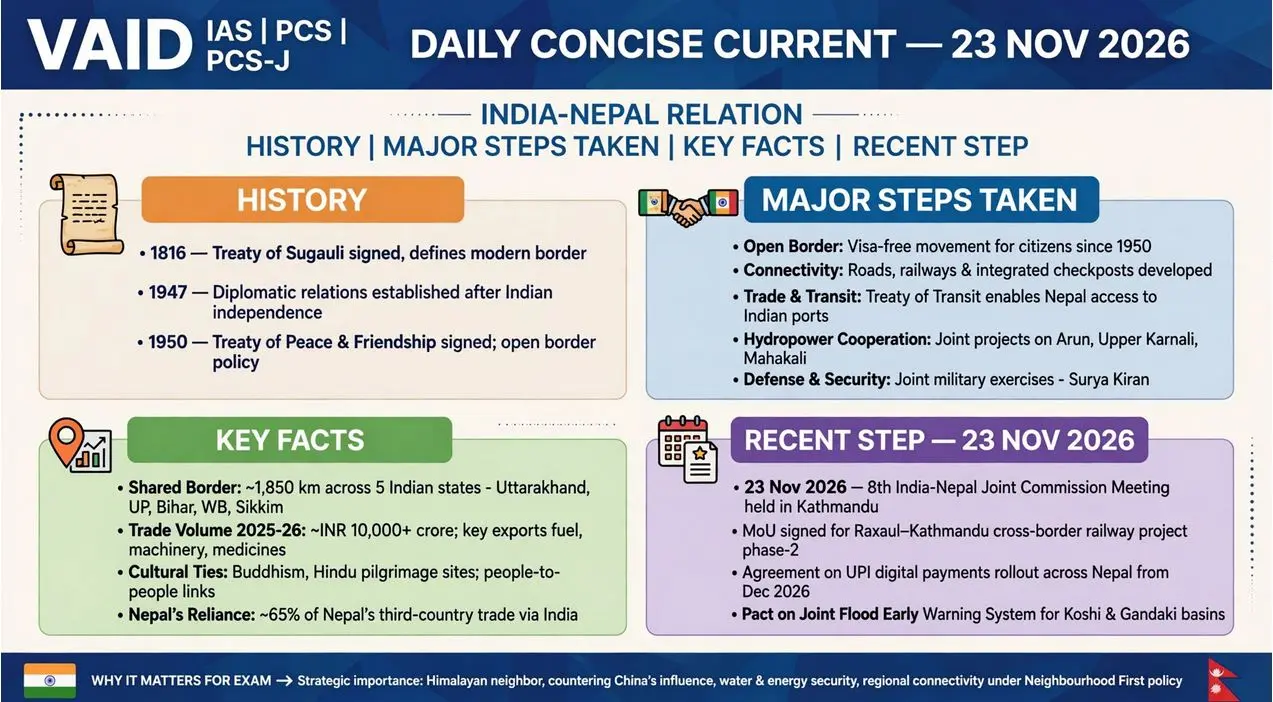
Important Terms for Examination:
Ramayana Circuit: A transnational religious and cultural tourism route connecting important sites associated with the life of Lord Rama in India and Nepal.
Buddhist Circuit: A network of important Buddhist pilgrimage destinations associated with the life and teachings of Gautama Buddha.
Digital Public Infrastructure (DPI): Shared digital systems that enable large-scale delivery of services through platforms relating to digital identity, payments and data exchange.
Neighbourhood First Policy: India’s foreign policy approach that gives priority to strengthening political, economic, security and developmental relations with neighbouring countries.
Belt and Road Initiative (BRI): China’s global infrastructure and connectivity initiative aimed at developing transport, trade and economic corridors.
Exam Focus: India–Nepal relations are important from the perspectives of Neighbourhood First Policy, hydropower cooperation, border disputes, China factor, regional connectivity and cultural diplomacy.
भारत–नेपाल संबंध: प्रमुख पहलें एवं चुनौतियाँ
चर्चा में क्यों:
नेपाल के प्रधानमंत्री बालेन्द्र शाह (राष्ट्रीय स्वतंत्र पार्टी) ने भारत की अपनी पहली द्विपक्षीय विदेश यात्रा के तहत नई दिल्ली का दौरा किया। इसका उद्देश्य भारत–नेपाल सहयोग को मजबूत करना है।
द्विपक्षीय सहयोग के प्रमुख क्षेत्र:
ऊर्जा सहयोग:
-
अगले 10 वर्षों में नेपाल से 10,000 मेगावाट बिजली आयात करने का लक्ष्य; वर्तमान आयात लगभग 1,200 मेगावाट है।
-
अरुण-3 जलविद्युत परियोजना: 900 मेगावाट की जलविद्युत परियोजना।
-
मोतिहारी–अमलेखगंज पाइपलाइन: सीमा पार पेट्रोलियम संपर्क का विस्तार।
व्यापार एवं निवेश:
-
नेपाल के कुल वस्तु निर्यात में भारत की हिस्सेदारी लगभग 80% है।
-
नेपाल में कुल आवक प्रत्यक्ष विदेशी निवेश (FDI) का लगभग एक-तिहाई भारत से आता है।
-
भारत नेपाल का सबसे बड़ा व्यापारिक साझेदार है।
संपर्क एवं आधारभूत संरचना:
-
रामायण सर्किट: जनकपुरधाम–अयोध्या सहित धार्मिक पर्यटन एवं सीमा पार संपर्क को बढ़ावा।
-
रेलवे, सड़क और पेट्रोलियम पाइपलाइन नेटवर्क का विस्तार।
शिक्षा एवं नवाचार:
-
नेपाल में भारतीय प्रौद्योगिकी संस्थान (IIT) का विदेशी परिसर स्थापित करने का प्रस्ताव।
-
भारत–नेपाल स्टार्टअप साझेदारी नेटवर्क: IIT मद्रास के सहयोग से युवा उद्यमिता एवं नवाचार को बढ़ावा।
सांस्कृतिक सहयोग:
-
बौद्ध सर्किट: बौद्ध तीर्थस्थलों एवं विरासत पर्यटन को बढ़ावा।
-
साझा धार्मिक एवं सांस्कृतिक विरासत से जन-स्तरीय संबंध मजबूत होते हैं।
रक्षा सहयोग:
-
भारतीय सेना में गोरखा सैनिकों की पारंपरिक भर्ती द्विपक्षीय रक्षा संबंधों का महत्वपूर्ण हिस्सा है।
-
अग्निपथ योजना के कारण पारंपरिक गोरखा भर्ती व्यवस्था की निरंतरता को लेकर चिंताएँ उत्पन्न हुई हैं।
प्रमुख संधियाँ एवं नीतिगत ढाँचे:
-
शांति एवं मैत्री संधि, 1950: भारत–नेपाल संबंधों का आधार; खुली सीमा व्यवस्था तथा नागरिकों को पारस्परिक सुविधाएँ प्रदान करती है।
-
सुगौली की संधि, 1816: नेपाल और ब्रिटिश भारत के बीच महत्वपूर्ण क्षेत्रीय सीमाओं का निर्धारण; वर्तमान सीमा विवादों से संबंधित।
-
पड़ोस प्रथम नीति (Neighbourhood First Policy): पड़ोसी देशों के साथ व्यापार, संपर्क, सुरक्षा एवं विकास सहयोग को प्राथमिकता देने वाली भारत की विदेश नीति।
-
बेल्ट एंड रोड पहल (BRI): चीन की वैश्विक आधारभूत संरचना एवं संपर्क विकास पहल, जिसके माध्यम से नेपाल में चीन का प्रभाव बढ़ रहा है।
प्रमुख चुनौतियाँ:
-
सीमा विवाद: कालापानी, लिपुलेख और लिम्पियाधुरा को लेकर ऐतिहासिक सीमा निर्धारण की अलग-अलग व्याख्याएँ।
-
चीन का प्रभाव: बेल्ट एंड रोड पहल के माध्यम से नेपाल में चीन का बढ़ता आर्थिक एवं सामरिक प्रभाव।
-
आर्थिक निर्भरता: व्यापार, पारगमन एवं निवेश के लिए भारत पर नेपाल की निर्भरता।
-
गोरखा भर्ती: अग्निपथ योजना के कारण पारंपरिक भर्ती व्यवस्था को लेकर मतभेद।
-
राजनीतिक मतभेद: नेपाल की बदलती राजनीतिक प्राथमिकताएँ एवं कूटनीतिक असहमतियाँ।
आगे की राह:
-
सीमा विवादों का समाधान: कूटनीतिक वार्ता के माध्यम से शांतिपूर्ण समाधान।
-
आर्थिक सहयोग: जलविद्युत, व्यापार एवं निवेश को बढ़ावा।
-
संपर्क विस्तार: सीमा पार रेल, सड़क एवं ऊर्जा संपर्क परियोजनाओं में तेजी।
-
संप्रभुता का सम्मान: नेपाल की स्वतंत्र विदेश नीति एवं सामरिक स्वायत्तता का सम्मान।
-
जन-स्तरीय संबंध: शिक्षा, संस्कृति, पर्यटन एवं क्षेत्रीय सहयोग का विस्तार।
निष्कर्ष:
भारत–नेपाल संबंध भौगोलिक निकटता, ऐतिहासिक संबंधों एवं आर्थिक परस्पर निर्भरता पर आधारित हैं। क्षेत्रीय स्थिरता के लिए आपसी विश्वास, सीमा विवादों का शांतिपूर्ण समाधान तथा संपर्क एवं ऊर्जा सहयोग को मजबूत करना आवश्यक है।

May 19, 2026
October 17, 2025
October 16, 2025
October 6, 2025

