November 18, 2026
India’s Solar Energy Expansion
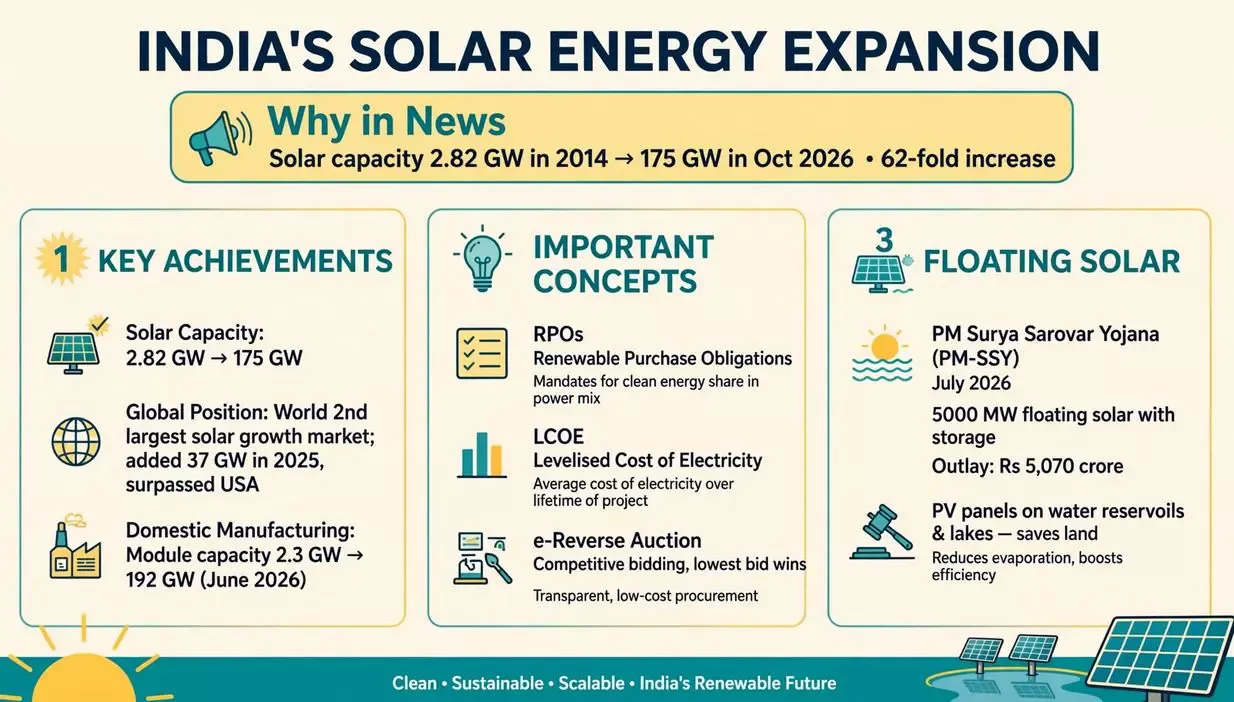
Why in News?India has witnessed a remarkable expansion in its solar energy sector, with installed solar capacity increasing from 2.82 GW in 2014 to approximately 175 GW in October 2026, reflecting its growing role in the global renewable energy transition.
Key Achievements:
- Solar Capacity: Increased from 82 GW (2014) to approximately 175 GW (October 2026), a nearly 62-fold increase.
- Global Position: India became the world’s second-largest solar growth market, adding 37 GW in 2025 and surpassing the USA in annual capacity additions.
- Domestic Manufacturing: Solar module manufacturing capacity increased from 3 GW (2014) to 192 GW (June 2026).
- Floating Solar: The Pradhan Mantri Surya Sarovar Yojana (PM-SSY) was approved in July 2026 to support 5,000 MW of floating solar projects with co-located energy storage systems, with an outlay of ₹5,070 crore.
Major Government Initiatives:
- National Solar Mission: Promotes large-scale solar energy development in India.
- Solar Parks Scheme: Facilitates the development of large solar parks and infrastructure.
- Green Energy Corridor Programme: Strengthens transmission infrastructure for renewable energy.
- PM Surya Ghar: Muft Bijli Yojana: Promotes rooftop solar installations in households. It has an outlay of ₹75,021 crore and benefited around 65 lakh households by November 2026.
- PM-KUSUM: Promotes solar-powered agricultural pumps and decentralised solar power plants, targeting 34,800 MW of solar capacity by 2026–27.
- PLI Scheme for High-Efficiency Solar PV Modules: Encourages domestic solar manufacturing and reduces import dependence.
- Approved List of Models and Manufacturers (ALMM): Promotes quality standards and domestic solar manufacturing.
Factors Driving Solar Energy Growth:
- Policy Support: Strong government policies and financial incentives.
- Lower Costs: Competitive bidding and e-Reverse Auctions reduced solar tariffs from around ₹18/unit (2010) to ₹99/unit.
- Domestic Manufacturing: Expansion of indigenous solar module production.
- Infrastructure: Development of solar parks and transmission networks.
- Public Participation: Rooftop solar adoption by households and solarisation of agriculture.
India’s Global Leadership:
- International Solar Alliance (ISA): Co-founded by India and France to promote global cooperation in solar energy.
- One Sun One World One Grid (OSOWOG): India’s initiative to promote interconnected global electricity grids for sharing renewable energy.
- Panchamrit Goals: India’s climate commitments announced at COP26, including:
- Achieving 500 GW of non-fossil fuel energy capacity by 2030.
- Achieving Net Zero emissions by 2070.
- Mission LiFE: Promotes environmentally responsible lifestyles and sustainable consumption.
Important Concepts:
- Renewable Purchase Obligations (RPOs): Require electricity distribution companies and other specified entities to procure a prescribed share of electricity from renewable energy sources.
- Levelised Cost of Electricity (LCOE): Average lifetime cost of generating electricity, including construction, operation and maintenance costs, divided by total electricity generated.
- e-Reverse Auction: A competitive bidding process in which sellers progressively reduce their quoted prices; the lowest eligible bid generally wins.
- Floating Solar PV: Solar panels installed on floating structures over water bodies such as reservoirs and lakes. It helps utilise water surfaces without requiring large areas of land.
Challenges:
- Land Acquisition: Large solar projects require substantial land.
- Intermittency: Solar power generation depends on sunlight and weather conditions.
- Energy Storage: High costs of battery storage and grid balancing.
- Import Dependence: Dependence on imported solar cells and critical minerals.
- Waste Management: Disposal and recycling of solar panels after their useful life.
Way Forward:
- Promote battery storage and pumped hydro storage.
- Strengthen domestic manufacturing of solar cells and critical components.
- Expand rooftop and floating solar projects.
- Improve electricity transmission and grid integration.
- Develop effective solar panel recycling mechanisms.
Conclusion:
India’s solar energy expansion is crucial for achieving energy security, reducing dependence on fossil fuels, promoting green manufacturing and fulfilling its climate commitments. Solar power will remain a key pillar of India’s transition towards a sustainable and low-carbon economy.

May 19, 2026
October 17, 2025
October 16, 2025
October 6, 2025

