November 17, 2026
The 2026 UN Water Conference/2026 2026 संयुक्त राष्ट्र जल सम्मेलन
POLIO ERADICATION, WATER, SANITATION AND WASTEWATER SURVEILLANCE
Why in News?
The 2026 UN Water Conference, to be held in Abu Dhabi, will focus on accelerating global efforts towards Sustainable Development Goal (SDG) 6 – Clean Water and Sanitation for All. The issue also highlights the importance of safe water and sanitation in preventing diseases such as Polio.
Global Progress in Polio Eradication:
-
Global Progress: Polio cases have declined by more than 99% since 1988, mainly due to vaccination and disease surveillance.
-
Remaining Challenges: Polio transmission continues in Afghanistan and Pakistan, with outbreaks and resurgences reported in other regions.
-
Role of Water and Sanitation: Poliovirus spreads mainly through the faecal-oral route, often through contaminated water and food. Therefore, safe drinking water and sanitation are essential for preventing transmission.
-
Vaccination: Immunisation remains the most important tool for preventing polio and achieving global eradication.
Global Water and Sanitation Crisis:
According to the figures provided:
-
2.1 billion people lacked safely managed drinking water in 2024.
-
3.4 billion people lacked safely managed sanitation in 2024.
-
Unsafe water, sanitation and hygiene contributed to approximately 1.4 million preventable deaths in 2019.
Why are Water and Sanitation Important for Polio Eradication?
-
Contaminated Water: Can transmit poliovirus through the faecal-oral route.
-
Safe Drinking Water: Reduces exposure to disease-causing pathogens.
-
Proper Sanitation: Prevents human waste from contaminating water sources.
-
Preventive Healthcare: Water infrastructure should be treated as an essential part of public health infrastructure.
Wastewater Surveillance:
-
Meaning: Systematic testing of sewage and wastewater to detect the presence of disease-causing pathogens in a community.
-
Early Detection: Helps identify the presence and spread of viruses, including poliovirus, even before people show symptoms.
-
AI Integration: Artificial Intelligence can help analyse wastewater data, identify disease patterns and provide early warnings.
-
Examples:
-
Abu Dhabi: Uses wastewater monitoring as part of disease surveillance.
-
European Wastewater Surveillance Dashboard (2025): Supports monitoring and tracking of pathogens through wastewater data.
-
-
Significance: Shifts public health from a reactive approach (responding after outbreaks) to a preventive and early-warning approach.
Reaching the Last Mile Fund:
-
Established by: United Arab Emirates (UAE), under the leadership of Sheikh Mohamed bin Zayed Al Nahyan, in partnership with the Bill & Melinda Gates Foundation.
-
Objective: Support the eradication of polio and control of neglected tropical diseases (NTDs).
-
Focus: Reaching underserved communities, remote areas and children who lack access to essential healthcare.
-
Significance: Promotes equitable access to healthcare and supports the global goal of disease eradication.
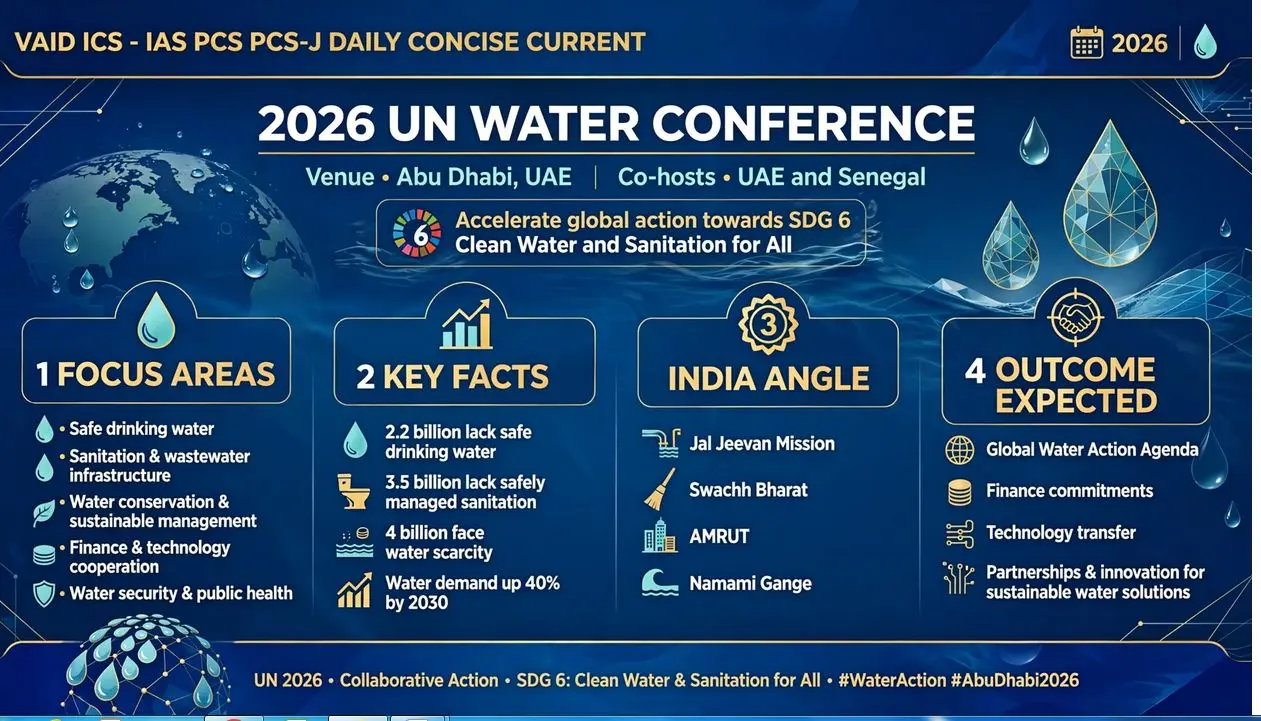
2026 UN Water Conference:
-
Venue: Abu Dhabi, United Arab Emirates.
-
Co-hosts: UAE and Senegal.
-
Objective: Accelerate global action towards SDG 6 – Clean Water and Sanitation for All.
-
Focus Areas:
-
Improving access to safe drinking water.
-
Expanding sanitation and wastewater infrastructure.
-
Promoting water conservation and sustainable water management.
-
Mobilising finance, technology and international cooperation.
-
Strengthening the link between water security and public health.
-
SDG 6: Clean Water and Sanitation
-
Adopted: 2015 under the UN 2030 Agenda for Sustainable Development.
-
Objective: Ensure availability and sustainable management of water and sanitation for all.
-
Major Targets:
-
Universal access to safe and affordable drinking water.
-
Adequate sanitation and hygiene for all.
-
Improvement in water quality and reduction of water pollution.
-
Increase water-use efficiency.
-
Protection and restoration of water-related ecosystems.
-
Challenges in Polio Eradication:
-
Incomplete Immunisation: Some children remain unvaccinated, particularly in remote and conflict-affected areas.
-
Poor Sanitation: Contaminated water and inadequate sanitation facilitate virus transmission.
-
Conflict and Displacement: Disrupt vaccination campaigns and healthcare services.
-
Vaccine Hesitancy: Misinformation and lack of awareness affect immunisation coverage.
-
Cross-border Transmission: Movement of infected individuals can spread the virus between countries.
Way Forward:
-
Strengthen routine immunisation and supplementary vaccination campaigns.
-
Improve access to safe drinking water and sanitation.
-
Expand AI-based wastewater surveillance for early detection of pathogens.
-
Increase international cooperation and funding for polio eradication.
-
Integrate health, water and sanitation policies for effective disease prevention.
Conclusion:
Polio eradication requires more than vaccination alone. Universal immunisation, safe drinking water, proper sanitation and effective disease surveillance must work together to achieve sustainable public health outcomes.
2026 संयुक्त राष्ट्र जल सम्मेलन:
चर्चा में क्यों?आगामी 2026 संयुक्त राष्ट्र जल सम्मेलन (2026 UN Water Conference), जिसका आयोजन अबू धाबी में किया जाएगा, सतत विकास लक्ष्य 6 (SDG 6 – स्वच्छ जल और स्वच्छता) की दिशा में प्रगति को गति देने पर केंद्रित होगा। यह पोलियो जैसी बीमारियों की रोकथाम में सुरक्षित जल और स्वच्छता की महत्वपूर्ण भूमिका को भी रेखांकित करता है।
पोलियो उन्मूलन में वैश्विक प्रगति:
- प्रगति: मुख्य रूप से टीकाकरण और निगरानी के कारण वर्ष 1988 से वैश्विक स्तर पर पोलियो के मामलों में 99% से अधिक की गिरावट आई है।
- शेष देश: अफगानिस्तान और पाकिस्तान में वाइल्ड पोलियोवायरस (Wild Poliovirus) का संचरण अभी भी जारी है।
- संचरण: पोलियोवायरस मुख्य रूप से मल-मुख मार्ग (faecal-oral route) से फैलता है, जो प्रायः दूषित जल और भोजन के माध्यम से होता है।
- रोकथाम: इसके पूर्ण उन्मूलन के लिए टीकाकरण, सुरक्षित पेयजल और उचित स्वच्छता अत्यंत आवश्यक हैं।
वैश्विक जल और स्वच्छता संकट:
- वर्ष 2024 में1 अरब (2.1 billion) लोग सुरक्षित रूप से प्रबंधित पेयजल की सुविधा से वंचित थे।
- वर्ष 2024 में4 अरब (3.4 billion) लोग सुरक्षित रूप से प्रबंधित स्वच्छता की सुविधा से वंचित थे।
- वर्ष 2019 में असुरक्षित जल, स्वच्छता और साफ-सफाई (WASH) के कारण लगभग 14 लाख (1.4 million) रोकी जा सकने वाली मौतें हुईं।
अपशिष्ट जल निगरानी (Wastewater Surveillance):
- अर्थ: किसी समुदाय में फैल रहे रोगजनक सूक्ष्मजीवों (pathogens) का पता लगाने के लिए अपशिष्ट जल (सीवेज) का परीक्षण करना।
- महत्त्व: यह नैदानिक प्रकोप (clinical outbreaks) के व्यापक होने से पहले ही पोलियोवायरस जैसे विषाणुओं की पहचान करने में सहायता करता है।
- एआई (AI) एकीकरण: कृत्रिम बुद्धिमत्ता (AI) अपशिष्ट जल के डेटा का विश्लेषण करने, रोगों के पैटर्न की पहचान करने और प्रारंभिक चेतावनी (early warnings) प्रदान करने में सहायक है।
- उदाहरण: अबू धाबी की अपशिष्ट जल निगरानी प्रणाली और यूरोपीय अपशिष्ट जल निगरानी डैशबोर्ड (2025)।
रीचिंग द लास्ट माइल फंड (Reaching the Last Mile Fund):
- स्थापना: संयुक्त अरब अमीरात (UAE) द्वारा शेख मोहम्मद बिन जायद अल नाहयान के नेतृत्व में तथा गेट्स फाउंडेशन (Gates Foundation) की साझेदारी से स्थापित।
- उद्देश्य: पोलियो और उपेक्षित उष्णकटिबंधीय रोगों (Neglected Tropical Diseases – NTDs) का मुकाबला करना।
- केंद्र बिंदु: वंचित समुदायों और सुदूर क्षेत्रों के बच्चों को स्वास्थ्य सेवाओं तक पहुँच प्रदान करना।
2026 संयुक्त राष्ट्र जल सम्मेलन (2026 UN Water Conference):
- आयोजन स्थल: अबू धाबी, संयुक्त अरब अमीरात (UAE)।
- सह-मेजबान: संयुक्त अरब अमीरात (UAE) और सेनेगल (Senegal)।
- उद्देश्य: सभी के लिए स्वच्छ जल और स्वच्छता (SDG 6) के कार्यान्वयन में तेजी लाना।
- मुख्य बिंदु: जल अवसंरचना, स्वच्छता, अपशिष्ट जल प्रबंधन, नवीन प्रौद्योगिकियां और अंतरराष्ट्रीय वित्तपोषण।
सतत विकास लक्ष्य 6 (SDG 6): स्वच्छ जल और स्वच्छता
- अपनाया गया: संयुक्त राष्ट्र के 2030 एजेंडा (UN 2030 Agenda) के अंतर्गत वर्ष 2015 में।
- उद्देश्य: सभी के लिए जल और स्वच्छता की उपलब्धता तथा सतत प्रबंधन सुनिश्चित करना।
- प्रमुख कार्य क्षेत्र: सुरक्षित पेयजल, स्वच्छता, साफ-सफाई (हाइजीन), जल की गुणवत्ता, अपशिष्ट जल उपचार और जल-उपयोग दक्षता।
आगे की राह:
- टीकाकरण और रोग निगरानी तंत्र को सुदृढ़ करना।
- सुरक्षित पेयजल और स्वच्छता तक सार्वभौमिक पहुँच सुनिश्चित करना।
- रोगों की प्रारंभिक पहचान के लिए एआई-आधारित (AI-based) अपशिष्ट जल निगरानी का विस्तार करना।
- जल अवसंरचना में अंतरराष्ट्रीय सहयोग और निवेश को बढ़ावा देना।
निष्कर्ष: पोलियो उन्मूलन और जल सुरक्षा आपस में अंतर्संबंधित हैं। सतत सार्वजनिक स्वास्थ्य प्राप्त करने के लिए टीकाकरण, सुरक्षित पेयजल, उचित स्वच्छता और प्रारंभिक रोग निगरानी अनिवार्य हैं।

May 19, 2026
October 17, 2025
October 16, 2025
October 6, 2025

