November 17, 2026
Daily UPSC Current : 17 NOV 2026/SARNA RELIGION
CENSUS 2027: RELIGION CLASSIFICATION AND SARNA RELIGION
Why in News?
The self-enumeration portal for Census 2027 initially displayed 287 entries under the ‘Other Religions’ category, including ISKCON, Sarna, Shia and Pentecostal. The list was subsequently removed following a query raised with the Union Home Ministry.
Key Points:
- Government Clarification: The 287 entries were only predictive text suggestions to assist enumerators and were not official classifications of new religions.
- Self-Enumeration Portal: A new facility allowing households to submit their demographic information online before the mandatory visit by census enumerators.
- Launch: The portal became operational on 16 November 2026 in Uttar Pradesh, Uttarakhand, Goa and Punjab. Nationwide access is planned for January 2027.
- Religious Categories: The Census traditionally records six major religions – Hinduism, Islam, Christianity, Sikhism, Buddhism and Jainism, along with an Others
Registrar General and Census Commissioner of India (RGCCI):
- The RGCCI functions under the Ministry of Home Affairs.
- It is responsible for conducting the Census of India and coordinating the registration of births and deaths.
- It oversees census operations, population data collection, compilation and publication.
- The office is headed by the Registrar General and Census Commissioner of India.
About Sarna Religion:
- Sarna is a traditional indigenous faith followed by several tribal communities, particularly in Jharkhand, Odisha, West Bengal and neighbouring regions.
- It is based on nature worship, including reverence for trees, forests, hills, rivers and other natural elements.
- Sacred Groves: Sarna followers worship at sacred forest areas known as Sarna Sthal.
- Belief System: It emphasises harmony with nature, community traditions and ancestral worship.
- Separate Identity: Tribal communities demand a separate religion code in the Census, arguing that Sarna is distinct from major organised religions.
Demand for Separate Sarna Code:
- Jharkhand Assembly: Passed a resolution in 2020 seeking a separate Sarna religion code.
- 2011 Census: Approximately 50 lakh people identified themselves as Sarna under the ‘Other Religions and Persuasions’ category.
- Significance: A separate code would help in recognising tribal religious identity and collecting more accurate demographic data.
Important Clarification:
The Registrar General and Census Commissioner of India has clarified that respondents remain free to write the name of any religion under the ‘Others’ category. A separate Sarna code has not yet been officially recognised in the Census classification.
OTHER RELIGIONS, INDIGENOUS FAITHS AND SECTS IN INDIA
The Census of India records several smaller religious communities, indigenous faiths and sects under the six major religions as well as the category ‘Other Religions and Persuasions’.
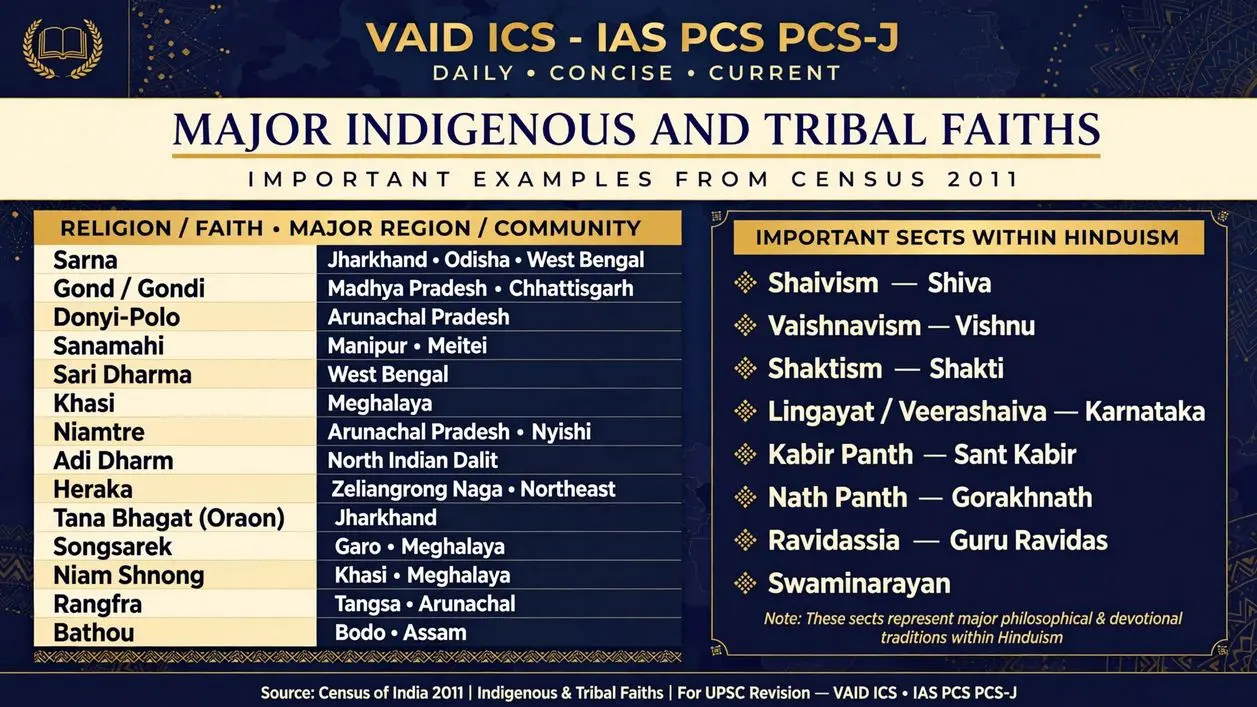
Major Indigenous and Tribal Faiths
IMPORTANT EXAMPLES FROM CENSUS 2011
| Religion / Faith | Major region / Community |
|---|---|
| Sarna | Jharkhand, Odisha, West Bengal |
| Gond / Gondi | Madhya Pradesh, Chhattisgarh |
| Donyi-Polo | Arunachal Pradesh |
| Sanamahi | Manipur (Meitei community) |
| Sari Dharma | West Bengal |
| Khasi | Meghalaya |
| Niamtre | Arunachal Pradesh (Nyishi community) |
| Adi Dharm | North Indian Dalit reform tradition |
| Heraka | Zeliangrong Naga communities, Northeast |
| Tana Bhagat | Oraon community, Jharkhand |
| Songsarek | Garo community, Meghalaya |
| Niam Shnong | Khasi community, Meghalaya |
| Rangfra | Tangsa community, Arunachal Pradesh |
| Bathou | Bodo community, Assam |
Important Sects / Traditions within Major Religions
Hinduism:
-
Shaivism: Worship of Lord Shiva.
-
Vaishnavism: Worship of Lord Vishnu and his incarnations.
-
Shaktism: Worship of Goddess Shakti.
-
Lingayat / Veerashaiva: Religious tradition originating in Karnataka.
-
Kabir Panth: Based on the teachings of Sant Kabir.
-
Nath Panth: Associated with Nath yogis and Gorakhnath.
-
Ravidassia: Tradition based on the teachings of Guru Ravidas.
-
Swaminarayan: Hindu religious tradition founded by Swaminarayan.
Islam:
-
Sunni: Largest branch of Islam.
-
Shia: Major branch recognising the leadership of Imam Ali and his descendants.
-
Ahmadiyya: Islamic religious movement founded by Mirza Ghulam Ahmad.
Buddhism:
-
Theravada: Traditional Buddhist school.
-
Mahayana: Emphasises the Bodhisattva ideal.
-
Vajrayana: Also known as Tantric Buddhism.
-
Navayana: Buddhist tradition inspired by Dr. B.R. Ambedkar.
Jainism:
-
Digambara: One of the two major Jain traditions.
-
Shwetambara: Another major Jain tradition.
Sikhism:
-
Nihang: Traditional Sikh warrior order.
-
Namdhari: Sikh religious movement.
-
Nirmala: Sikh religious tradition.
Other Religious Communities in India
-
Zoroastrianism: Followed by the Parsi community.
-
Judaism: Followed by Jewish communities in India.
-
Baháʼí Faith: A monotheistic religion.
-
Animism: Belief in spiritual powers associated with natural objects and living beings.
जनगणना 2027: धर्म वर्गीकरण और सरना धर्म
चर्चा में क्यों?जनगणना 2027 (Census 2027) के लिए बनाए गए स्व-गणना पोर्टल (Self-Enumeration Portal) पर प्रारंभ में ‘अन्य धर्म’ (Other Religions) श्रेणी के अंतर्गत 287 प्रविष्टियाँ प्रदर्शित की गई थीं, जिनमें इस्कॉन (ISKCON), सरना, शिया और पेंटेकोस्टल शामिल थे। केंद्रीय गृह मंत्रालय से इस संबंध में स्पष्टीकरण मांगे जाने के बाद इस सूची को पोर्टल से हटा दिया गया।
मुख्य बिंदु:
-
सरकारी स्पष्टीकरण: ये 287 प्रविष्टियाँ केवल प्रगणकों (enumerators) की सहायता के लिए ‘पूर्वानुमानित पाठ सुझाव’ (predictive text suggestions) मात्र थीं और ये नए धर्मों का कोई आधिकारिक वर्गीकरण नहीं थीं।
-
स्व-गणना पोर्टल: यह एक नई सुविधा है जो परिवारों को जनगणना प्रगणकों के अनिवार्य दौरे से पहले ऑनलाइन माध्यम से अपनी जनसांख्यिकीय जानकारी दर्ज करने की अनुमति देती है।
-
शुभारंभ: यह पोर्टल 16 नवंबर 2026 को उत्तर प्रदेश, उत्तराखंड, गोवा और पंजाब में संचालित (प्रारंभ) किया गया। जनवरी 2027 में इसे देशव्यापी स्तर पर लागू किए जाने की योजना है।
-
धार्मिक श्रेणियाँ: जनगणना में पारंपरिक रूप से छह प्रमुख धर्मों— हिंदू, इस्लाम, ईसाई, सिख, बौद्ध और जैन— के साथ-साथ ‘अन्य’ (Others) श्रेणी को दर्ज किया जाता है।
भारत के महारजिस्ट्रार एवं जनगणना आयुक्त (RGCCI):
-
RGCCI केंद्रीय गृह मंत्रालय के अधीन कार्य करता है।
-
यह भारत की जनगणना आयोजित करने तथा जन्म एवं मृत्यु के पंजीकरण में समन्वय स्थापित करने के लिए उत्तरदायी है।
-
यह जनगणना कार्यों, जनसंख्या डेटा संग्रह, संकलन और प्रकाशन की देखरेख करता है।
-
इस कार्यालय का नेतृत्व भारत के महारजिस्ट्रार एवं जनगणना आयुक्त द्वारा किया जाता है।
सरना धर्म के बारे में:
-
सरना एक पारंपरिक देशज (आदिवासी) आस्था है, जिसका पालन मुख्य रूप से झारखंड, ओडिशा, पश्चिम बंगाल और निकटवर्ती क्षेत्रों के कई जनजातीय समुदायों द्वारा किया जाता है।
-
यह प्रकृति पूजा पर आधारित है, जिसमें वृक्षों, वनों, पहाड़ियों, नदियों और अन्य प्राकृतिक तत्वों के प्रति श्रद्धा शामिल है।
-
पवित्र उपवन (Sacred Groves): सरना अनुयायी पवित्र वन क्षेत्रों में पूजा करते हैं, जिन्हें ‘सरना स्थल’ कहा जाता है।
-
विश्वास प्रणाली: यह प्रकृति के साथ सामंजस्य, सामुदायिक परंपराओं और पूर्वजों की पूजा पर बल देती है।
-
पृथक पहचान: जनजातीय समुदाय जनगणना में एक अलग धर्म कोड की मांग कर रहे हैं, उनका तर्क है कि सरना प्रमुख संगठित धर्मों से भिन्न है।
पृथक सरना कोड की मांग:
-
झारखंड विधानसभा: वर्ष 2020 में एक अलग सरना धर्म कोड की मांग करते हुए एक प्रस्ताव पारित किया गया था।
-
2011 की जनगणना: लगभग 50 लाख लोगों ने ‘अन्य धर्म और मत’ (Other Religions and Persuasions) श्रेणी के अंतर्गत स्वयं को सरना के रूप में दर्ज कराया था।
-
महत्त्व: एक अलग कोड जनजातीय धार्मिक पहचान को मान्यता देने और अधिक सटीक जनसांख्यिकीय डेटा एकत्र करने में सहायक होगा।
महत्त्वपूर्ण स्पष्टीकरण: भारत के महारजिस्ट्रार एवं जनगणना आयुक्त ने यह स्पष्ट किया है कि उत्तरदाता ‘अन्य’ श्रेणी के अंतर्गत किसी भी धर्म का नाम लिखने के लिए स्वतंत्र हैं। जनगणना वर्गीकरण में अभी तक एक अलग सरना कोड को आधिकारिक रूप से मान्यता नहीं दी गई है।
-

May 19, 2026
October 17, 2025
October 16, 2025
October 6, 2025

