November 3, 2026
Climate-Resilient Urban Development in India
Why in News?
A recent study highlights the need to make Indian cities climate-resilient, particularly smaller cities with populations below one million. It emphasises integrating climate considerations into urban planning, infrastructure development and investment to reduce future climate risks.
The study argues that India has a major opportunity to build climate-resilient cities because a large share of its future housing and urban infrastructure is yet to be constructed.
Current Status of Urbanisation in India:
-
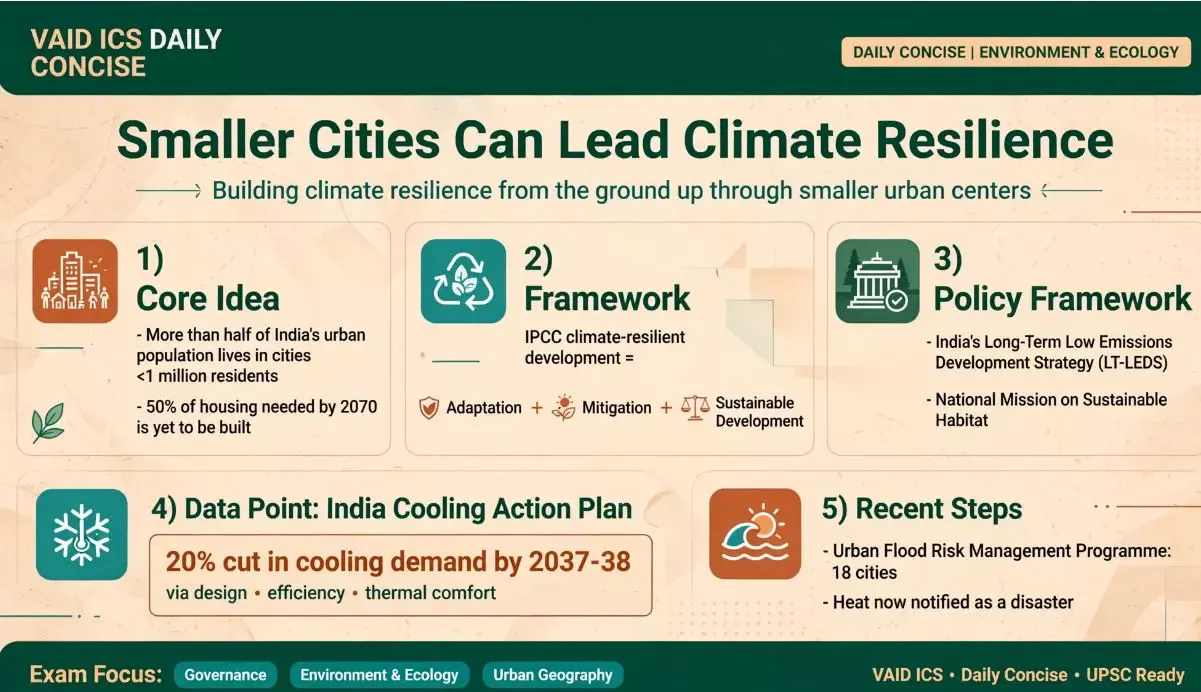
More than 50% of India’s urban population lives in cities with fewer than one million residents.
-
Estimates suggest that more than 50% of the housing required by 2070 is yet to be built.
-
Rapid urban expansion is increasing pressure on housing, transport, drainage, water supply and energy infrastructure.
-
Smaller cities have an opportunity to incorporate climate resilience into urban development from the beginning rather than spending heavily on retrofitting existing infrastructure.
Climate-Resilient Development:
Meaning: Climate-resilient development is an approach that integrates climate change adaptation, greenhouse gas emission reduction and sustainable development.
According to the Intergovernmental Panel on Climate Change (IPCC), it involves three interconnected components:
-
Climate Change Adaptation: Reducing vulnerability to climate impacts such as floods, heatwaves and water scarcity.
-
Emission Reduction (Mitigation): Reducing greenhouse gas emissions through energy-efficient buildings, clean energy and sustainable transport.
-
Sustainable Development: Promoting inclusive economic growth, environmental protection and improved quality of life.
Key Findings of the Study
-
A study covering 88 Indian cities found that urban cooling demand is influenced by multiple factors, not just temperature.
-
Important factors include:
-
Land-use patterns.
-
Building density.
-
Urban expansion.
-
Availability of green cover.
-
-
Unplanned urban expansion can increase vulnerability to heatwaves and urban flooding.
-
Smaller cities can avoid expensive future retrofitting by incorporating climate resilience into present-day planning.
-
Climate considerations should become part of routine urban planning, project appraisal and infrastructure investment.
Major Government Policies and Initiatives
National Action Plan on Climate Change (NAPCC), 2008
-
Provides India’s overarching policy framework for addressing climate change.
-
Includes eight national missions, including the National Mission on Sustainable Habitat.
National Mission on Sustainable Habitat (NMSH)
-
One of the eight missions under NAPCC.
-
Focuses on sustainable urbanisation and reducing the environmental impact of cities.
-
Promotes energy-efficient buildings, sustainable transport, waste management and improved urban infrastructure.
India Cooling Action Plan (ICAP), 2019
-
Aims to reduce cooling demand, refrigerant consumption and energy requirements associated with cooling.
-
Estimates that improved building design, energy efficiency and thermal comfort practices can reduce cooling demand by 20% by 2037–38.
-
Encourages energy-efficient cooling technologies and sustainable building practices.
Long-Term Low Emission Development Strategy (LT-LEDS)
-
India’s long-term strategy for transitioning towards low-emission development.
-
Emphasises sustainable infrastructure, energy efficiency and climate-friendly development pathways.
Urban Flood Risk Management Programme
-
Covers 18 cities.
-
Focuses on reducing urban flood risks through improved planning and disaster preparedness.
Recognition of Heat as a Notified Disaster
-
Heat-related hazards have been recognised as notified disasters under the Disaster Management framework.
-
This enables eligible heatwave-related relief and response activities to access funds from disaster management funds, subject to applicable guidelines.
Major Recommendations for Climate-Resilient Cities
Integrating Climate into Urban Planning
-
Climate considerations should be included in routine urban planning, project appraisal and investment decisions.
-
Roads, buildings, drainage systems and other infrastructure should be designed keeping future climate risks in mind.
Strengthening Institutional Coordination
-
Better coordination is required among urban local bodies, state departments and other government agencies.
-
Climate resilience should not remain the responsibility of a single department.
Mobilising Financial Resources
Existing financial resources can be used to fund climate-resilient infrastructure.
-
Municipal revenues.
-
Government transfers.
-
Grants

May 19, 2026
October 17, 2025
October 16, 2025
October 6, 2025

