October 28, 2026
Daily UPSC Current Affairs : 28 Oct 2026/ What are Silver Economy and Care Economy?
Why in News?
An article titled “Not Just Welfare for the Elderly, Keralam Needs a Silver Economy” highlights Kerala’s rapidly ageing population and the need to move beyond traditional welfare measures towards a Silver Economy and a Care Economy that promote dignified ageing, employment generation and economic participation.
The article also discusses the Keralam Senior Citizens’ (Care and Protection of Rights) Bill, 2026, which seeks to strengthen the rights, care and protection of senior citizens.
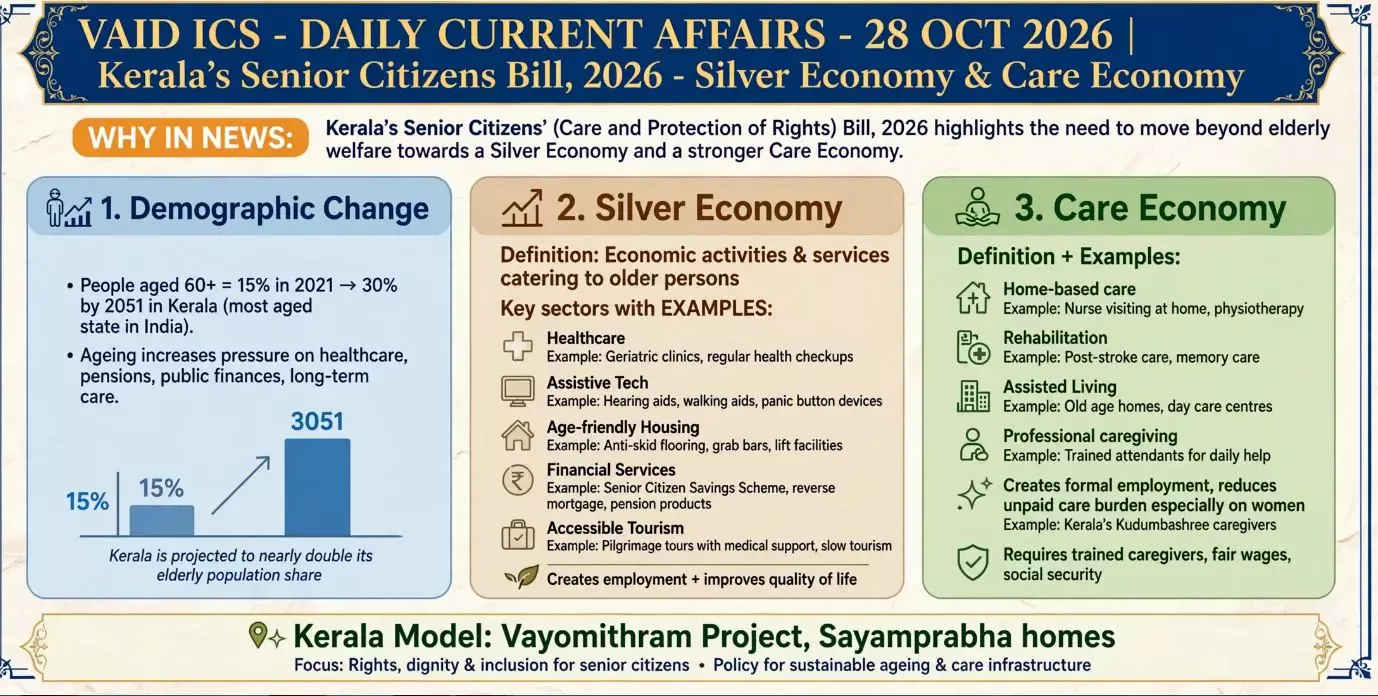
1. Demographic Transition in Kerala:
-
Ageing Population: People aged 60 years and above constituted approximately 15% of Kerala’s population in 2021.
-
Future Projection: Their share is projected to reach 30% by 2051, according to the International Institute of Migration and Development.
-
Increasing Life Expectancy: Longer life expectancy reflects improvements in healthcare, nutrition and living conditions.
-
Emerging Challenges: An ageing population increases pressure on pensions, public expenditure, healthcare infrastructure and long-term care services.
-
Changing Dependency Structure: A relatively smaller working-age population may have to support a growing number of older people, increasing the importance of productivity and social protection.
Key Insight: Population ageing is not merely a welfare challenge; it also creates opportunities for economic growth, employment generation and the development of specialised services.
2. Keralam Senior Citizens’ (Care and Protection of Rights) Bill, 2026:
Status: According to the provided material, the Bill was unanimously passed by the Kerala Legislative Assembly.
Key Provisions:
-
Care Infrastructure: Regulation of care centres and caregivers, promotion of home-based care and improvement of accessibility in public spaces.
-
Protection of Rights: Safeguards against abuse, neglect and exploitation of senior citizens.
-
Ageing at Home: Encourages older people to remain in their own homes and communities while receiving appropriate care and support.
-
Living Wills: Recognises the importance of advance healthcare planning and individual autonomy, subject to the applicable legal framework.
-
Legal Assistance: Facilitates access to legal support for older persons.
-
Digital Inclusion: Promotes digital literacy and access to digital services.
-
Assistive Products: Encourages access to devices and technologies that support independent living.
-
Economic Participation: Promotes opportunities for older persons to engage in income-generating activities.
-
State Reserve Fund: Proposes a dedicated fund to support care and welfare initiatives.
Significance: The proposed legislation seeks to move beyond a narrow welfare-based approach towards a rights-based, accessible and person-centred system of elderly care.
3. Silver Economy and Care Economy:
Silver Economy:
The Silver Economy refers to the economic activities, goods and services associated with the needs, preferences and participation of older people.
Major Components:
-
Healthcare Services: Geriatric care, preventive healthcare and specialised medical services.
-
Assistive Technology: Mobility aids, hearing devices, remote health monitoring and other technologies that support independent living.
-
Age-Friendly Housing: Accessible homes, assisted-living facilities and barrier-free residential infrastructure.
-
Financial Services: Pension planning, insurance and financial products suited to the needs of older people.
-
Lifelong Learning: Educational programmes and opportunities for continued personal and professional development.
-
Tourism and Recreation: Accessible tourism, cultural activities and age-friendly recreational services.
Importance: The Silver Economy can transform population ageing into an opportunity for innovation, entrepreneurship, investment and employment generation.
Care Economy:
The Care Economy includes paid and unpaid activities involved in providing care to individuals, including older persons, children and people requiring additional support.
Major Components:
-
Home-Based Care: Assistance with daily activities in an individual’s home.
-
Physiotherapy and Rehabilitation: Services that improve mobility, recovery and functional independence.
-
Assisted Living: Residential facilities providing varying levels of personal care and support.
-
Community-Based Care: Local support networks, day-care centres and community health services.
-
Professional Caregiving: Trained caregivers providing personal assistance and health-related support.
Importance: Developing the Care Economy can create formal employment opportunities, improve the quality of care and reduce the burden on family members, particularly women who often perform unpaid care work.
Silver Economy vs Care Economy:
-
Silver Economy: Focuses on the wider economic opportunities arising from the needs, consumption and participation of older people.
-
Care Economy: Focuses on the provision of care services and the workforce, institutions and infrastructure required to deliver them.
Both are interconnected and can contribute to inclusive growth and dignified ageing.
4. From Passive Welfare to Active and Dignified Ageing:
-
Traditional Welfare Approach: Primarily focuses on pensions, financial assistance and social security.
-
Proposed Approach: Retains essential welfare support while enabling older people to participate in economic, social and community life.
-
Voluntary Participation: Older persons should have the opportunity to continue working, learning or contributing to society if they wish to do so.
-
Economic Independence: Suitable employment and income-generating opportunities can reduce financial dependence.
-
Social Inclusion: Community participation can help reduce isolation and strengthen social relationships.
-
Individual Autonomy: Policies should respect the choices, preferences and dignity of older persons.
Key Principle: Active ageing must remain a voluntary choice, not an obligation imposed on senior citizens.
5. Employment Generation and Caregiver Professionalisation:
The expansion of elderly care services can create employment opportunities for younger workers.
-
New Employment Opportunities: Home healthcare, physiotherapy, assisted living, rehabilitation and care management can generate jobs.
-
Skill Development: Training programmes can equip workers with specialised caregiving and geriatric-care skills.
-
Certification Framework: A recognised system of caregiver training and certification can improve service quality.
-
Fair Wages: Care workers should receive appropriate remuneration for their work.
-
Social Security: Formal employment should include suitable social protection and safeguards for workers.
-
Improved Working Conditions: Regulation can reduce exploitation and promote professional standards.
Key Challenge: Care work is frequently undervalued and informal. Professionalisation must therefore improve both the quality of care and the dignity of care workers.
6. Harnessing Intergenerational Knowledge:
Kerala has a substantial pool of retired professionals, including teachers, nurses, engineers, administrators, artisans and entrepreneurs.
Their knowledge and experience can be used for wider social and economic development.
Possible Measures:
-
Mentorship Programmes: Retired professionals can guide young people in education, employment and career development.
-
Vocational Training: Experienced workers can transfer practical and technical skills to younger generations.
-
Entrepreneurship Support: Retired entrepreneurs can advise emerging business owners and start-ups.
-
Community Development: Experienced professionals can contribute to local planning and community initiatives.
-
University Partnerships: Educational institutions can connect retired experts with students and researchers.
-
Knowledge Preservation: Traditional skills, professional experience and local knowledge can be passed on to younger generations.
Significance: Older people should be recognised not only as recipients of care but also as valuable holders of human capital, skills and social knowledge.
7. Role of Local Governance and Funding:
Role of Panchayats and Municipalities:
Local governments can play a central role in implementing elderly-friendly policies because they understand local needs and vulnerabilities.
-
Senior Citizens’ Sub-Plans: Prepare dedicated plans with predictable funding for elderly welfare and care.
-
Local Needs Assessment: Identify healthcare requirements, mobility barriers, financial vulnerabilities and care needs.
-
Accessible Infrastructure: Develop barrier-free public spaces, accessible transport and age-friendly community facilities.
-
Community Support: Strengthen local care networks and services for older persons living alone or requiring assistance.
-
Skill Mapping: Identify the professional experience and skills of retired residents for community engagement.
Role of the State Government:
-
Service Standards: Establish minimum quality and safety standards for care centres and caregiving services.
-
Technical Support: Provide training, resources and guidance to local governments.
-
Monitoring: Evaluate the implementation and effectiveness of elderly-care programmes.
-
Institutional Coordination: Improve coordination among healthcare institutions, local governments and social welfare departments.
Funding Framework:
-
State Reserve Fund: The proposed fund could support elderly-care infrastructure and welfare initiatives.
-
Predictable Budgetary Support: Regular government funding remains necessary to ensure continuity of services.
-
Complementary Financing: The reserve fund should supplement, not replace, regular budgetary allocations.
-
Accountability: Transparent expenditure, monitoring and outcome-based evaluation should guide the use of funds.
8. Major Challenges:
-
Fiscal Pressure: Rising expenditure on pensions, healthcare and long-term care can strain public finances.
-
Care Workforce Shortage: An inadequate supply of trained caregivers may reduce service availability and quality.
-
Unequal Access: Poor, rural and socially vulnerable older persons may face greater barriers to care.
-
Digital Exclusion: Limited digital literacy can prevent some senior citizens from accessing essential services.
-
Family Care Burden: Changing family structures and migration can weaken traditional support systems.
-
Financial Insecurity: Inadequate pensions, limited savings and rising healthcare costs can increase vulnerability.
-
Underdeveloped Care Markets: Insufficient investment and uneven regulation may limit the availability of affordable, reliable care services.
-
Social Isolation: Older persons living alone may experience loneliness, neglect and reduced community participation.
9. Way Forward:
-
Rights-Based Policy: Ensure that elderly-care policies protect dignity, autonomy, equality and freedom from abuse.
-
Universal Access to Essential Care: Strengthen affordable healthcare, rehabilitation and long-term care services.
-
Investment in the Silver Economy: Encourage responsible innovation and investment in age-friendly products, housing and services.
-
Professional Caregiving: Establish training, certification, fair wages and social security for caregivers.
-
Age-Friendly Cities and Villages: Improve public transport, buildings, public spaces and digital accessibility.
-
Intergenerational Engagement: Connect older people with educational institutions, community organisations and young entrepreneurs.
-
Sustainable Financing: Combine predictable public expenditure with transparent and accountable funding mechanisms.
-
Evidence-Based Planning: Use demographic data and local assessments to identify emerging care needs.
-
Respect for Choice: Enable older persons to remain economically and socially active without making productivity a condition for dignity or support.
Conclusion:
Kerala’s demographic transition requires a shift from an exclusively welfare-oriented approach towards an integrated model combining social protection, the Silver Economy and the Care Economy. While pensions and public assistance remain essential, investment in professional caregiving, age-friendly infrastructure, intergenerational knowledge and local governance can turn population ageing into an opportunity for inclusive economic growth, employment generation and dignified ageing.
The ultimate objective should be to ensure that every older person can live with dignity, security, independence and meaningful social participation

May 19, 2026
October 17, 2025
October 16, 2025
October 6, 2025

