October 22, 2026
UNO REFORM
Why in news?
The United Nations (UN) celebrates its 81st anniversary (UN Day) amidst a precarious crossroads characterized by Security Council deadlocks, global conflicts, and funding cuts under the second Trump administration. Despite severe structural challenges and growing cynicism, the Organization remains an indispensable pillar of international law, global governance, and multilateral diplomacy.
Key Achievements & Legacy of the UN:
-
Humanitarian & Public Health Successes:
-
Child Mortality: Joint campaigns by UNICEF and WHO nearly halved global child mortality, reducing it from 12 million in 1990 to 6.9 million by 2011.
-
Eradication Efforts: Brought polio to the brink of global eradication and led coordinated responses to public health crises such as Ebola and COVID-19.
-
Refugee Assistance: UNHCR assists over 35 million displaced people annually, while the World Food Programme (WFP) delivers vital food relief during catastrophic disasters.
-
-
Development & Environmental Frameworks:
-
MDGs & SDGs: The Millennium Development Goals (2000–2015) halved extreme poverty worldwide, expanded primary education, and laid the groundwork for the 2015–2030 Sustainable Development Goals (SDGs).
-
Environmental Treaties: UN-brokered legal instruments, including the Montreal Protocol (phased out 99% of ozone-depleting chlorofluorocarbons), the Kyoto Protocol, and the Paris Agreement, defined modern global environmental governance.
-
Social Policy: Advanced women’s rights (Beijing Conference) and established global migration frameworks (2018 Global Compact for Migration).
-
-
Peacebuilding & Crisis Management:
-
Brokered roughly 170 peace settlements, defusing major geopolitical flashpoints (e.g., Cuban Missile Crisis, Iran-Iraq War).
-
Assisted in stabilizing nations transitioning to freedom, such as Namibia, East Timor, and Mozambique.
-
Current Challenges & Structural Deficits:
-
UNSC Anachronism & Crisis of Legitimacy:
-
1945 vs. Present Realities: The United Nations Security Council (UNSC) permanent composition reflects the geopolitical landscape of 1945 rather than contemporary global power dynamics.
-
Representational Deficit: Billions of people and key economic powerhouses/emerging regions remain without permanent representation, eroding faith in international law.
-
-
Veto Power Abuse & Gridlock:
-
Permanent members frequently use the threat or exercise of the veto to shield themselves or allies from accountability during humanitarian catastrophes, wars, and sovereignty violations (e.g., Ukraine, Gaza, Libya, Yemen).
-
Gridlock has led countries to bypass the UN in favor of mini-lateral groupings, smaller self-selected coalitions, or ad-hoc regional forums (e.g., G20).
-
-
Limitations of Alternative Forums:
-
Mini-lateral blocs and regional forums lack the universal membership, legal authority, and moral mandate required to dispatch peacekeepers or issue binding international decisions.
-
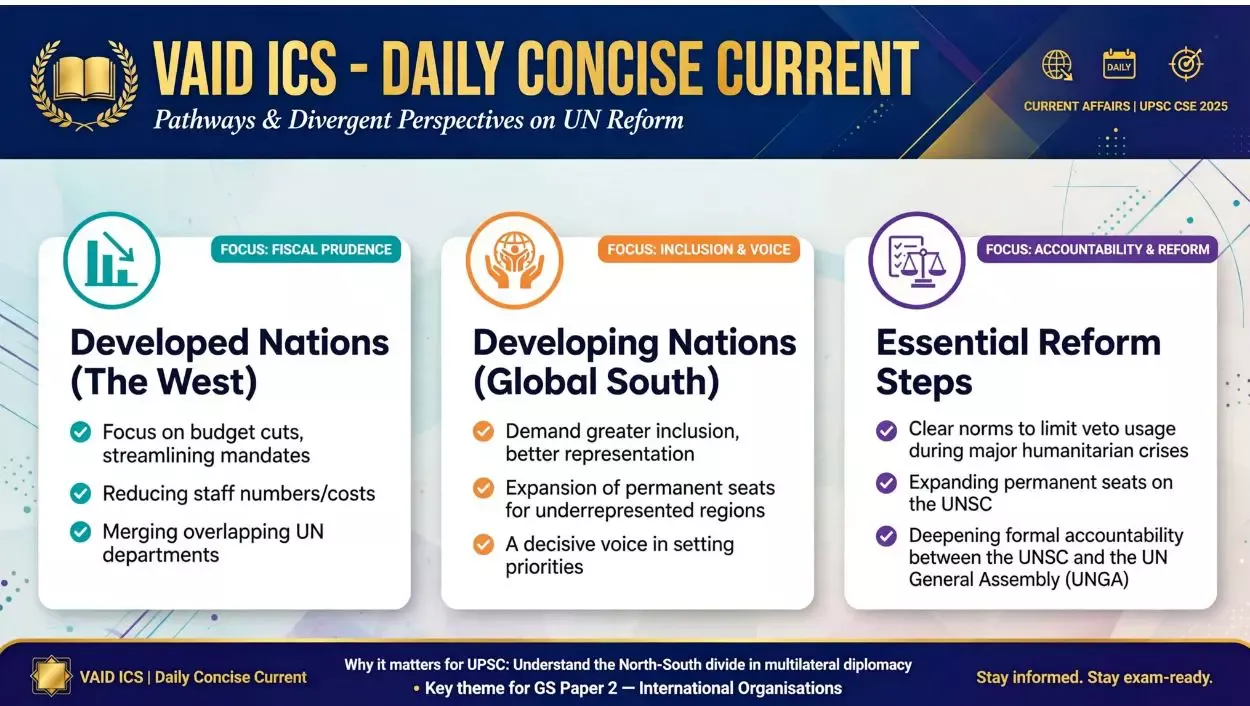
Pathways & Divergent Perspectives on UN Reform:
| Perspective / Aspect | Key Priorities & Standpoints |
| Developed Nations (The West) |
Focus on budget cuts, streamlining mandates, reducing staff numbers/costs, and merging overlapping UN departments. |
| Developing Nations (Global South) |
Demand greater inclusion, better representation, expansion of permanent seats for underrepresented regions, and a decisive voice in setting priorities. |
| Essential Reform Steps |
* Clear norms to limit veto usage during major humanitarian crises. * Expanding permanent seats on the UNSC. * Deepening formal accountability between the UNSC and the UN General Assembly (UNGA). |
| The Prudential Boundary |
Pragmatic Reform: Reform must stop short of pushing the most powerful and influential states to walk away, as their exit would effectively end the UN. |
Potential Exam Relevance (GS Paper II):
-
Important International Institutions: Structure, mandate, and functioning of the United Nations and its specialized agencies.
-
Institutional Reforms: Imperative of UNSC reforms, veto dynamics, and Indian claims for permanent membership in a restructured Security Council.
-
Multilateralism: Challenges facing multilateral diplomacy in a multipolar world amidst rising unilateralism and regionalism.
Would you like model answers or practice questions for UPSC Main Exam (GS Paper II) based on this topic?

May 19, 2026
October 17, 2025
October 16, 2025
October 6, 2025

