October 13, 2026
Climate Change and Disasters in the Indian Himalayan Region (IHR)
Why in News?
Reports published by the International Centre for Integrated Mountain Development (ICIMOD) in March 2026 highlighted an alarming acceleration in glacial ice loss across the Hindu Kush Himalaya (HKH) region. This rapid cryospheric degradation significantly escalates the frequency and severity of glacier-related disasters in the Indian Himalayan Region (IHR).
Key Facts
-
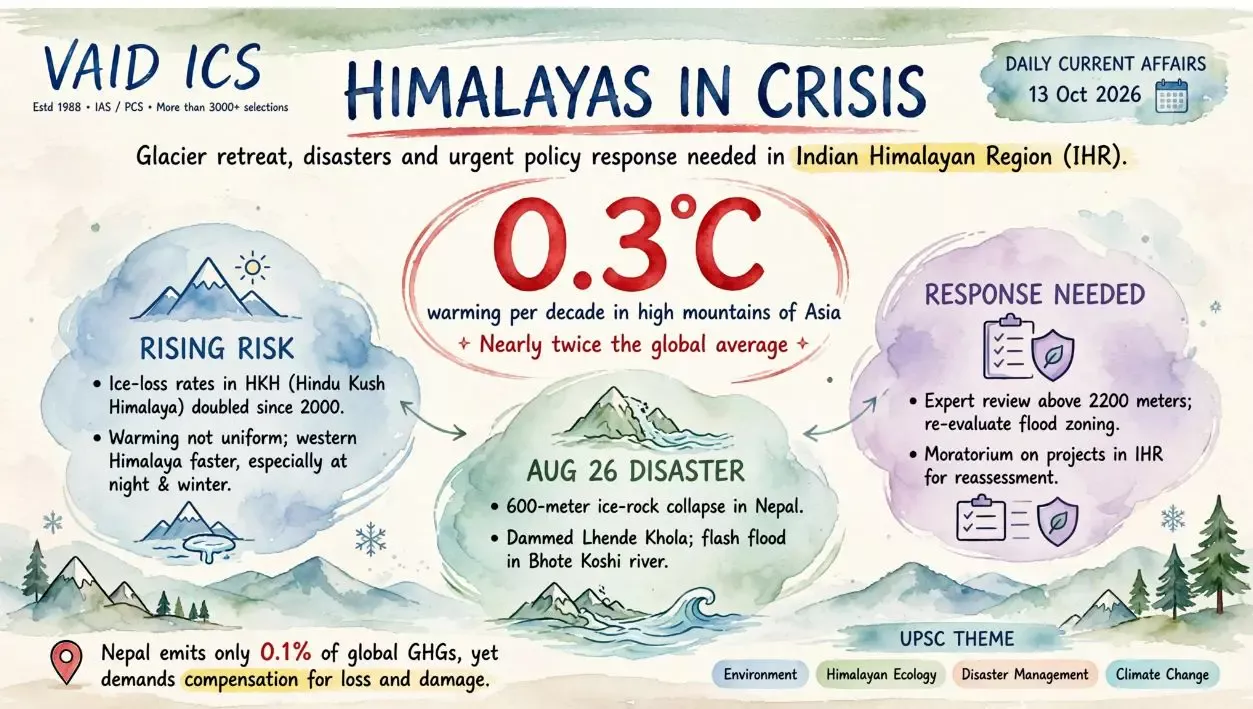
Rapid Warming Rate: High-altitude mountain zones in Asia are warming at approximately 0.3°C per decade, nearly twice the global average rate.
-
Accelerated Ice Loss: The rate of glacial ice loss across the HKH region has doubled since the year 2000.
-
Regional Thermal Disparities: The Western Himalaya exhibits accelerated warming trends, particularly during winter seasons and nighttime hours.
-
Extreme Downstream Disasters: In August 2026, an ice and rock collapse triggered a sudden flash flood in Nepal after debris choked the Lhende Khola (a tributary of the Bhote Koshi River).
-
Climate Justice Concerns: Nations like Nepal contribute barely 0.1% of global greenhouse gas (GHG) emissions but face disproportionate climate vulnerabilities, prompting demands for Loss and Damage funding.
Why is the Himalaya Vulnerable?
-
Glacier Retreat: Soaring temperatures accelerate snow-melt and disrupt historical seasonal snow accumulation patterns.
-
Permafrost Thaw: Rising subsurface temperatures degrade mountain stability, increasing landslides, rockfalls, avalanches, and debris flows.
-
Glacial Lake Outburst Floods (GLOFs): Unstable moraine-dammed glacial lakes risk sudden breaches, unleashing catastrophic downstream deluge and siltation.
-
Unplanned Development: Indiscriminate construction of highways, hydropower dams, and urban infrastructure within fragile mountain slopes intensifies systemic risks.
-
Extreme Cloudbursts: Frequent short-duration, high-intensity rainfall events trigger high-velocity flash floods and mass mudslides.
Major Challenges
-
Monitoring Deficits: Lack of continuous, real-time cryosphere monitoring for high-altitude glaciers and unstable slopes.
-
Early Warning Gaps: Absence of fully integrated Early Warning Systems (EWS) and limited transboundary hydrometeorological data sharing.
-
Fragile Infrastructure: Unregulated infrastructure development in ecologically sensitive and hazard-prone terrains.
-
Planning Deficits: Inadequate climate-resilient engineering standards and poor implementation of land-use zoning laws.
Measures Needed
-
Transboundary Cooperation: Establish seamless regional data-sharing frameworks for real-time climate, river discharge, and hydrological tracking.
-
High-Altitude Tech Deployment: Utilize satellites, drones (UAVs), and ground sensors to track remote glacial dynamics continuously.
-
GLOF Mitigation: Regularly audit high-risk glacial lakes and implement controlled siphoning/drainage channels.
-
Hazard-Informed Zoning: Re-align flood-risk zoning protocols based on valley slope topographies and localized disaster vulnerability.
-
Environmental Appraisals: Subject all large-scale power and connectivity projects to stringent Cumulative Environmental Impact Assessments (CEIA).
-
Ecological Re-assessments: Re-evaluate infrastructure proposals in ultra-fragile belts (such as the proposed Chenab–Beas river-linking project) before execution.
-
Resilience & Climate Finance: Fortify disaster response infrastructure and secure multilateral climate adaptation finance for vulnerable mountain populations.
Conclusion
Securing the Indian Himalayan Region demands a transition from uncontrolled infrastructure expansion to ecosystem-based, climate-resilient, and hazard-conscious spatial planning. Robust scientific tracking, regional cooperation, and enforced environmental safeguards are indispensable to protecting mountain ecology and millions living in downstream river basins.

May 19, 2026
October 17, 2025
October 16, 2025
October 6, 2025

