October 12, 2026
Nobel Peace Prize 2026:/ नोबेल शांति पुरस्कार 2026:
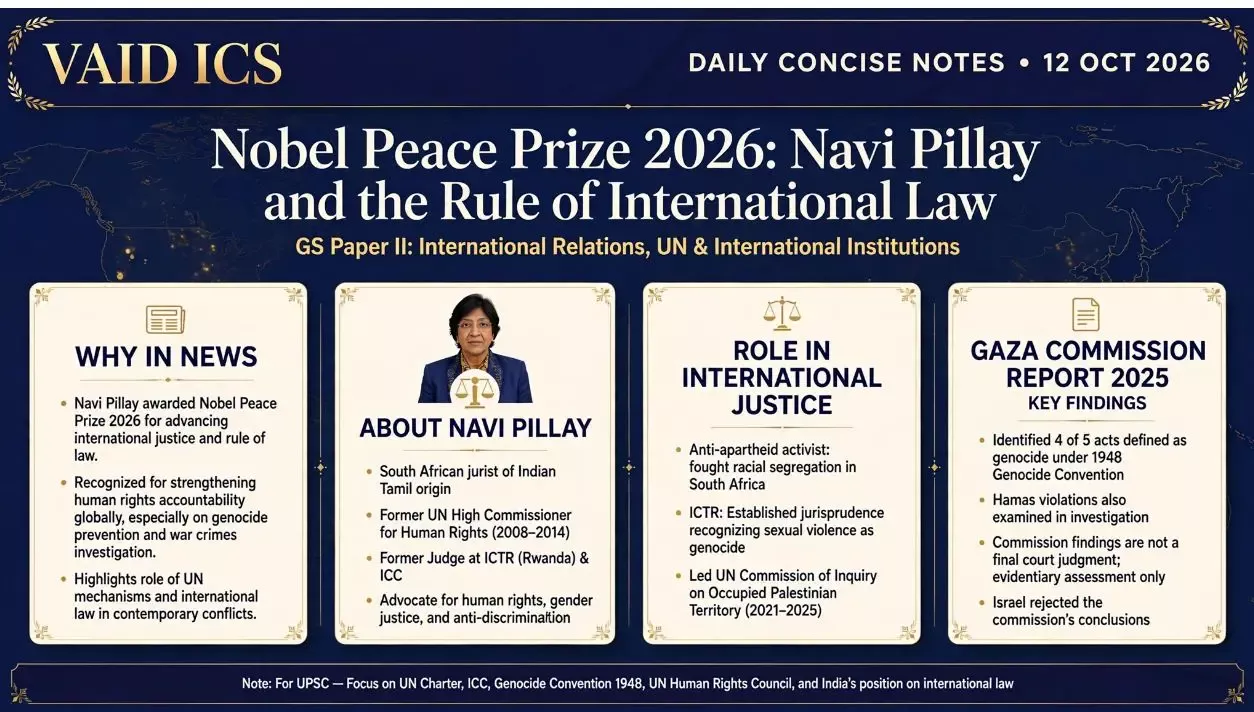
Nobel Peace Prize 2026:
GS Paper II: International Relations, United Nations and International Institutions
GS Paper IV: Ethics, Justice and Accountability
Why in News?:
The Nobel Peace Prize 2026 has been associated in the provided material with Navi Pillay’s efforts to uphold international law, human rights, and accountability amid global conflicts.
About Navi Pillay:
-
A South African jurist of Indian Tamil origin, known for her work in human rights and international justice.
-
Served as a judge of the International Criminal Tribunal for Rwanda (ICTR) and the International Criminal Court (ICC).
-
Served as UN High Commissioner for Human Rights.
-
Her career highlights the importance of judicial independence, human dignity, and accountability under international law.
Role in International Justice:
-
Anti-Apartheid Movement: Defended activists opposing racial discrimination in South Africa.
-
ICTR Jurisprudence: As a judge and president, contributed to landmark jurisprudence recognizing sexual violence as a possible act of genocide.
-
UN Commission of Inquiry: Chaired the commission investigating alleged violations in the Occupied Palestinian Territory, including East Jerusalem, and Israel, from 2021 to 2025.
Gaza Commission Report, 2025:
-
The commission’s September 2025 report concluded that Israeli authorities and security forces committed four of the five acts defined as genocide under the 1948 Genocide Convention.
-
The report also examined violations of international humanitarian law by Hamas during and after the 7 October 2023 attacks.
-
These are findings of a UN Commission of Inquiry; they should be distinguished from final judgments by a competent international court. Israel has rejected the commission’s conclusions.
Key Concepts:
-
International Law: Rules governing relations among states and other international actors.
-
Genocide: Specified acts committed with intent to destroy, in whole or in part, a national, ethnic, racial, or religious group.
-
War Crimes: Serious violations of international humanitarian law that entail individual criminal responsibility.
-
International Humanitarian Law (IHL): Rules protecting civilians and non-combatants while restricting the means and methods of warfare.
-
Rule of Law: The principle that everyone, including governments and state officials, is subject to law.
Significance of the Award:
-
Accountability: Reinforces efforts to investigate and prosecute international crimes.
-
Human Rights: Emphasizes human dignity and protection against discrimination and atrocities.
-
Global Governance: Highlights the importance of independent international judicial institutions.
-
Peace and Justice: Underscores that lasting peace requires justice, legal accountability, and peaceful dispute resolution.
Challenges:
-
Selective enforcement of international law.
-
Political pressure on international courts and institutions.
-
Limited enforcement mechanisms and lack of state cooperation.
-
Difficulty in securing accountability during ongoing conflicts.
Way Forward:
-
Strengthen cooperation with international courts and investigative bodies.
-
Ensure impartial investigation of alleged violations by all parties.
-
Protect judicial independence and uphold due process.
-
Improve enforcement of international humanitarian law and protection of civilians.
Conclusion:
Navi Pillay’s recognition highlights the relationship between international law, human rights, accountability, and peace. A rules-based international order requires consistent application of legal principles, irrespective of political power, and credible mechanisms to deliver justice to victims.
नोबेल शांति पुरस्कार 2026:
जीएस प्रश्नपत्र II: अंतर्राष्ट्रीय संबंध, संयुक्त राष्ट्र और अंतर्राष्ट्रीय संस्थान
जीएस प्रश्नपत्र IV: नीतिशास्त्र, न्याय और जवाबदेही
चर्चा में क्यों?:
प्रदत्त सामग्री में नोबेल शांति पुरस्कार 2026 को नवी पिल्ले द्वारा वैश्विक संघर्षों के बीच अंतर्राष्ट्रीय कानून, मानवाधिकारों और जवाबदेही को बनाए रखने के प्रयासों से जोड़ा गया है।
नवी पिल्ले के बारे में:
-
भारतीय तमिल मूल की एक दक्षिण अफ़्रीकी न्यायविद, जो मानवाधिकारों और अंतर्राष्ट्रीय न्याय के क्षेत्र में अपने कार्यों के लिए जानी जाती हैं।
-
रवांडा के लिए अंतर्राष्ट्रीय आपराधिक न्यायाधिकरण (ICTR) और अंतर्राष्ट्रीय आपराधिक न्यायालय (ICC) की न्यायाधीश के रूप में कार्य किया।
-
मानवाधिकार उच्चायुक्त (UN High Commissioner for Human Rights) के रूप में सेवा दी।
-
उनका करियर अंतर्राष्ट्रीय कानून के तहत न्यायिक स्वतंत्रता, मानवीय गरिमा और जवाबदेही के महत्व को रेखांकित करता है।
अंतर्राष्ट्रीय न्याय में भूमिका:
-
रंगभेद विरोधी आंदोलन: दक्षिण अफ्रीका में नस्लीय भेदभाव का विरोध करने वाले कार्यकर्ताओं का बचाव किया।
-
ICTR का निर्णय: न्यायाधीश और अध्यक्ष के रूप में, यौन हिंसा को नरसंहार के संभावित कृत्य के रूप में मान्यता देने वाले ऐतिहासिक निर्णयों में योगदान दिया।
-
संयुक्त राष्ट्र जांच आयोग: 2021 से 2025 तक पूर्वी यरूशलेम सहित पूर्वी फ़िलिस्तीनी क्षेत्र और इजराइल में कथित उल्लंघनों की जांच करने वाले आयोग की अध्यक्षता की।
गाजा आयोग रिपोर्ट, 2025:
-
आयोग की सितंबर 2025 की रिपोर्ट ने निष्कर्ष निकाला कि इजराइली अधिकारियों और सुरक्षा बलों ने 1948 के नरसंहार सम्मेलन (Genocide Convention) के तहत परिभाषित पांच कृत्यों में से चार कृत्यों को अंजाम दिया।
-
रिपोर्ट में 7 अक्टूबर 2023 के हमलों के दौरान और उसके बाद हमास द्वारा किए गए अंतर्राष्ट्रीय मानवीय कानून के उल्लंघनों की भी जांच की गई।
-
ये संयुक्त राष्ट्र जांच आयोग के निष्कर्ष हैं; इन्हें किसी सक्षम अंतर्राष्ट्रीय अदालत के अंतिम फैसलों से अलग समझा जाना चाहिए। इजराइल ने आयोग के निष्कर्षों को खारिज कर दिया है।
प्रमुख अवधारणाएं:
-
अंतर्राष्ट्रीय कानून: राज्यों और अन्य अंतर्राष्ट्रीय संस्थाओं के बीच संबंधों को संचालित करने वाले नियम।
-
नरसंहार (Genocide): किसी राष्ट्रीय, जातीय, नस्लीय या धार्मिक समूह को पूरी तरह या आंशिक रूप से नष्ट करने के इरादे से किए गए निर्दिष्ट कृत्य।
-
युद्ध अपराध (War Crimes): अंतर्राष्ट्रीय मानवीय कानून के गंभीर उल्लंघन जो व्यक्तिगत आपराधिक जिम्मेदारी तय करते हैं।
-
अंतर्राष्ट्रीय मानवीय कानून (IHL): नागरिकों और गैर-लड़ाकों की सुरक्षा करने वाले तथा युद्ध के साधनों और तरीकों को सीमित करने वाले नियम।
-
कानून का शासन (Rule of Law): यह सिद्धांत कि सरकार और राज्य के अधिकारियों सहित प्रत्येक व्यक्ति कानून के अधीन है।
पुरस्कार का महत्व:
-
जवाबदेही: अंतर्राष्ट्रीय अपराधों की जांच और मुकदमा चलाने के प्रयासों को सुदृढ़ करता है।
-
मानवाधिकार: मानवीय गरिमा और भेदभाव एवं अत्याचारों के खिलाफ सुरक्षा पर बल देता है।
-
वैश्विक शासन: स्वतंत्र अंतर्राष्ट्रीय न्यायिक संस्थानों के महत्व को रेखांकित करता है।
-
शांति और न्याय: इस बात पर जोर देता है कि स्थायी शांति के लिए न्याय, कानूनी जवाबदेही और शांतिपूर्ण विवाद समाधान आवश्यक हैं।
चुनौतियां:
-
अंतर्राष्ट्रीय कानून का चयनात्मक प्रवर्तन (Selective Enforcement)।
-
अंतर्राष्ट्रीय अदालतों और संस्थाओं पर राजनीतिक दबाव।
-
सीमित प्रवर्तन तंत्र और राज्य सहयोग की कमी।
-
जारी संघर्षों के दौरान जवाबदेही सुनिश्चित करने में कठिनाई।
आगे की राह:
-
अंतर्राष्ट्रीय अदालतों और जांच निकायों के साथ सहयोग मजबूत करना।
-
सभी पक्षों द्वारा किए गए कथित उल्लंघनों की निष्पक्ष जांच सुनिश्चित करना।
-
न्यायिक स्वतंत्रता की रक्षा करना और उचित कानूनी प्रक्रिया (Due Process) को बनाए रखना।
-
अंतर्राष्ट्रीय मानवीय कानून के प्रवर्तन और नागरिकों की सुरक्षा में सुधार करना।
निष्कर्ष:
नवी पिल्ले की यह मान्यता अंतर्राष्ट्रीय कानून, मानवाधिकार, जवाबदेही और शांति के बीच संबंध को उजागर करती है। राजनीतिक शक्ति की परवाह किए बिना कानूनी सिद्धांतों के निरंतर अनुप्रयोग और पीड़ितों को न्याय दिलाने के लिए विश्वसनीय तंत्रों की आवश्यकता एक नियम-आधारित अंतर्राष्ट्रीय व्यवस्था के लिए अनिवार्य है।

May 19, 2026
October 17, 2025
October 16, 2025
October 6, 2025

