September 28, 2026
Election Commission of India: Appointment, Independence & Removal/भारत निर्वाचन आयोग: नियुक्ति, स्वतंत्रता एवं पद से हटाना
Why in News?
On 23 September 2026, Opposition parties sought the removal of Chief Election Commissioner (CEC) Gyanesh Kumar following an Indian Express investigation that reported 14 formal objections recorded by Election Commissioners Sukhbir Singh Sandhu and Vivek Joshi over the preceding 10 months.
The development has renewed debate over the independence, appointment and accountability of the Election Commission of India (ECI).
Constitutional Basis: Article 324
Article 324 vests the superintendence, direction and control of elections in the Election Commission of India.
-
Article 324(2): The President appoints the CEC and other Election Commissioners, subject to any law made by Parliament.
-
Article 324(5): Provides special safeguards regarding the conditions of service and removal of the CEC and Election Commissioners.
Appointment Before 2023: Executive-Dominated System
For several decades, Parliament had not enacted a specific law governing appointments to the ECI.
-
Appointments were effectively made by the executive under Article 324(2).
-
This raised concerns regarding the institutional independence of the ECI.
-
The issue reached the Supreme Court in Anoop Baranwal v. Union of India.
Anoop Baranwal Case: 2023
A five-judge Constitution Bench of the Supreme Court delivered its judgment in March 2023.
Supreme Court’s Interim Arrangement:
Until Parliament enacted a law under Article 324(2), appointments were to be made on the recommendation of a three-member committee comprising:
-
Prime Minister
-
Leader of Opposition in Lok Sabha
-
Chief Justice of India
The Court clarified that this arrangement would operate only until Parliament enacted a law on appointments.
2023 Act: New Appointment Mechanism
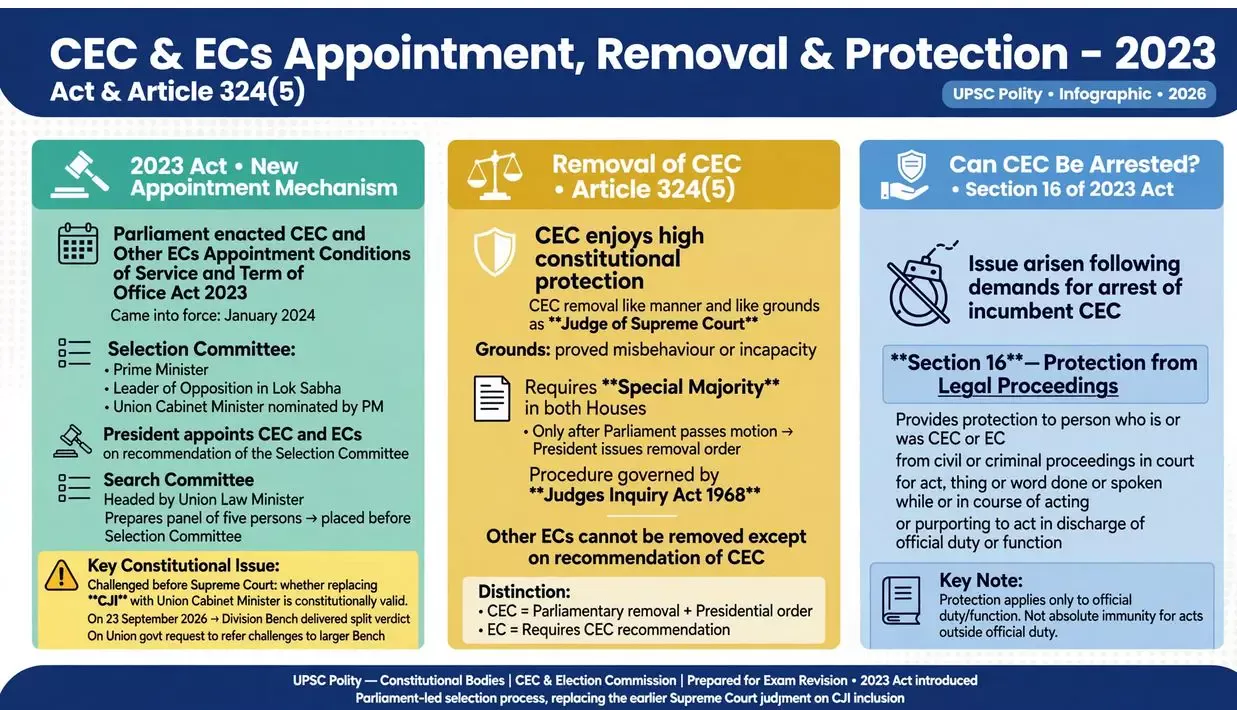
Parliament enacted the Chief Election Commissioner and Other Election Commissioners (Appointment, Conditions of Service and Term of Office) Act, 2023, which came into force in January 2024.
Selection Committee:
-
Prime Minister
-
Leader of Opposition in Lok Sabha
-
Union Cabinet Minister nominated by the Prime Minister
The President appoints the CEC and ECs on the recommendation of this committee.
Search Committee:
-
Headed by the Union Law Minister
-
Prepares a panel of five persons
-
Panel is placed before the Selection Committee for consideration.
Key Constitutional Issue:
The 2023 Act has been challenged before the Supreme Court, including the question of whether replacing the CJI with a Union Cabinet Minister in the Selection Committee is constitutionally valid.
On 23 September 2026, a Division Bench delivered a split verdict on the Union government’s request to refer challenges to a larger Bench.
Removal of the CEC: Article 324(5)
The CEC enjoys a high degree of constitutional protection against removal.
CEC:
The CEC can be removed:
-
In like manner and on like grounds as a Judge of the Supreme Court
-
Grounds: proved misbehaviour or incapacity
-
Requires the prescribed special majority in both Houses of Parliament
-
Only after Parliament passes the removal motion can the President issue the removal order.
The procedure is governed by the Judges (Inquiry) Act, 1968.
Other Election Commissioners:
An Election Commissioner or Regional Commissioner cannot be removed except on the recommendation of the CEC.
Important distinction:
CEC → Parliamentary removal procedure + Presidential order
EC/Regional EC → Removal requires CEC’s recommendation
Can the CEC Be Arrested?
The issue has arisen following demands for the arrest of the incumbent CEC.
Section 16 of the 2023 Act:
It provides protection to a person who is or was a CEC or Election Commissioner from civil or criminal proceedings in court for an act, thing or word done or spoken while, or in the course of, acting or purporting to act in discharge of official duty or function.
Scope of Protection:
-
Applies to current as well as former CECs/ECs.
-
Protects specified conduct connected with official functions.
-
Section 16 does not expressly use the terms “arrest”, “investigation” or “police custody”.
-
Therefore, it should not automatically be characterised as a blanket immunity from arrest.
-
The protection is connected to conduct performed in the discharge or purported discharge of official duty.
Core Constitutional Issues:
Appointment: Executive role vs institutional independence
Selection Committee: PM + LoP + Cabinet Minister vs earlier PM + LoP + CJI model
Removal: Strong constitutional protection for the CEC
Accountability: Need to balance institutional independence with legal accountability
Section 16: Scope of protection for official acts
Election Commission of India: History & Major Controversies
Constitutional Origin:
The Election Commission of India (ECI) was established on 25 January 1950 under Article 324 of the Constitution.
-
It is a constitutional body responsible for supervising elections to Parliament, State Legislatures, and the offices of the President and Vice-President.
-
The first CEC was Sukumar Sen.
-
Initially, the ECI functioned as a single-member body.
Evolution of the Commission:
-
1950: ECI established as a single-member commission.
-
1989: Two Election Commissioners were appointed, making it a three-member body temporarily.
-
1990: It reverted to a single-member body.
-
1993: Two Election Commissioners were again appointed.
-
Since then, the ECI has generally functioned as a three-member body: CEC + two ECs.
Major Disputes & Institutional Milestones:
Appointment & Independence:
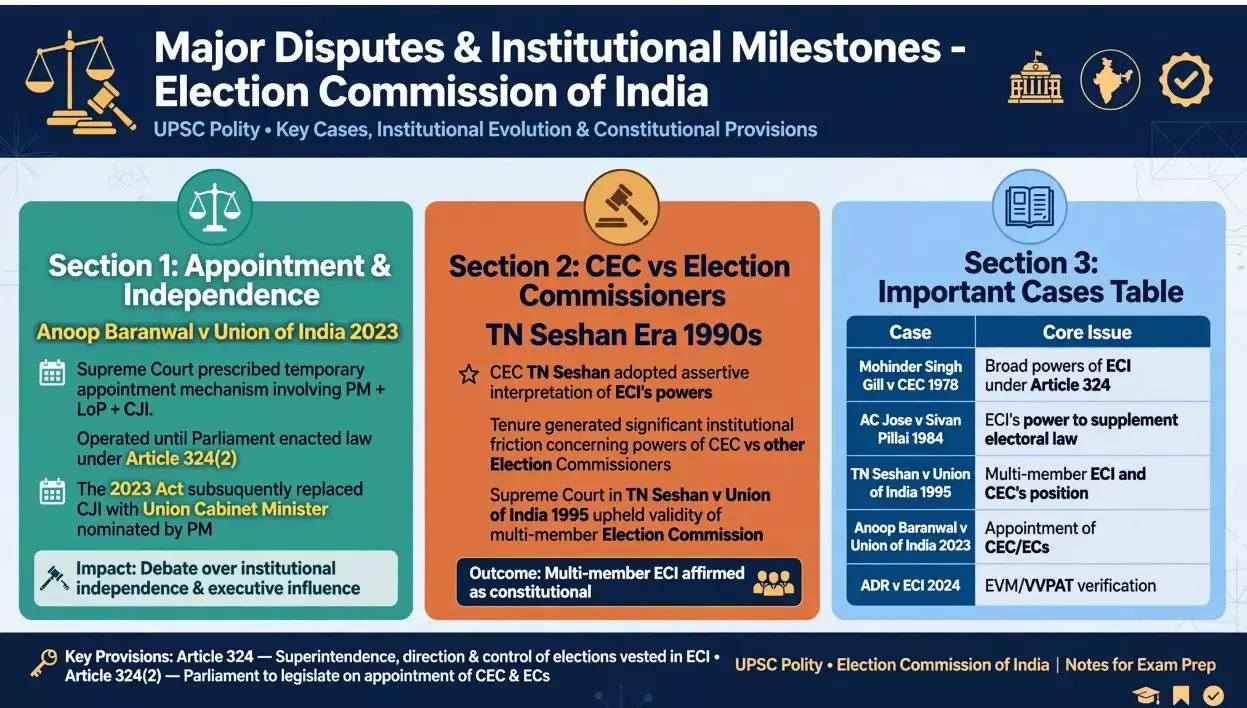
Anoop Baranwal v. Union of India, 2023
-
Supreme Court prescribed a temporary appointment mechanism involving:
PM + LoP + CJI -
It operated until Parliament enacted a law under Article 324(2).
-
The 2023 Act subsequently replaced the CJI with a Union Cabinet Minister nominated by the PM.
-
This has generated debate over institutional independence and executive influence.
CEC vs Election Commissioners:
T.N. Seshan Era, 1990s
-
CEC T.N. Seshan adopted an assertive interpretation of the ECI’s powers.
-
His tenure generated significant institutional friction concerning the powers of the CEC vis-à-vis other Election Commissioners.
-
The Supreme Court in T.N. Seshan v. Union of India (1995) upheld the validity of a multi-member Election Commission.
Election Expenditure & Model Code:
The ECI has repeatedly faced the challenge of enforcing:
-
Model Code of Conduct (MCC)
-
Election expenditure limits
-
Paid news
-
Hate speech and campaign violations
-
Use of government machinery during elections
A recurring institutional question is the extent to which the ECI can exercise effective regulatory power when several of its enforcement powers are not expressly codified as statutory offences.
Electoral Rolls & Voter Data:
Disputes have periodically arisen regarding:
-
Addition/deletion of names from electoral rolls
-
Electoral-roll revision
-
Transparency of voter data
-
Use of technology in electoral processes
These debates have intensified with the increasing use of digital electoral databases and electronic voting systems.
EVM & VVPAT Debate:
Electronic Voting Machines have been subject to repeated legal and political challenges concerning:
-
Reliability
-
Transparency
-
Verification
-
VVPAT counting
The Supreme Court in Association for Democratic Reforms v. Election Commission of India (2024) declined to order a return to ballot papers or 100% VVPAT verification, while issuing directions concerning preservation and verification procedures.
Appointment & Removal: Current Debate:
The present controversy concerns the independence and functioning of the ECI, including:
-
Composition of the appointment committee
-
Relationship between the CEC and other ECs
-
Internal decision-making
-
Removal safeguards
-
Legal protection for official acts
Important Cases for UPSC:
| Case | Core Issue |
|---|---|
| Mohinder Singh Gill v. CEC (1978) | Broad powers of ECI under Article 324 |
| A.C. Jose v. Sivan Pillai (1984) | ECI’s power to supplement electoral law |
| T.N. Seshan v. Union of India (1995) | Multi-member ECI and CEC’s position |
| Anoop Baranwal v. Union of India (2023) | Appointment of CEC/ECs |
| ADR v. ECI (2024) | EVM/VVPAT verification |

May 19, 2026
October 17, 2025
October 16, 2025
October 6, 2025

