Red Sanders Smuggling/लाल चंदन की तस्करी: आंध्र प्रदेश में कार्रवाई

Home   »  Red Sanders Smuggling/लाल चंदन की तस्करी: आंध्र प्रदेश में कार्रवाई

September 26, 2026

Red Sanders Smuggling/लाल चंदन की तस्करी: आंध्र प्रदेश में कार्रवाई

Why in News?

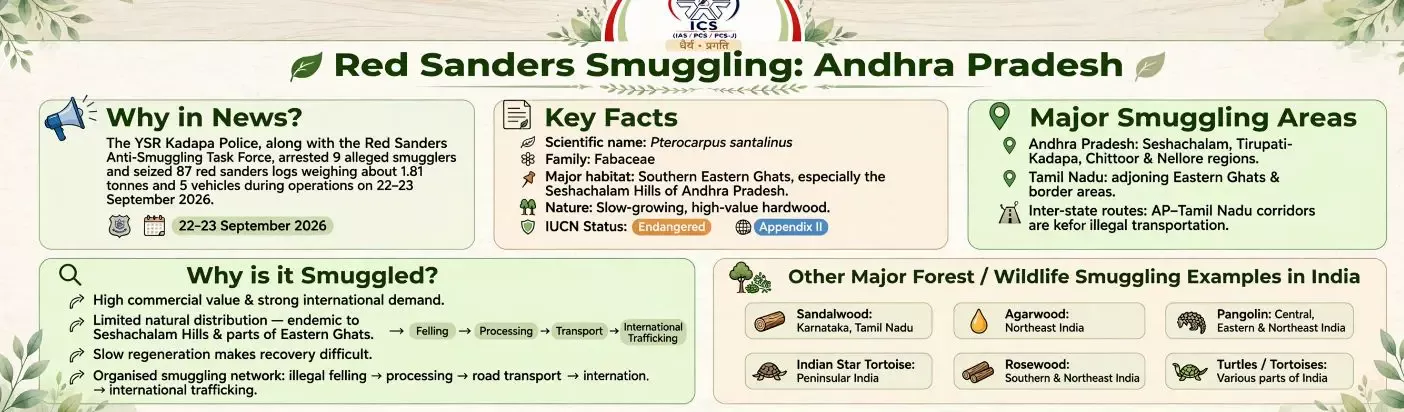
The YSR Kadapa District Police, in coordination with the Red Sanders Anti-Smuggling Task Force, arrested nine alleged red sanders smugglers in three separate operations and seized 87 red sanders logs weighing around 1.81 tonnes, along with five vehicles.

The operations were conducted on 22–23 September 2026 in the Mannur, Veeraballi and Khajipet police station areas.

Key Developments:

  • Mannur Operation:

    • Police intercepted a container near Akepadu Cross Road in Rajampet mandal.

    • 42 red sanders logs, weighing around 1,037 kg, were seized.

    • A container lorry and Maruti Suzuki XL6 were also seized.

    • Three suspects were allegedly found attempting to flee.

  • Veeraballi Operation:

    • Police intercepted persons allegedly loading red sanders logs near Konetivandlapalli.

    • 8 logs, weighing around 179 kg, were seized.

    • An Innova and two mobile phones were also recovered.

    • One person was arrested.

  • Khajipet Operation:

    • Police intercepted two vehicles near Chillakanuma on the Khajipet–Badvel road.

    • 37 logs, weighing around 574 kg, were seized.

    • A Bolero pickup and Suzuki Dzire were also seized.

    • Five suspects were apprehended.

Red Sanders: Key Facts:

  • Scientific name: Pterocarpus santalinus

  • Family: Fabaceae

  • Nature: A slow-growing, highly valuable hardwood tree.

  • It is particularly associated with the Eastern Ghats of Andhra Pradesh.

  • The wood is valued for its colour, density and special properties.

  • It has significant demand in international illegal timber markets.

Distribution and Habitat:

Red sanders has a restricted natural distribution in the southern Eastern Ghats, particularly in:

  • Andhra Pradesh: Major natural habitat, especially the Seshachalam and adjoining hill ranges.

  • Telangana: Occurs in some adjoining areas.

  • Tamil Nadu: Certain parts of the Eastern Ghats also support the species.

Why is Red Sanders Smuggled?

The species is targeted by illegal networks because of:

  • High commercial value of its heartwood.

  • International demand for specialised timber products.

  • Limited natural distribution.

  • Slow growth and restricted availability.

  • Illegal trade networks operating through forest extraction, transportation and cross-border trafficking.

Major Smuggling Routes/Regions:

Red-sanders smuggling is primarily associated with the Eastern Ghats, particularly Andhra Pradesh.

Important areas:

  • Seshachalam Hills: Major source region.

  • Tirupati–Kadapa belt: Important area for illegal extraction and transportation.

  • Chittoor region: Historically associated with red-sanders trafficking.

  • Kadapa region: Repeated cases of illegal felling and transportation.

  • Nellore and adjoining areas: Transit and seizure locations have also been reported.

  • Tamil Nadu–Andhra Pradesh border: Vulnerable to movement of illegally harvested timber.

International Dimension:

Illegal red-sanders trade has a transnational character:

Forest extraction → Local collection → Road transportation → Border/transit networks → International trafficking

Historically, smuggled red sanders has been linked to markets in parts of East and Southeast Asia, where the wood is used in specialised furniture, decorative products and traditional applications.

Legal and Conservation Status:

  • IUCN Red List: Endangered

  • CITES: Listed in Appendix II

  • India regulates its international trade through the CITES framework and domestic wildlife/forest laws.

  • Illegal felling, possession and transportation can attract stringent action under applicable laws.

Why is its Conservation Important?

  • Restricted geographical distribution makes the species particularly vulnerable.

  • Its slow growth means that natural populations cannot recover quickly after extensive extraction.

  • Illegal logging can cause forest degradation and biodiversity loss.

  • Smuggling networks can encourage organised exploitation of protected forest resources.

  • Conservation therefore requires both forest protection and disruption of illegal supply chains.

Government Measures:

  • Red Sanders Anti-Smuggling Task Force: Specialised enforcement mechanism in Andhra Pradesh.

  • Intelligence-based operations: Identification of suspected loading and transportation points.

  • Vehicle interception: Monitoring of road-based timber transportation.

  • Forest and police coordination: Joint action against illegal extraction and trafficking.

  • CITES-based regulation: International trade is subject to regulatory controls.

  • Strict penal action: Illegal felling, possession and transportation can result in prosecution under applicable laws.

Other Major Examples of Wildlife/Forest Smuggling in India:

Red Sanders: Andhra Pradesh and Eastern Ghats → illegal timber trade

Sandalwood: Karnataka, Tamil Nadu and other southern states → illegal felling and trafficking

Agarwood: Northeastern India → illegal extraction and international trade

Rosewood: Southern and northeastern regions → illegal timber trade

Turtles and tortoises: Several parts of India → illegal wildlife trade

Pangolin: Central, eastern and northeastern India → trafficking for scales and meat

Star tortoise: Peninsular India → illegal international pet trade

Mithun/other forest species: Northeast → illegal wildlife exploitation in specific areas

UPSC Relevance:

GS Paper III: Environment and Ecology | Biodiversity Conservation | Wildlife Crime | Forest Governance | Organised Illegal Trade

Prelims Focus:
Pterocarpus santalinus | Eastern Ghats | Seshachalam Hills | IUCN Status | CITES Appendix II | Red Sanders Anti-Smuggling Task Force

Mains Link:
“Discuss the ecological and governance challenges associated with illegal trade in high-value forest resources such as red sanders. Suggest measures to strengthen conservation and enforcement

लाल चंदन की तस्करी: आंध्र प्रदेश में कार्रवाई

क्यों चर्चा में?

वाई.एस.आर. कडपा जिला पुलिस ने लाल चंदन तस्करी-रोधी कार्यबल (Red Sanders Anti-Smuggling Task Force) के साथ समन्वय में तीन अलग-अलग अभियानों में नौ संदिग्ध तस्करों को गिरफ्तार किया। कार्रवाई के दौरान लगभग 1.81 टन वजन के 87 लाल चंदन के लट्ठे तथा अवैध परिवहन में प्रयुक्त पाँच वाहन जब्त किए गए।

ये अभियान 22–23 सितंबर 2026 को मन्नूर, वीरबल्लि और खाजिपेट थाना क्षेत्रों में चलाए गए।

प्रमुख कार्रवाई:

मन्नूर अभियान:

  • राजमपेट मंडल के अकेपाडु क्रॉस रोड के पास एक कंटेनर को रोका गया।

  • लगभग 1,037 किलोग्राम वजन के 42 लाल चंदन के लट्ठे बरामद किए गए।

  • एक कंटेनर लॉरी और मारुति सुजुकी XL6 जब्त की गई।

  • तीन संदिग्धों ने कथित रूप से भागने का प्रयास किया।

वीरबल्लि अभियान:

  • कोनेतिवंदलापल्ली के पास लाल चंदन के लट्ठों को वाहन में लादने का प्रयास कर रहे लोगों को पकड़ा गया।

  • लगभग 179 किलोग्राम वजन के 8 लट्ठे बरामद किए गए।

  • एक इननोवा वाहन और दो मोबाइल फोन जब्त किए गए।

  • एक व्यक्ति को गिरफ्तार किया गया।

खाजिपेट अभियान:

  • खाजिपेट-बडवेल मार्ग पर चिल्लाकनुमा के निकट दो वाहनों को रोका गया।

  • लगभग 574 किलोग्राम वजन के 37 लट्ठे जब्त किए गए।

  • एक बोलेरो पिकअप और सुजुकी डिजायर जब्त की गई।

  • पाँच संदिग्धों को पकड़ा गया।

लाल चंदन: प्रमुख तथ्य:

  • वैज्ञानिक नाम: Pterocarpus santalinus

  • कुल: फैबेसी (Fabaceae)

  • यह एक धीमी गति से बढ़ने वाली मूल्यवान कठोर लकड़ी की प्रजाति है।

  • इसका प्राकृतिक वितरण मुख्यतः दक्षिणी पूर्वी घाट में सीमित है।

  • आंध्र प्रदेश के शेषाचलम पर्वत क्षेत्र में इसके महत्वपूर्ण प्राकृतिक वन पाए जाते हैं।

  • इसकी लकड़ी अपने रंग, घनत्व और विशिष्ट गुणों के कारण मूल्यवान मानी जाती है।

वितरण एवं प्राकृतिक आवास:

लाल चंदन का प्राकृतिक वितरण मुख्यतः पूर्वी घाट के दक्षिणी भागों में पाया जाता है।

प्रमुख क्षेत्र:

  • आंध्र प्रदेश: प्रमुख प्राकृतिक क्षेत्र, विशेषकर शेषाचलम तथा आसपास की पर्वत श्रृंखलाएँ।

  • तेलंगाना: कुछ समीपवर्ती क्षेत्रों में इसका वितरण।

  • तमिलनाडु: पूर्वी घाट के कुछ क्षेत्रों में इसकी उपस्थिति।

लाल चंदन की तस्करी क्यों होती है?

  • इसकी उच्च वाणिज्यिक कीमत।

  • अंतरराष्ट्रीय बाजार में विशेष प्रकार की लकड़ी की मांग।

  • इसका सीमित प्राकृतिक वितरण।

  • धीमी वृद्धि के कारण इसकी प्राकृतिक उपलब्धता सीमित होना।

  • अवैध नेटवर्क द्वारा कटाई, संग्रहण, परिवहन और अंतरराष्ट्रीय तस्करी।

प्रमुख तस्करी क्षेत्र एवं मार्ग:

लाल चंदन की तस्करी मुख्यतः पूर्वी घाट क्षेत्र, विशेषकर आंध्र प्रदेश से जुड़ी हुई है।

  • शेषाचलम पहाड़ियाँ: प्रमुख स्रोत क्षेत्र।

  • तिरुपति–कडपा क्षेत्र: अवैध कटाई एवं परिवहन से जुड़े महत्वपूर्ण क्षेत्र।

  • चित्तूर क्षेत्र: लाल चंदन की तस्करी के मामलों के लिए जाना जाता है।

  • कडपा क्षेत्र: अवैध कटाई और परिवहन के मामले सामने आते रहे हैं।

  • नेल्लोर एवं आसपास के क्षेत्र: अवैध लकड़ी के परिवहन में पारगमन क्षेत्र के रूप में उपयोग।

  • आंध्र प्रदेश–तमिलनाडु सीमा: अवैध रूप से काटी गई लकड़ी की आवाजाही के लिए संवेदनशील क्षेत्र।

लाल चंदन तस्करी का अंतरराष्ट्रीय आयाम:

अवैध लाल चंदन व्यापार का अंतरराष्ट्रीय स्वरूप भी है।

वन क्षेत्र में अवैध कटाई → स्थानीय संग्रहण → सड़क मार्ग से परिवहन → पारगमन/सीमा नेटवर्क → अंतरराष्ट्रीय तस्करी

अवैध रूप से प्राप्त लाल चंदन की लकड़ी की मांग मुख्यतः पूर्वी एवं दक्षिण-पूर्वी एशिया के कुछ बाजारों में रही है।

कानूनी एवं संरक्षण स्थिति:

  • IUCN Red List: Endangered (संकटग्रस्त)

  • CITES: Appendix II

  • भारत में इसके अंतरराष्ट्रीय व्यापार को CITES व्यवस्था तथा घरेलू वन एवं वन्यजीव कानूनों के माध्यम से नियंत्रित किया जाता है।

  • अवैध कटाई, कब्जे और परिवहन पर लागू कानूनों के तहत दंडात्मक कार्रवाई की जा सकती है।

संरक्षण का महत्व:

  • इसका सीमित भौगोलिक वितरण इसे अत्यधिक संवेदनशील बनाता है।

  • धीमी वृद्धि के कारण अत्यधिक कटाई के बाद प्राकृतिक आबादी की पुनर्बहाली में लंबा समय लगता है।

  • अवैध कटाई से वन क्षरण और जैव विविधता की हानि हो सकती है।

  • संगठित तस्करी प्राकृतिक वन संसाधनों के अवैध दोहन को बढ़ावा देती है।

  • इसलिए संरक्षण के साथ-साथ अवैध आपूर्ति शृंखला को तोड़ना भी आवश्यक है।

सरकार एवं प्रवर्तन संबंधी उपाय:

  • लाल चंदन तस्करी-रोधी कार्यबल: आंध्र प्रदेश में विशेष प्रवर्तन व्यवस्था।

  • खुफिया सूचना आधारित कार्रवाई: संदिग्ध कटाई, लोडिंग और परिवहन स्थलों की पहचान।

  • वाहनों की जांच एवं जब्ती: सड़क मार्ग से अवैध परिवहन पर नियंत्रण।

  • वन विभाग एवं पुलिस के बीच समन्वय: अवैध कटाई और तस्करी के विरुद्ध संयुक्त कार्रवाई।

  • CITES के तहत नियंत्रण: अंतरराष्ट्रीय व्यापार का नियमन।

  • कठोर दंडात्मक कार्रवाई: अवैध कटाई, कब्जे और परिवहन के मामलों में लागू कानूनों के तहत अभियोजन।

भारत में अन्य प्रमुख वन्यजीव एवं वन-संसाधन तस्करी के उदाहरण:

  • लाल चंदन: आंध्र प्रदेश एवं पूर्वी घाट → अवैध लकड़ी व्यापार

  • चंदन: कर्नाटक, तमिलनाडु आदि → अवैध कटाई एवं तस्करी

  • अगरवुड: पूर्वोत्तर भारत → अवैध कटाई एवं अंतरराष्ट्रीय व्यापार

  • रोजवुड: दक्षिणी एवं पूर्वोत्तर क्षेत्र → अवैध लकड़ी व्यापार

  • कछुए एवं स्थलीय कछुए: विभिन्न क्षेत्र → अवैध वन्यजीव व्यापार

  • पैंगोलिन: मध्य, पूर्वी एवं पूर्वोत्तर भारत → अवैध तस्करी

  • स्टार कछुआ: प्रायद्वीपीय भारत → अवैध अंतरराष्ट्रीय पालतू पशु व्यापार

UPSC प्रासंगिकता:

GS Paper III: पर्यावरण एवं पारिस्थितिकी

प्रमुख विषय: जैव विविधता संरक्षण | वन अपराध | वन्यजीव तस्करी | वन प्रशासन | संगठित अवैध व्यापार | CITES

प्रारंभिक परीक्षा हेतु तथ्य:

वैज्ञानिक नाम: Pterocarpus santalinus
प्रमुख प्राकृतिक क्षेत्र: शेषाचलम पहाड़ियाँ, आंध्र प्रदेश
पर्वत प्रणाली: पूर्वी घाट
IUCN स्थिति: संकटग्रस्त (Endangered)
CITES: Appendix II
प्रमुख प्रवर्तन संस्था: Red Sanders Anti-Smuggling Task Force

मुख्य परीक्षा हेतु प्रश्न:

“लाल चंदन जैसे मूल्यवान वन संसाधनों के अवैध व्यापार से उत्पन्न संरक्षण एवं शासन संबंधी चुनौतियों की चर्चा कीजिए। इनके प्रभावी नियंत्रण के उपाय सुझाइए।”


Get In Touch

B-36, Sector-C, Aliganj – Near Aliganj, Post Office Lucknow – 226024 (U.P.) India

vaidsicslucknow1@gmail.com

+91 8858209990, +91 9415011892

Newsletter

Subscribe now for latest updates.

Follow Us

© www.vaidicslucknow.com. All Rights Reserved.