September 26, 2026
World Economic Forum: India’s Strong Growth Outlook
Why in News?
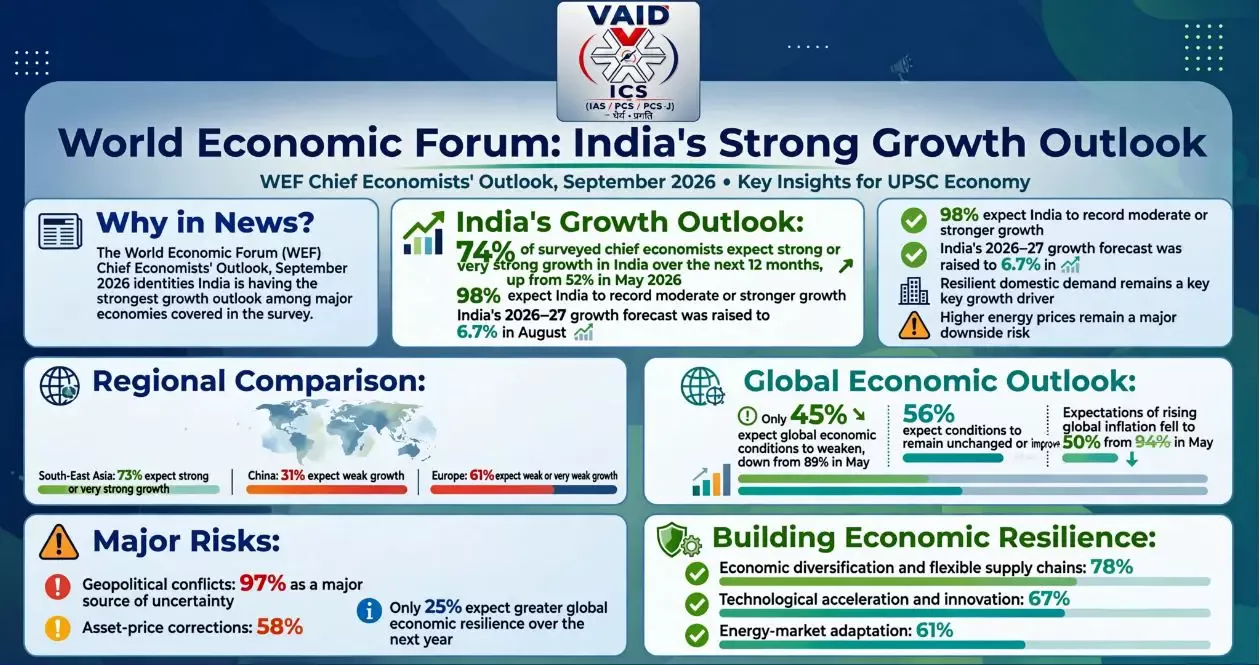
The World Economic Forum (WEF) Chief Economists’ Outlook, September 2026 identifies India as having one of the strongest growth outlooks among major economies over the next 12 months.
India’s Growth Outlook:
-
74% of surveyed chief economists expect strong or very strong growth in India over the next 12 months, up significantly from 52% in May 2026.
-
98% expect India to record moderate or stronger growth, indicating broad confidence in India’s near-term economic prospects.
-
Resilient domestic demand remains a major driver of India’s growth.
-
Real incomes: More than 60% of economists expect real incomes in India to increase over the next year.
-
Energy prices: Higher energy prices remain a major downside risk because they can raise import costs, inflationary pressures and production costs.
-
India’s strong domestic demand provides a degree of protection against weaker external conditions.
Regional Comparison:
-
India: 74% expect strong or very strong growth.
-
South-East Asia: Around 73% expect strong or very strong growth.
-
China: Around 31% expect weak growth.
-
Europe: 61% expect weak or very weak growth.
-
The outlook therefore remains uneven across major regions, with stronger expectations for India and South-East Asia.
Global Economic Outlook:
-
The global economic outlook has improved considerably compared with May 2026.
-
Only 45% of chief economists expect global economic conditions to weaken.
-
56% expect global conditions to remain unchanged or improve.
-
Expectations of rising global inflation have declined sharply compared with the May assessment.
-
However, the improvement in sentiment does not eliminate major structural and geopolitical risks.
Cost-of-Living Pressures:
The report continues to highlight persistent pressure on household living costs:
-
88% expect food prices to increase.
-
83% expect electricity costs to rise.
-
77% expect transport costs to increase.
-
Real incomes are expected to stagnate or decline in many regions.
-
India and South-East Asia have a relatively better real-income outlook.
Major Global Risks:
Geopolitical conflicts:
-
97% identify geopolitical conflicts as a major source of uncertainty.
-
Conflicts can disrupt energy supplies, trade routes, investment flows and commodity markets.
Asset-price corrections:
-
58% identify asset-price corrections as a significant risk.
-
A sharp correction can affect financial stability, investment and consumption.
Limited economic resilience:
-
Only around 25% expect greater global economic resilience over the next year.
-
This indicates that the improvement in global sentiment remains vulnerable to new shocks.
Building Economic Resilience:
The report identifies several important areas for strengthening economic resilience:
-
Economic diversification and flexible supply chains: Reduce dependence on a limited number of countries, suppliers or markets.
-
Technological acceleration and innovation: Improve productivity and competitiveness through technological adoption.
-
Energy-market adaptation: Reduce vulnerability to energy-price volatility and supply disruptions.
-
Fiscal policy: Fiscal support played an important role during earlier economic shocks, but governments now face limited fiscal space.
Artificial Intelligence and Economic Growth:
-
97% expect AI adoption to increase over the next 12 months.
-
69% expect AI to generate meaningful productivity gains.
-
Around 78% expect data-centre investment to contribute significantly to economic growth.
-
However, large-scale data-centre expansion may create pressure on electricity and water resources.
-
AI-driven growth may therefore generate both productivity gains and new infrastructure/resource challenges.
Geoeconomic Fragmentation:
-
77% expect geoeconomic fragmentation to increase over the next year.
-
55% anticipate higher US tariffs.
-
43% anticipate higher tariffs in Europe.
-
Despite increasing fragmentation, around two-thirds expect global trade volumes to increase.
-
Around 83% expect Chinese exports to markets outside the United States to increase.
Significance for India:
-
Strong domestic demand can act as a buffer against weak global demand.
-
Rising real incomes can support household consumption.
-
Supply-chain diversification can create opportunities for India to attract manufacturing and investment.
-
Technological adoption and AI can improve productivity and competitiveness.
-
Energy-price volatility remains a major vulnerability.
-
Geopolitical tensions and trade fragmentation can affect India’s exports, imports, investment and energy security.
-
India needs to balance growth with energy security, inflation management, supply-chain resilience and technological capability.
UPSC Relevance:
GS Paper III: Indian Economy
Themes: Economic Growth | Domestic Demand | Inflation | Energy Security | Global Economy | Geoeconomic Fragmentation | Supply-Chain Resilience | AI and Productivity
Key Takeaway:
The WEF September 2026 Chief Economists’ Outlook reflects strong confidence in India’s near-term growth prospects, primarily because of resilient domestic demand and improving real-income expectations. However, energy-price volatility, geopolitical conflicts, trade fragmentation and global economic shocks remain important challenges for sustaining India’s growth.
विश्व आर्थिक मंच: भारत की मजबूत आर्थिक वृद्धि की संभावना
क्यों चर्चा में?
विश्व आर्थिक मंच (WEF) के सितंबर 2026 के मुख्य अर्थशास्त्रियों के परिदृश्य (Chief Economists’ Outlook) के अनुसार, आगामी 12 महीनों में भारत की आर्थिक वृद्धि की संभावनाएँ प्रमुख अर्थव्यवस्थाओं में सबसे मजबूत बनी हुई हैं।
भारत की आर्थिक वृद्धि की संभावना:
-
सर्वेक्षण में शामिल 74% मुख्य अर्थशास्त्रियों को आगामी 12 महीनों में भारत में मजबूत या बहुत मजबूत आर्थिक वृद्धि की उम्मीद है। मई 2026 में यह आंकड़ा 52% था।
-
98% अर्थशास्त्रियों को भारत में मध्यम या उससे अधिक आर्थिक वृद्धि की उम्मीद है।
-
भारत की आर्थिक वृद्धि का प्रमुख आधार सुदृढ़ घरेलू मांग बनी हुई है।
-
वास्तविक आय: 60% से अधिक अर्थशास्त्रियों को भारत में वास्तविक आय में वृद्धि की उम्मीद है।
-
ऊर्जा की कीमतें: ऊर्जा कीमतों में वृद्धि भारत के लिए प्रमुख नकारात्मक जोखिम है, क्योंकि इससे आयात लागत, मुद्रास्फीति तथा उत्पादन लागत बढ़ सकती है।
-
मजबूत घरेलू मांग वैश्विक आर्थिक कमजोरी के प्रभाव से भारत को कुछ हद तक सुरक्षित रख सकती है।
क्षेत्रीय तुलना:
-
भारत: 74% अर्थशास्त्रियों को मजबूत या बहुत मजबूत वृद्धि की उम्मीद।
-
दक्षिण-पूर्व एशिया: लगभग 73% को मजबूत या बहुत मजबूत वृद्धि की उम्मीद।
-
चीन: लगभग 31% को कमजोर वृद्धि की उम्मीद।
-
यूरोप: 61% को कमजोर या बहुत कमजोर वृद्धि की उम्मीद।
-
इससे वैश्विक अर्थव्यवस्था में क्षेत्रीय स्तर पर असमान वृद्धि की संभावनाएँ दिखाई देती हैं।
वैश्विक आर्थिक परिदृश्य:
-
मई 2026 की तुलना में वैश्विक आर्थिक परिदृश्य में सुधार हुआ है।
-
केवल 45% मुख्य अर्थशास्त्रियों को वैश्विक आर्थिक परिस्थितियों के कमजोर होने की उम्मीद है।
-
56% को वैश्विक आर्थिक परिस्थितियों के स्थिर रहने या सुधारने की उम्मीद है।
-
वैश्विक मुद्रास्फीति में वृद्धि की आशंकाएँ मई की तुलना में काफी कम हुई हैं।
-
हालांकि, वैश्विक आर्थिक परिदृश्य अभी भी भूराजनीतिक तनाव, व्यापारिक विखंडन और वित्तीय जोखिमों के प्रति संवेदनशील है।
जीवन-यापन की लागत पर दबाव:
रिपोर्ट के अनुसार, वैश्विक स्तर पर जीवन-यापन की लागत पर दबाव बना हुआ है:
-
88% अर्थशास्त्रियों को खाद्य कीमतों में वृद्धि की उम्मीद है।
-
83% को विद्युत कीमतों में वृद्धि की आशंका है।
-
77% को परिवहन लागत बढ़ने की उम्मीद है।
-
कई क्षेत्रों में वास्तविक आय के स्थिर रहने या घटने की संभावना है।
-
भारत और दक्षिण-पूर्व एशिया में वास्तविक आय की संभावनाएँ तुलनात्मक रूप से बेहतर हैं।
प्रमुख वैश्विक जोखिम:
भूराजनीतिक संघर्ष:
-
97% अर्थशास्त्रियों ने भूराजनीतिक संघर्षों को वैश्विक अर्थव्यवस्था के लिए प्रमुख अनिश्चितता का स्रोत माना है।
-
इससे ऊर्जा आपूर्ति, व्यापार मार्ग, निवेश प्रवाह और जिंस बाजार प्रभावित हो सकते हैं।
परिसंपत्ति कीमतों में सुधार:
-
58% ने परिसंपत्ति कीमतों में संभावित सुधार को प्रमुख जोखिम माना है।
-
तीव्र गिरावट से वित्तीय स्थिरता, निवेश और उपभोग प्रभावित हो सकते हैं।
सीमित आर्थिक प्रत्यास्थता:
-
केवल लगभग 25% अर्थशास्त्रियों को आगामी वर्ष में वैश्विक अर्थव्यवस्था की प्रत्यास्थता बढ़ने की उम्मीद है।
-
इससे संकेत मिलता है कि वैश्विक आर्थिक सुधार अभी भी बाहरी झटकों के प्रति संवेदनशील है।
आर्थिक प्रत्यास्थता को मजबूत करने के उपाय:
रिपोर्ट के अनुसार, अर्थव्यवस्थाओं की दीर्घकालिक प्रत्यास्थता के लिए निम्नलिखित महत्वपूर्ण हैं:
-
आर्थिक विविधीकरण और लचीली आपूर्ति शृंखलाएँ: कुछ देशों, आपूर्तिकर्ताओं या बाजारों पर अत्यधिक निर्भरता कम करना।
-
तकनीकी प्रगति और नवाचार: उत्पादकता तथा प्रतिस्पर्धात्मकता में वृद्धि करना।
-
ऊर्जा बाजार में अनुकूलन: ऊर्जा कीमतों में अस्थिरता और आपूर्ति व्यवधानों के प्रभाव को कम करना।
-
राजकोषीय नीति: पूर्व के आर्थिक संकटों में राजकोषीय सहायता महत्वपूर्ण रही है, लेकिन वर्तमान में कई सरकारों के पास सीमित राजकोषीय गुंजाइश है।
कृत्रिम बुद्धिमत्ता और आर्थिक वृद्धि:
-
97% अर्थशास्त्रियों को आगामी 12 महीनों में AI के उपयोग में वृद्धि की उम्मीद है।
-
69% को AI से महत्वपूर्ण उत्पादकता वृद्धि की उम्मीद है।
-
लगभग 78% को डेटा सेंटर में निवेश से आर्थिक वृद्धि में महत्वपूर्ण योगदान की उम्मीद है।
-
हालांकि, बड़े पैमाने पर डेटा सेंटर के विस्तार से विद्युत और जल संसाधनों पर दबाव बढ़ सकता है।
-
इसलिए AI आर्थिक वृद्धि के साथ-साथ ऊर्जा, जल और आधारभूत संरचना संबंधी नई चुनौतियाँ भी उत्पन्न कर सकता है।
भू-आर्थिक विखंडन:
-
77% अर्थशास्त्रियों को आगामी वर्ष में भू-आर्थिक विखंडन बढ़ने की उम्मीद है।
-
55% को अमेरिका द्वारा अधिक शुल्क लगाए जाने की आशंका है।
-
43% को यूरोप में अधिक शुल्क लगाए जाने की उम्मीद है।
-
इसके बावजूद लगभग दो-तिहाई अर्थशास्त्रियों को वैश्विक व्यापार की मात्रा बढ़ने की उम्मीद है।
-
लगभग 83% को अमेरिका के अतिरिक्त अन्य बाजारों में चीन के निर्यात में वृद्धि की उम्मीद है।
भारत के लिए महत्व:
-
मजबूत घरेलू मांग वैश्विक मांग में कमजोरी के प्रभाव को कम कर सकती है।
-
वास्तविक आय में वृद्धि निजी उपभोग को बढ़ावा दे सकती है।
-
आपूर्ति शृंखलाओं में वैश्विक विविधीकरण से भारत को विनिर्माण और निवेश आकर्षित करने के अवसर मिल सकते हैं।
-
तकनीकी प्रगति और AI उत्पादकता तथा प्रतिस्पर्धात्मकता बढ़ा सकते हैं।
-
ऊर्जा कीमतों में अस्थिरता भारत के लिए प्रमुख संवेदनशीलता बनी हुई है।
-
भूराजनीतिक तनाव और व्यापारिक विखंडन भारत के निर्यात, आयात, निवेश और ऊर्जा सुरक्षा को प्रभावित कर सकते हैं।
-
दीर्घकालिक उच्च वृद्धि के लिए भारत को ऊर्जा सुरक्षा, मुद्रास्फीति नियंत्रण, आपूर्ति शृंखला प्रत्यास्थता और तकनीकी क्षमता के बीच संतुलन बनाना होगा।
UPSC प्रासंगिकता:
GS Paper III: भारतीय अर्थव्यवस्था
प्रमुख विषय: आर्थिक वृद्धि | घरेलू मांग | मुद्रास्फीति | ऊर्जा सुरक्षा | वैश्विक अर्थव्यवस्था | भू-आर्थिक विखंडन | आपूर्ति शृंखला प्रत्यास्थता | AI एवं उत्पादकता
मुख्य निष्कर्ष:
WEF सितंबर 2026 Chief Economists’ Outlook भारत की निकट अवधि की आर्थिक वृद्धि के प्रति मजबूत विश्वास को दर्शाता है। भारत की सुदृढ़ घरेलू मांग और वास्तविक आय की बेहतर संभावनाएँ इसकी प्रमुख ताकत हैं। हालांकि, ऊर्जा कीमतों में अस्थिरता, भूराजनीतिक संघर्ष, व्यापारिक विखंडन और वैश्विक आर्थिक झटके भारत की आर्थिक वृद्धि के लिए प्रमुख चुनौतियाँ बने हुए हैं।

May 19, 2026
October 17, 2025
October 16, 2025
October 6, 2025

