September 23, 2026
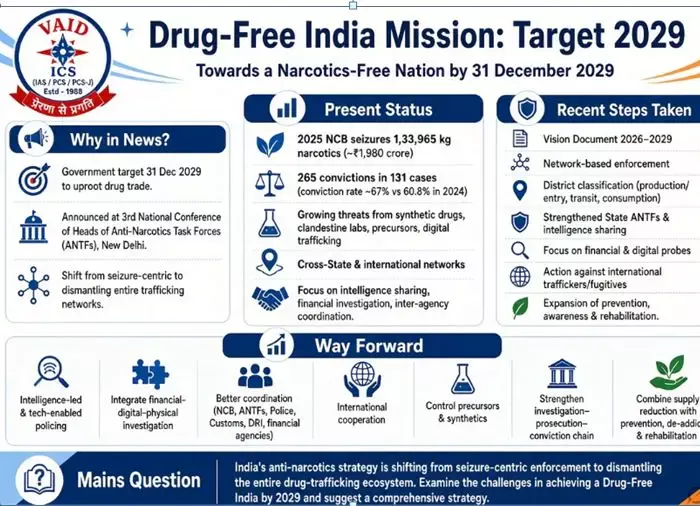
Daily Current Affairs : 23 Sep 2026/ Drug-Free India Mission: Target 2029/नशा-मुक्त भारत मिशन: वर्ष 2029 का लक्ष्य
Why in News?
-
Union Home Minister Amit Shah has set 31 December 2029 as the target to eliminate the drug trade from India through coordinated enforcement and intelligence-based action.
-
He was addressing the third National Conference of Heads of Anti-Narcotics Task Force (ANTF) of States and Union Territories in New Delhi.
-
The two-day conference was organised by the Narcotics Control Bureau (NCB) and attended by ANTF heads from 36 States and Union Territories.
Shift in India’s Anti-Narcotics Strategy:
-
The approach is proposed to move from a “seizure-centric” model to dismantling entire drug-trafficking networks.
-
The focus will be on identifying and disrupting the complete trafficking chain, from production and entry into India to distribution and local sale.
-
Greater emphasis will be placed on:
-
Financial investigation and tracing proceeds of drug trafficking.
-
Tracking digital links used by trafficking networks.
-
Targeting the profits and financial infrastructure of drug cartels.
-
Converting intelligence inputs into actionable intelligence.
-
Three-Level Targeting of Drug Networks:
-
Entry/Production Level: Targeting drug manufacturing centres and points through which narcotics enter India.
-
Inter-State Distribution Level: Disrupting transportation corridors and networks connecting different States.
-
Local Distribution Level: Breaking district-level networks involved in the sale and distribution of drugs.
District-Based Classification:
Districts will be categorised according to their role in the narcotics ecosystem:
-
Production/Entry Districts: Areas where drugs are produced or enter the country.
-
Transit Districts: Areas functioning as transportation and trafficking corridors.
-
Consumption Districts: Areas where drug consumption is prevalent.
Focus on International Drug Traffickers:
-
Agencies have been directed to strengthen action against foreign nationals involved in drug trafficking.
-
Such individuals are to be deported and prevented from re-entering India, wherever legally applicable.
-
Fugitive traffickers operating from abroad should be identified, apprehended and brought before Indian courts through appropriate legal and international cooperation mechanisms.
Legal and Investigative Measures:
-
Greater utilisation of the Prevention of Illicit Traffic in Narcotic Drugs and Psychotropic Substances Act, 1988 (PITNDPS Act) was emphasised.
-
Agencies have been asked to develop a comprehensive investigation-to-conviction roadmap in coordination with public prosecutors.
-
Enforcement agencies must identify and plug loopholes along international borders and drug-production centres.
-
Strengthening the link between investigation, prosecution and conviction is essential for effective enforcement.
Role of ANTFs:
-
State and Union Territory Anti-Narcotics Task Forces are expected to function as key pillars of coordinated anti-drug enforcement.
-
Intelligence sharing should become an integral part of policing.
-
The emphasis is on transforming raw information into actionable intelligence and coordinated operations.
-
Greater inter-State and inter-agency coordination is necessary because drug-trafficking networks frequently operate across jurisdictions.
Significance:
-
Represents a shift from individual seizure and case-based enforcement towards network-based disruption.
-
Targeting financial flows can weaken the economic foundations of drug cartels.
-
District-level classification can help authorities adopt area-specific anti-narcotics strategies.
-
Stronger coordination between investigation agencies and prosecutors can improve the conviction-oriented approach.
-
International cooperation is important for dealing with cross-border trafficking and fugitives operating from abroad.
Key Challenges:
-
Cross-border nature of organised drug trafficking.
-
Use of digital platforms and encrypted communication by trafficking networks.
-
Complex and concealed financial transactions.
-
Coordination challenges among multiple central, State and international agencies.
-
Drug networks adapting rapidly to enforcement measures.
-
Difficulty in securing convictions due to challenges in investigation, evidence collection and prosecution.
Way Forward:
-
Strengthen intelligence-led and technology-enabled policing.
-
Develop integrated mechanisms for financial, digital and physical investigation.
-
Improve coordination among NCB, State ANTFs, border agencies, police and prosecution authorities.
-
Strengthen international cooperation for extradition, deportation and investigation of transnational networks.
-
Adopt district-specific strategies based on production, transit and consumption patterns.
-
Focus simultaneously on supply reduction, demand reduction, rehabilitation and prevention.
-
Build a continuous investigation-to-conviction monitoring mechanism to ensure that seizures translate into successful prosecution.
National Narcotics Control Bureau (NCB)
National Narcotics Control Bureau (NCB) is India’s apex coordinating and enforcement agency for combating drug trafficking and illicit narcotics-related activities.
Key Facts:
-
Established: 1986
-
Legal basis: Constituted under the Narcotic Drugs and Psychotropic Substances (NDPS) Act, 1985
-
Administrative control: Ministry of Home Affairs (MHA)
-
Headquarters: New Delhi
-
Head: Director General
-
Nature: Central law-enforcement and intelligence agency
Major Functions:
-
Coordinates actions of Central and State agencies against drug trafficking.
-
Collects and analyses intelligence on narcotics trafficking.
-
Conducts investigations and operations against illicit drug trafficking networks.
-
Coordinates with international agencies to combat transnational drug trafficking.
-
Assists in implementing India’s obligations under international drug-control conventions.
-
Works with agencies such as the Customs, DRI, State Police, ED and other enforcement bodies.
-
Supports efforts to prevent the diversion and illegal trafficking of narcotic drugs and psychotropic substances.
Legal Framework:
The NCB primarily operates within the framework of:
-
NDPS Act, 1985
-
Prevention of Illicit Traffic in Narcotic Drugs and Psychotropic Substances Act, 1988
-
Relevant international conventions on narcotic drugs and psychotropic substances
Mains Question:
Discuss the need for shifting India’s anti-narcotics strategy from a seizure-centric approach to a network-dismantling approach. Examine the role of financial investigation, digital intelligence and inter-agency coordination in achieving this objective.

May 19, 2026
October 17, 2025
October 16, 2025
October 6, 2025

