September 22, 2026
Article 371K: Proposed Special Constitutional Safeguards for Ladakh/अनुच्छेद 371K: लद्दाख के लिए प्रस्तावित विशेष संवैधानिक संरक्षण:
Why in News?
-
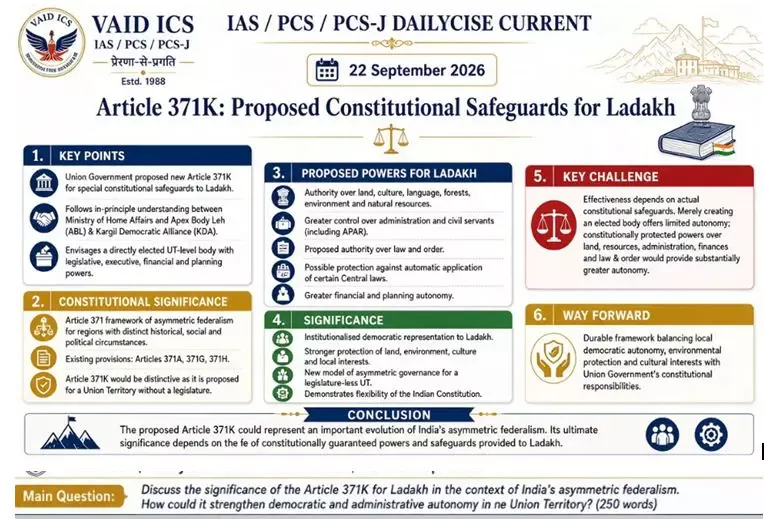
The Union Government has proposed inserting a new Article 371K in the Constitution to provide special constitutional safeguards for Ladakh.
-
The proposal follows an “in-principle understanding” between the Ministry of Home Affairs (MHA) and representatives of the Apex Body, Leh (ABL) and the Kargil Democratic Alliance (KDA).
-
The proposed framework envisages a directly elected Union Territory-level body with legislative, executive, financial and planning powers.
-
The proposal is significant because Ladakh is a Union Territory without a legislature, making the proposed arrangement different from the existing Article 371 provisions.
Article 371: Historical Background
-
Article 371 was not originally designed as a cultural or tribal protection provision.
-
At Independence, India consisted of British-administered provinces as well as several hundred princely states.
-
Princely states that acceded to India were initially placed in Part B States, including Hyderabad, Mysore, Jammu and Kashmir and Rajasthan.
-
The original Article 371, adopted in 1950, was essentially a transitional provision.
-
It placed the governments of Part B States under the general control of the President for a specified transitional period.
-
Its primary objective was to facilitate political integration and administrative consolidation rather than provide protection to particular communities.
The 1956 Turning Point
-
The States Reorganisation Act, 1956 and the Seventh Constitutional Amendment Act, 1956 abolished the earlier classification of States into Part A, Part B and Part C States.
-
The original Article 371 was consequently replaced by a new provision.
-
The present Article 371 provides special arrangements for Maharashtra and Gujarat, particularly concerning the equitable development of regions such as Vidarbha, Marathwada, Saurashtra and Kutch.
Evolution of the Article 371 Framework
-
Over time, Parliament created a series of special constitutional provisions for particular States and regions.
-
These provisions are examples of asymmetric federalism, under which different regions may have different constitutional arrangements according to their historical, social, cultural or political circumstances.
-
Articles 371A to 371J reflect different forms of such arrangements.
-
These provisions emerged from diverse circumstances, including:
-
Political integration
-
Peace agreements
-
Insurgency and conflict
-
Regional grievances
-
Protection of tribal customs and traditions
-
Demands for greater autonomy
-
-
Therefore, Article 371 is not a single uniform model; each provision has a distinct constitutional design.
What is Proposed under Article 371K for Ladakh?
The emerging proposal reportedly includes:
-
Directly elected UT-level body with legislative, executive, financial, budgetary and planning powers.
-
Powers relating to:
-
Land
-
Culture
-
Language
-
Forests
-
Environment
-
Natural resources
-
Other subjects falling within the Union Territory’s domain.
-
-
Greater control over civil servants, including performance appraisal through APARs, for matters falling within the elected body’s jurisdiction.
-
Law-and-order powers for the elected administration.
-
Constitutional protection relating to land and other local interests.
-
The possibility of restricting the automatic application of certain Central laws to Ladakh, depending upon the final constitutional design.
Why is Article 371K Different?
-
Existing Article 371 provisions primarily operate in States, whereas the proposed Article 371K would concern a Union Territory without a legislature.
-
It would therefore represent a distinctive form of asymmetric federalism within a Union Territory.
-
The proposal seeks to combine:
-
Direct democratic representation
-
Legislative authority
-
Administrative control
-
Financial autonomy
-
Protection of land and natural resources
-
-
This would make the institutional design of Ladakh substantially different from the ordinary administrative structure of a UT without a legislature.
Comparison with Existing Special Provisions
-
Article 371A — Nagaland: Provides constitutional protection to Naga religious/social practices, customary law, administration of civil and criminal justice according to customary law, and ownership and transfer of land and resources, subject to specified conditions.
-
Article 371G — Mizoram: Provides similar protection concerning Mizo religious/social practices, customary law and ownership/transfer of land.
-
Article 371H — Arunachal Pradesh: Gives the Governor special responsibility for law and order, subject to the constitutional framework.
-
The proposed Ladakh arrangement would reportedly move in a different direction by placing law and order under the elected UT-level authority.
What Will Determine the Strength of Article 371K?
The effectiveness of the proposed provision would depend largely on its constitutional wording and institutional safeguards.
-
Limited protection: If it merely establishes an elected body and assigns specified functions to it.
-
Stronger protection: If the Constitution guarantees control over land, natural resources, recruitment and administration.
-
Stronger still: If specified Central laws are prevented from automatically applying to Ladakh without the consent or approval of the elected body.
-
Greater administrative autonomy: If the elected authority receives substantial control over bureaucracy, finances and law and order.
Significance for Indian Polity
-
Article 371K would illustrate asymmetric federalism in a new institutional setting.
-
It raises important questions regarding the balance between:
-
Union control and regional autonomy
-
Democratic representation and administrative governance
-
Development and protection of fragile ecosystems
-
National laws and local customary interests
-
-
The proposal also highlights the constitutional flexibility of India’s federal system to accommodate region-specific political and socio-economic requirements.
UPSC Prelims Focus
-
Article 371: Special provision for Maharashtra and Gujarat.
-
Article 371A: Nagaland.
-
Article 371B: Assam.
-
Article 371C: Manipur.
-
Article 371F: Sikkim.
-
Article 371G: Mizoram.
-
Article 371H: Arunachal Pradesh.
-
Article 371I: Goa.
-
Article 371J: Karnataka.
-
Article 371K: Proposed special constitutional framework for Ladakh.
Mains Perspective
Article 371K represents the continuing evolution of India’s asymmetric federalism. Its importance would depend not merely on creating a new constitutional article but on the extent to which the provision constitutionally secures democratic representation, administrative authority, financial powers, land and resource protection, and meaningful local autonomy while maintaining the constitutional position of Ladakh as a Union Territory.

May 19, 2026
October 17, 2025
October 16, 2025
October 6, 2025

