September 19, 2026
Electric Vehicles: PHEV and Other Types
Why in News?
India has launched its first mainstream Plug-in Hybrid Electric Vehicle (PHEV) SUV, highlighting the growing debate around different types of electric and hybrid vehicles.
Types of Electric Vehicles:
-
ICE: Conventional petrol/diesel vehicle powered by an internal combustion engine.
-
BEV: Runs entirely on a battery and electric motor; requires external charging.
-
HEV: Uses engine + electric motor; battery is charged through the engine and regenerative braking. Cannot be plugged in.
-
PHEV: Hybrid vehicle with a larger battery that can also be externally charged.
-
FCEV: Uses hydrogen fuel cells to generate electricity; mainly emits water.
PHEV: Why Important for India?
-
Combines electric driving with long-range capability of an internal combustion engine.
-
Can reduce fuel consumption and emissions when regularly charged.
-
Helps address range anxiety caused by limited charging infrastructure.
-
Can reduce dependence on imported crude oil.
-
Limitation: Higher purchase cost and environmental benefits are lower if the vehicle is not regularly charged.
Policy Issue:
-
India’s EV incentives mainly focus on BEVs, while hybrids generally face higher taxation.
-
Key debate: whether PHEVs should receive greater policy support as a transition technology or whether policy should focus primarily on full electrification.
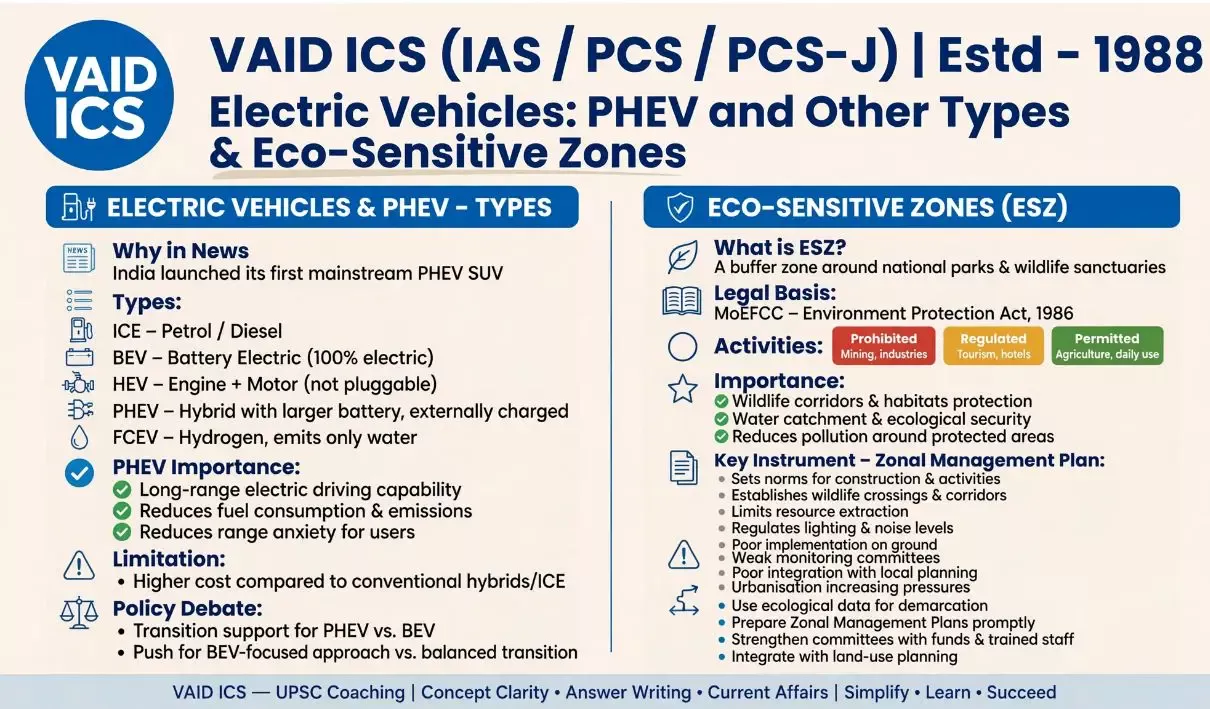
Eco-Sensitive Zones (ESZ):
What is an ESZ?
-
An Eco-Sensitive Zone (ESZ) is an area around a National Park or Wildlife Sanctuary created to act as a protective buffer.
-
Not a complete no-development zone.
-
Activities are classified as prohibited, regulated or permitted.
Legal Basis:
-
Notified by the Ministry of Environment, Forest and Climate Change (MoEFCC) under the Environment (Protection) Act, 1986.
-
Concept supported by the National Wildlife Action Plan (2002–2016) and 2011 MoEFCC Guidelines.
Why are ESZs Important?
-
Wildlife often moves beyond protected-area boundaries.
-
Human activities outside parks can affect:
-
Wildlife corridors
-
Water sources and watersheds
-
Air and water quality
-
Noise levels
-
Habitat connectivity
-
Key Instrument: Zonal Management Plan
It provides for:
-
Development restrictions
-
Wildlife crossings
-
Setback and construction norms
-
Extraction limits
-
Lighting standards
-
Environmental mitigation measures
Major Challenges:
-
Many ESZs lack effective Zonal Management Plans.
-
Zonal Management Committees may lack adequate staff, funds and authority.
-
ESZ restrictions are often not properly integrated into urban Master Plans.
-
Pollution, traffic, construction and waste can create pressure on protected areas.
Way Forward:
-
Prepare ESZ boundaries using ecological and hydrological data.
-
Ensure timely preparation of Zonal Management Plans.
-
Give ESZ committees adequate powers, funds and technical support.
-
Integrate ESZ restrictions into Master Plans and land-use planning.
-
Strengthen monitoring of water pollution, noise and wildlife movement.
Mains Point:
An ESZ should function as an active ecological buffer, not merely as a boundary drawn around a protected area.
इलेक्ट्रिक वाहन: PHEV एवं अन्य प्रकार
क्यों चर्चा में?
भारत में पहला मुख्यधारा प्लग-इन हाइब्रिड इलेक्ट्रिक वाहन (PHEV) SUV लॉन्च किया गया है। इससे विभिन्न प्रकार के इलेक्ट्रिक एवं हाइब्रिड वाहनों तथा भारत की इलेक्ट्रिक मोबिलिटी नीति पर चर्चा तेज हुई है।
इलेक्ट्रिक एवं हाइब्रिड वाहनों के प्रकार:
-
ICE (Internal Combustion Engine): पेट्रोल/डीजल से चलने वाला पारंपरिक वाहन, जिसमें आंतरिक दहन इंजन का प्रयोग होता है।
-
BEV (Battery Electric Vehicle): केवल बैटरी और इलेक्ट्रिक मोटर से चलता है तथा बाहरी स्रोत से चार्ज करना आवश्यक होता है।
-
HEV (Hybrid Electric Vehicle): आंतरिक दहन इंजन + इलेक्ट्रिक मोटर का संयोजन। बैटरी इंजन तथा पुनर्योजी ब्रेकिंग (Regenerative Braking) से चार्ज होती है। इसे बाहरी विद्युत स्रोत से चार्ज नहीं किया जा सकता।
-
PHEV (Plug-in Hybrid Electric Vehicle): हाइब्रिड वाहन जिसमें बड़ी बैटरी होती है और जिसे बाहरी विद्युत स्रोत से भी चार्ज किया जा सकता है।
-
FCEV (Fuel Cell Electric Vehicle): हाइड्रोजन ईंधन सेल के माध्यम से बिजली उत्पन्न करता है। इसके प्रमुख उत्सर्जन में जल शामिल है।
भारत के लिए PHEV का महत्व:
-
इलेक्ट्रिक ड्राइविंग तथा आंतरिक दहन इंजन की लंबी दूरी की क्षमता को जोड़ता है।
-
नियमित रूप से चार्ज करने पर ईंधन की खपत एवं उत्सर्जन कम किया जा सकता है।
-
सीमित चार्जिंग अवसंरचना के कारण उत्पन्न रेंज एंग्जायटी को कम कर सकता है।
-
आयातित कच्चे तेल पर निर्भरता कम करने में सहायता कर सकता है।
सीमाएँ:
-
BEV की तुलना में खरीद लागत अधिक हो सकती है।
-
यदि वाहन को नियमित रूप से चार्ज नहीं किया जाए, तो इसके पर्यावरणीय लाभ कम हो जाते हैं।
नीतिगत मुद्दा:
भारत की EV नीतियों में मुख्य जोर BEV पर रहा है, जबकि हाइब्रिड वाहनों पर सामान्यतः अधिक कर भार रहता है।
मुख्य बहस यह है कि PHEV को संक्रमणकालीन प्रौद्योगिकी के रूप में अधिक नीतिगत समर्थन दिया जाए या पूर्ण विद्युतीकरण पर प्राथमिकता बनाए रखी जाए।
पारिस्थितिक रूप से संवेदनशील क्षेत्र (Eco-Sensitive Zone: ESZ)
ESZ क्या है?
पारिस्थितिक रूप से संवेदनशील क्षेत्र (ESZ) किसी राष्ट्रीय उद्यान या वन्यजीव अभयारण्य के आसपास निर्धारित क्षेत्र है, जो संरक्षित क्षेत्र के लिए सुरक्षात्मक बफर के रूप में कार्य करता है।
-
ESZ पूर्णतः विकास-विहीन क्षेत्र नहीं होता।
-
गतिविधियों को सामान्यतः निषिद्ध, विनियमित और अनुमत श्रेणियों में वर्गीकृत किया जाता है।
कानूनी आधार:
-
ESZ को पर्यावरण, वन एवं जलवायु परिवर्तन मंत्रालय (MoEFCC) द्वारा पर्यावरण (संरक्षण) अधिनियम, 1986 के अंतर्गत अधिसूचित किया जाता है।
-
इसकी अवधारणा को राष्ट्रीय वन्यजीव कार्ययोजना (2002–2016) तथा 2011 के MoEFCC दिशा-निर्देशों से समर्थन मिला।
ESZ क्यों महत्वपूर्ण है?
वन्यजीव केवल संरक्षित क्षेत्रों की सीमाओं तक सीमित नहीं रहते। आसपास की मानवीय गतिविधियाँ प्रभावित कर सकती हैं:
-
वन्यजीव गलियारों को
-
जल स्रोतों एवं जलग्रहण क्षेत्रों को
-
वायु एवं जल की गुणवत्ता को
-
ध्वनि स्तर को
-
आवासीय संपर्कता (Habitat Connectivity) को
प्रमुख साधन: क्षेत्रीय प्रबंधन योजना (Zonal Management Plan)
इसमें निम्नलिखित का प्रावधान किया जा सकता है:
-
विकास संबंधी प्रतिबंध
-
वन्यजीवों के आवागमन हेतु मार्ग
-
भवन निर्माण एवं सेटबैक मानदंड
-
प्राकृतिक संसाधनों के दोहन की सीमाएँ
-
प्रकाश व्यवस्था के मानदंड
-
पर्यावरणीय क्षति को कम करने के उपाय
प्रमुख चुनौतियाँ:
-
अनेक ESZ में प्रभावी क्षेत्रीय प्रबंधन योजनाओं का अभाव।
-
क्षेत्रीय प्रबंधन समितियों के पास पर्याप्त कर्मचारी, वित्तीय संसाधन एवं अधिकारों की कमी।
-
ESZ के प्रावधानों का शहरी मास्टर प्लान में पर्याप्त एकीकरण न होना।
-
प्रदूषण, यातायात, निर्माण गतिविधियाँ एवं कचरा संरक्षित क्षेत्रों पर दबाव बढ़ाते हैं।
आगे की राह:
-
ESZ की सीमाएँ निर्धारित करने में पारिस्थितिक एवं जलवैज्ञानिक आँकड़ों का उपयोग।
-
क्षेत्रीय प्रबंधन योजनाओं का समयबद्ध निर्माण।
-
ESZ समितियों को पर्याप्त अधिकार, वित्तीय संसाधन एवं तकनीकी सहायता प्रदान करना।
-
ESZ प्रावधानों को मास्टर प्लान एवं भूमि-उपयोग नियोजन में एकीकृत करना।
-
जल प्रदूषण, ध्वनि प्रदूषण एवं वन्यजीवों की आवाजाही की प्रभावी निगरानी।
मुख्य परीक्षा हेतु:
ESZ को केवल संरक्षित क्षेत्र के चारों ओर खींची गई सीमा के रूप में नहीं, बल्कि एक सक्रिय पारिस्थितिक बफर के रूप में कार्य करना चाहिए।

May 19, 2026
October 17, 2025
October 16, 2025
October 6, 2025

