September 19, 2026
EPFO Wage Ceiling Raised from ₹15,000 to ₹25,000/EPFO वेतन सीमा ₹15,000 से बढ़कर ₹25,000:
Why in News?
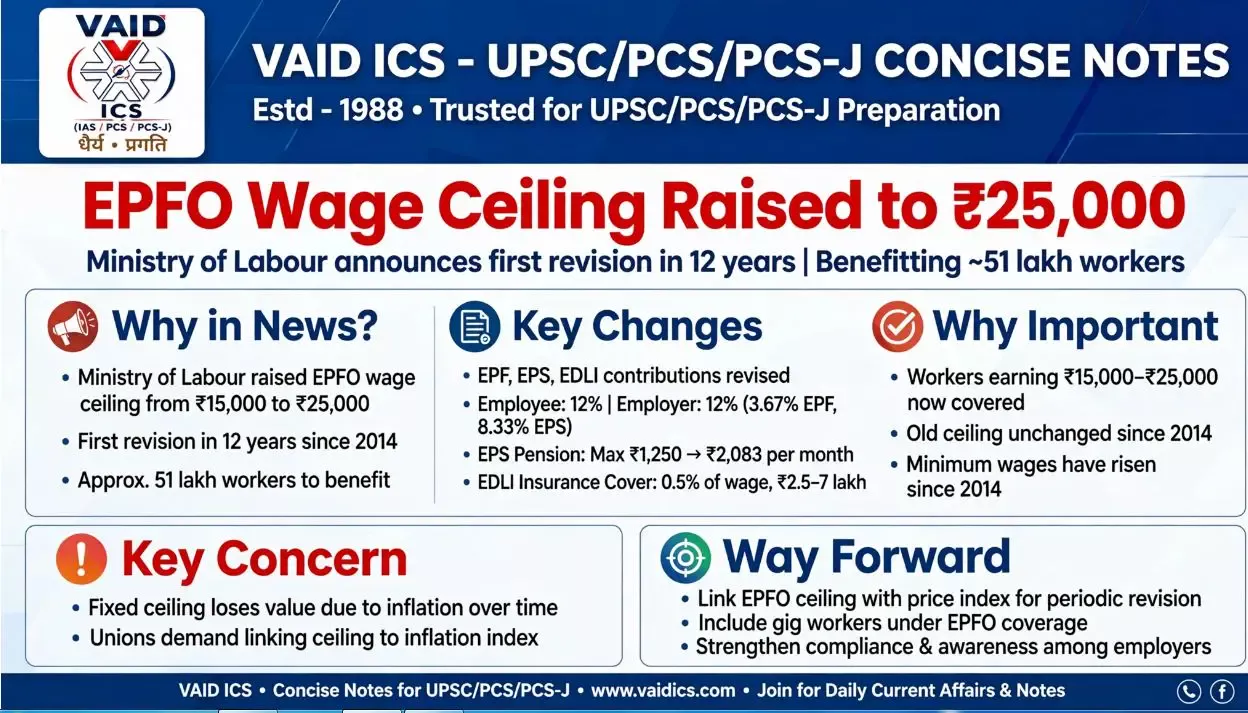
The Ministry of Labour and Employment has raised the EPFO wage ceiling from ₹15,000 to ₹25,000 per month, following approval by the Union Cabinet. This is the first revision in 12 years.
-
The revision is expected to bring around 51 lakh additional workers under mandatory EPFO coverage.
-
More than 8 crore subscribers will be covered under the revised ceiling.
-
Trade unions have demanded a higher ceiling and indexation with wages/inflation.
What is EPFO Wage Ceiling?
-
It is the monthly wage limit up to which EPFO membership is compulsory for eligible employees in covered establishments.
-
The ceiling applies to:
-
EPF – Provident Fund
-
EPS – Pension
-
EDLI – Deposit Linked Insurance
-
-
It is a coverage ceiling, not a maximum limit on provident-fund savings.
What Changes?
-
Employee contribution: 12% of basic wages + dearness allowance + retaining allowance.
-
Employer contribution: 12%.
-
Employer’s contribution is divided into:
-
3.67% → EPF
-
8.33% → EPS
-
-
EPS contribution rises from ₹1,250 to ₹2,083 per month as 8.33% of the ceiling is now calculated on ₹25,000.
-
EDLI contribution: Employer contributes 0.5%; no employee contribution.
-
EDLI provides life insurance cover of ₹2.5 lakh–₹7 lakh.
Who Benefits Most?
Workers earning ₹15,000–₹25,000 per month are the principal beneficiaries because they enter the mandatory coverage bracket.
Why Was the Revision Needed?
-
The ceiling had remained unchanged at ₹15,000 since September 2014.
-
In several States/UTs, statutory minimum wages for unskilled workers have crossed ₹15,000.
-
Examples:
-
Delhi – ₹17,800
-
Maharashtra – ₹17,000
-
Karnataka – ₹16,800
-
-
Thus, the old EPFO ceiling had fallen below the minimum-wage levels in several jurisdictions.
History of EPFO Wage Ceiling
-
1952: EPF scheme introduced.
-
2001: Ceiling increased from ₹5,000 → ₹6,500.
-
2014: Ceiling increased from ₹6,500 → ₹15,000.
-
2026: Ceiling increased from ₹15,000 → ₹25,000.
Key Issues
1. Inflation: A fixed monetary ceiling loses real value over time.
Way Forward: Link the ceiling to a wage or price index with periodic automatic revision.
2. Gig and platform workers: EPFO coverage remains largely linked to covered establishments.
Way Forward: Operationalise social-security mechanisms for gig and platform workers under the Code on Social Security, 2020.
3. Compliance: Higher contribution costs may create incentives for under-reporting of wages or employment.
Way Forward: Strengthen wage and establishment compliance audits.
4. Pension adequacy: EPS pensionable salary is generally subject to the wage ceiling, which can limit pension benefits for higher-paid workers.
Way Forward: Greater actuarial transparency while revising the ceiling.
5. Take-home salary: Higher mandatory contributions can reduce current take-home pay while increasing retirement savings.
Way Forward: Consider phased implementation for workers newly brought under mandatory coverage.
Trade Union Demand
Trade unions, including AITUC, have argued that ₹25,000 remains inadequate and have demanded a higher ceiling, along with a mechanism linking it to minimum wages, inflation and cost of living.
Back to Basics: EPFO
-
Statutory basis: Employees’ Provident Funds and Miscellaneous Provisions Act, 1952.
-
Ministry: Ministry of Labour and Employment.
-
Governing body: Central Board of Trustees (CBT).
-
Nature: Tripartite body representing Government, employers and employees.
-
Three major schemes:
-
EPF – retirement savings
-
EPS – pension
-
EDLI – life insurance
-
-
The parent Act generally covers establishments employing 20 or more persons in notified industries.

May 19, 2026
October 17, 2025
October 16, 2025
October 6, 2025

