September 16, 2026
Weaponisation of Outer Space/बाह्य अंतरिक्ष का सैन्यीकरण एवं हथियारीकरण:
Why in News?
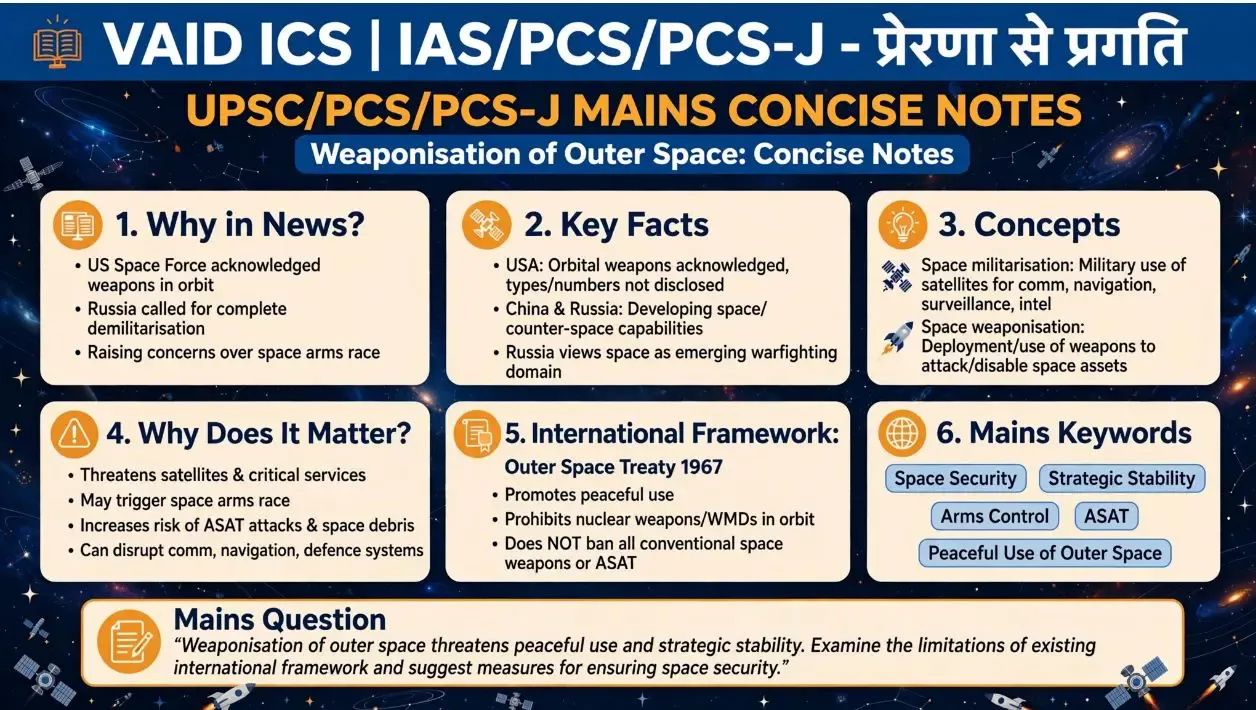
The United States Space Force has acknowledged that the U.S. has weapons deployed in orbit, while Russia has called for the complete demilitarisation of outer space.
The disclosure has renewed concerns over a possible space arms race, particularly involving the U.S., China and Russia.
Key Facts:
-
US Space Force: Has acknowledged the deployment of weapons in orbit but has not disclosed their number or specific types.
-
Its space-control capabilities include kinetic and non-kinetic means to affect an adversary’s space systems.
-
Russia: Called for outer space to remain free of weapons and advocated the complete demilitarisation of space.
-
China and Russia are identified by the U.S. as major potential threats to its space interests.
-
China: Developing space and counter-space capabilities as part of military modernisation.
-
Russia: Considers space an increasingly important warfighting domain.
Why is Space Militarisation Important?
Modern militaries depend heavily on satellites for:
-
Communication
-
Navigation and positioning
-
Surveillance and reconnaissance
-
Intelligence gathering
-
Early warning and military operations
Therefore, attacks on or disruption of satellites can significantly affect a country’s military and strategic capabilities.
Militarisation vs Weaponisation:
-
Militarisation of Space: Use of space-based assets for military purposes, such as GPS, communication and surveillance satellites.
-
Weaponisation of Space: Deployment or use of weapons capable of attacking or disabling space assets.
Major Concern: Space Arms Race
The open acknowledgement of orbital weapons could:
-
Increase strategic competition among major powers.
-
Encourage development of counter-space weapons.
-
Increase the risk of satellite disruption and space debris.
-
Threaten civilian services dependent on satellites.
-
Complicate efforts towards peaceful use of outer space.
Historical Context:
-
Space-based military competition intensified during the Cold War.
-
The launch of Sputnik by the Soviet Union in 1957 accelerated U.S.–Soviet competition in space.
-
Both sides developed capabilities to protect their satellites and potentially disable adversary satellites.
International Framework:
The Outer Space Treaty, 1967 establishes key principles for the peaceful use of outer space and prohibits the placement of nuclear weapons and other weapons of mass destruction in orbit.
However, it does not comprehensively prohibit all conventional weapons or anti-satellite (ASAT) capabilities, leaving important gaps in space arms-control regulation.
Mains Significance:
The growing weaponisation of space raises questions regarding:
Strategic stability + Space security + Arms control + Protection of satellites + Prevention of space debris + Peaceful use of outer space
बाह्य अंतरिक्ष का सैन्यीकरण एवं हथियारीकरण:
चर्चा में क्यों?
अमेरिकी अंतरिक्ष बल (US Space Force) ने कक्षा में हथियारों की मौजूदगी को स्वीकार किया है, जबकि रूस ने बाह्य अंतरिक्ष के पूर्ण विसैन्यीकरण (Demilitarisation) की मांग की है।
इससे अंतरिक्ष में हथियारों की होड़ और अंतरिक्ष सुरक्षा को लेकर चिंताएँ बढ़ी हैं।
प्रमुख तथ्य:
-
अमेरिका: कक्षा में हथियार तैनात होने की बात स्वीकार की, लेकिन उनकी संख्या और प्रकार सार्वजनिक नहीं किए।
-
अमेरिकी अंतरिक्ष नियंत्रण क्षमताओं में काइनेटिक और गैर-काइनेटिक साधन शामिल हैं।
-
रूस: बाह्य अंतरिक्ष को हथियारों से मुक्त रखने और पूर्ण विसैन्यीकरण की मांग करता है।
-
अमेरिका ने चीन और रूस को अपने अंतरिक्ष हितों के लिए प्रमुख संभावित खतरे माना है।
-
चीन: अंतरिक्ष एवं काउंटर-स्पेस क्षमताओं का विकास कर रहा है।
-
रूस: अंतरिक्ष को संभावित युद्धक्षेत्र के रूप में देखता है।
सैन्य क्षेत्र में अंतरिक्ष का महत्व:
उपग्रह आधुनिक सैन्य अभियानों के लिए महत्वपूर्ण हैं:
-
संचार
-
नेविगेशन एवं स्थिति निर्धारण
-
निगरानी एवं टोही
-
खुफिया जानकारी
-
प्रारंभिक चेतावनी
-
सैन्य अभियानों का समन्वय
सैन्यीकरण बनाम हथियारीकरण:
अंतरिक्ष का सैन्यीकरण (Militarisation):
सैन्य उद्देश्यों के लिए अंतरिक्ष आधारित प्रणालियों का उपयोग, जैसे संचार, नेविगेशन और निगरानी उपग्रह।
अंतरिक्ष का हथियारीकरण (Weaponisation):
अंतरिक्ष में या अंतरिक्ष आधारित प्रणालियों के माध्यम से हथियारों की तैनाती/उपयोग, जैसे उपग्रहों को निष्क्रिय करने वाली क्षमताएँ।
प्रमुख चिंता: अंतरिक्ष में हथियारों की होड़
-
अमेरिका, चीन और रूस के बीच रणनीतिक प्रतिस्पर्धा बढ़ सकती है।
-
काउंटर-स्पेस हथियारों का विकास तेज हो सकता है।
-
उपग्रहों को नुकसान पहुँचने से संचार, नेविगेशन और नागरिक सेवाएँ प्रभावित हो सकती हैं।
-
उपग्रह-विरोधी गतिविधियों से अंतरिक्ष मलबे (Space Debris) का खतरा बढ़ सकता है।
-
अंतरिक्ष के शांतिपूर्ण उपयोग को चुनौती मिल सकती है।
ऐतिहासिक संदर्भ:
-
अंतरिक्ष में सैन्य प्रतिस्पर्धा शीत युद्ध के दौरान तेज हुई।
-
1957 में सोवियत संघ द्वारा Sputnik-1 का प्रक्षेपण अंतरिक्ष प्रतिस्पर्धा का महत्वपूर्ण चरण था।
-
अमेरिका और सोवियत संघ ने अपने उपग्रहों की सुरक्षा तथा विरोधी के उपग्रहों को निष्क्रिय करने की क्षमताएँ विकसित कीं।
अंतर्राष्ट्रीय व्यवस्था:
Outer Space Treaty, 1967 अंतरिक्ष के शांतिपूर्ण उपयोग के लिए प्रमुख अंतर्राष्ट्रीय समझौता है।
यह परमाणु हथियारों तथा अन्य सामूहिक विनाश के हथियारों (WMDs) को पृथ्वी की कक्षा में रखने पर प्रतिबंध लगाता है।
हालाँकि, यह सभी प्रकार के पारंपरिक अंतरिक्ष हथियारों और Anti-Satellite (ASAT) क्षमताओं पर व्यापक प्रतिबंध नहीं लगाता, जिससे अंतरिक्ष हथियार नियंत्रण में महत्वपूर्ण नियामक अंतर बना हुआ है।
UPSC Mains के लिए महत्व:
अंतरिक्ष सुरक्षा + रणनीतिक स्थिरता + हथियार नियंत्रण + उपग्रह सुरक्षा + अंतरिक्ष मलबा + अंतरिक्ष का शांतिपूर्ण उपयोग

May 19, 2026
October 17, 2025
October 16, 2025
October 6, 2025

