September 15, 2026
UPI Payments and MDR:/UPI भुगतान और MDR:
Why in News?
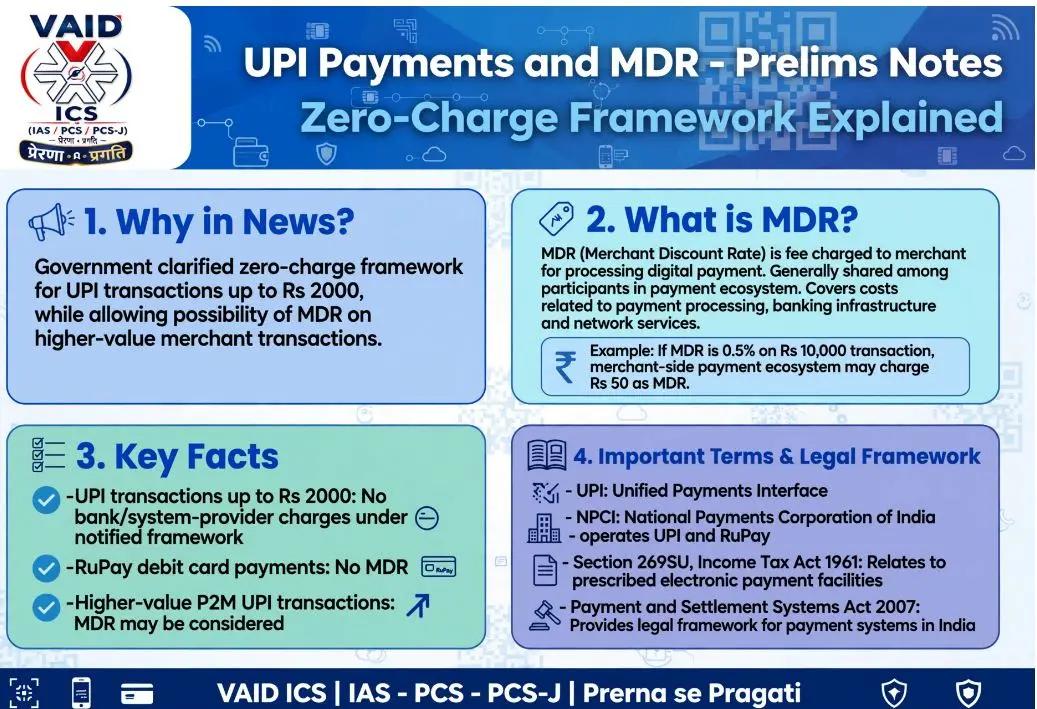
The government has clarified the zero-charge framework for UPI transactions up to ₹2,000. At the same time, the possibility of introducing Merchant Discount Rate (MDR) on higher-value merchant transactions has been opened.
What is UPI?
UPI (Unified Payments Interface) is a real-time digital payment system developed and operated by the National Payments Corporation of India (NPCI).
It allows users to transfer money directly between bank accounts using methods such as:
-
UPI ID
-
Mobile number
-
QR code
-
Bank account details
What is MDR?
MDR (Merchant Discount Rate) is the fee charged to a merchant for accepting and processing a digital payment.
For example:
If a customer makes a ₹10,000 digital payment and the applicable MDR is 0.5%, the MDR would be ₹50.
The charge is generally distributed among participants involved in processing the payment.
Why is MDR Important?
Digital payments require infrastructure such as:
-
Payment networks
-
Banking systems
-
Cybersecurity
-
Transaction processing
-
Technical infrastructure
MDR can provide a source of revenue to the payment ecosystem for these services.
What is the Present Framework?
-
UPI transactions up to ₹2,000: No bank/system-provider charges under the notified framework.
-
RuPay debit card payments: No MDR.
-
Higher-value P2M UPI transactions: MDR may be considered.
-
The possibility of MDR does not mean that MDR has automatically been imposed on every transaction above ₹2,000.
What is Zero-MDR?
Zero-MDR means that the merchant is not charged an MDR for the specified digital transaction.
The government introduced zero-MDR measures to encourage low-cost digital payments and wider adoption of digital transactions.
Why Was Zero-MDR Introduced?
The major objectives were:
-
Promote digital payments
-
Reduce dependence on cash
-
Encourage small-value transactions
-
Increase financial inclusion
-
Support the growth of India’s digital payment ecosystem
What is P2M?
P2M = Person-to-Merchant
It refers to a payment made by an individual to a business or merchant.
Example: Paying a shopkeeper through a UPI QR code.
This is different from:
P2P = Person-to-Person
Example: Sending money through UPI to a friend or family member.
Important Institutions
NPCI:
National Payments Corporation of India is the umbrella organisation for India’s retail payment systems.
It operates important systems such as:
-
UPI
-
RuPay
-
IMPS
-
BHIM
Important Legal Provisions
Section 269SU of the Income Tax Act, 1961:
Relates to the provision of prescribed electronic payment facilities by specified businesses.
Payment and Settlement Systems Act, 2007:
Provides the legal framework for regulating and supervising payment systems in India.
Why is ₹2,000 Important?
The ₹2,000 threshold creates a distinction between small-value retail payments and higher-value merchant payments.
The basic idea is:
Small payments → Continue to remain free
Higher-value merchant payments → MDR may be considered
This attempts to balance digital-payment adoption with the cost of maintaining payment infrastructure.
UPI भुगतान और MDR:
चर्चा में क्यों?
सरकार ने ₹2,000 तक के UPI लेन-देन को शुल्क-मुक्त रखने की व्यवस्था स्पष्ट की है। साथ ही, अधिक मूल्य वाले व्यापारी लेन-देन (P2M) पर MDR लगाए जाने की संभावना का मार्ग खुला है।
UPI क्या है?
UPI (Unified Payments Interface) भारत की एक रियल-टाइम डिजिटल भुगतान प्रणाली है, जिसे NPCI द्वारा विकसित और संचालित किया जाता है।
UPI के माध्यम से भुगतान किया जा सकता है:
-
UPI ID
-
मोबाइल नंबर
-
QR Code
-
बैंक खाते के विवरण के माध्यम से
MDR क्या है?
MDR (Merchant Discount Rate) वह शुल्क है जो किसी डिजिटल भुगतान को स्वीकार करने और संसाधित करने के लिए व्यापारी से लिया जाता है।
उदाहरण:
यदि ₹10,000 के भुगतान पर MDR 0.5% है, तो MDR ₹50 होगा।
यह शुल्क भुगतान प्रक्रिया में शामिल विभिन्न संस्थाओं के बीच बाँटा जा सकता है।
MDR क्यों महत्वपूर्ण है?
डिजिटल भुगतान के लिए कई प्रकार के बुनियादी ढाँचे की आवश्यकता होती है, जैसे:
-
भुगतान नेटवर्क
-
बैंकिंग प्रणाली
-
साइबर सुरक्षा
-
लेन-देन प्रसंस्करण
-
तकनीकी अवसंरचना
MDR इस भुगतान व्यवस्था की लागत की भरपाई का एक माध्यम हो सकता है।
वर्तमान व्यवस्था क्या है?
-
₹2,000 तक के UPI लेन-देन: बैंक/सिस्टम प्रदाता द्वारा कोई शुल्क नहीं।
-
RuPay डेबिट कार्ड भुगतान: MDR नहीं।
-
₹2,000 से अधिक के P2M UPI लेन-देन: MDR पर विचार किया जा सकता है।
-
इसका अर्थ यह नहीं है कि ₹2,000 से अधिक के प्रत्येक UPI लेन-देन पर MDR स्वतः लागू हो गया है।
Zero-MDR क्या है?
Zero-MDR का अर्थ है कि निर्धारित डिजिटल लेन-देन पर व्यापारी से MDR नहीं लिया जाता है।
इसका उद्देश्य कम लागत वाले डिजिटल भुगतान को बढ़ावा देना और डिजिटल भुगतान के व्यापक उपयोग को प्रोत्साहित करना है।
Zero-MDR क्यों लागू किया गया?
इसके प्रमुख उद्देश्य हैं:
-
डिजिटल भुगतान को बढ़ावा देना
-
नकदी पर निर्भरता कम करना
-
छोटे मूल्य के लेन-देन को प्रोत्साहित करना
-
वित्तीय समावेशन को बढ़ावा देना
-
डिजिटल भुगतान व्यवस्था का विस्तार करना
P2M क्या है?
P2M = Person-to-Merchant
इसका अर्थ है किसी व्यक्ति द्वारा किसी व्यापारी/व्यवसाय को भुगतान करना।
उदाहरण: दुकान पर QR Code स्कैन करके UPI से भुगतान करना।
इसके विपरीत:
P2P = Person-to-Person
अर्थात एक व्यक्ति द्वारा दूसरे व्यक्ति को भुगतान करना।
प्रमुख संस्था: NPCI
NPCI (National Payments Corporation of India) भारत की खुदरा भुगतान प्रणालियों की प्रमुख संस्था है।
NPCI से जुड़ी प्रमुख भुगतान प्रणालियाँ:
-
UPI
-
RuPay
-
IMPS
-
BHIM
महत्वपूर्ण कानूनी प्रावधान
आयकर अधिनियम, 1961 की धारा 269SU:
निर्दिष्ट व्यवसायों द्वारा निर्धारित इलेक्ट्रॉनिक भुगतान सुविधाएँ उपलब्ध कराने से संबंधित प्रावधान।
Payment and Settlement Systems Act, 2007:
भारत में भुगतान प्रणालियों के नियमन और पर्यवेक्षण के लिए कानूनी ढाँचा प्रदान करता है।
₹2,000 की सीमा क्यों महत्वपूर्ण है?
₹2,000 की सीमा छोटे मूल्य के खुदरा भुगतान और अधिक मूल्य वाले व्यापारी भुगतान के बीच अंतर करने में मदद करती है।
छोटे भुगतान → शुल्क-मुक्त
बड़े व्यापारी भुगतान → MDR पर विचार संभव
इसका उद्देश्य डिजिटल भुगतान को बढ़ावा देने और भुगतान प्रणाली की लागत की भरपाई के बीच संतुलन बनाना है।

May 19, 2026
October 17, 2025
October 16, 2025
October 6, 2025

