September 11, 2026
Role of AI chatbots in Mental Health : मानसिक स्वास्थ्य संकट : AI चैटबॉट्स
Why in News?
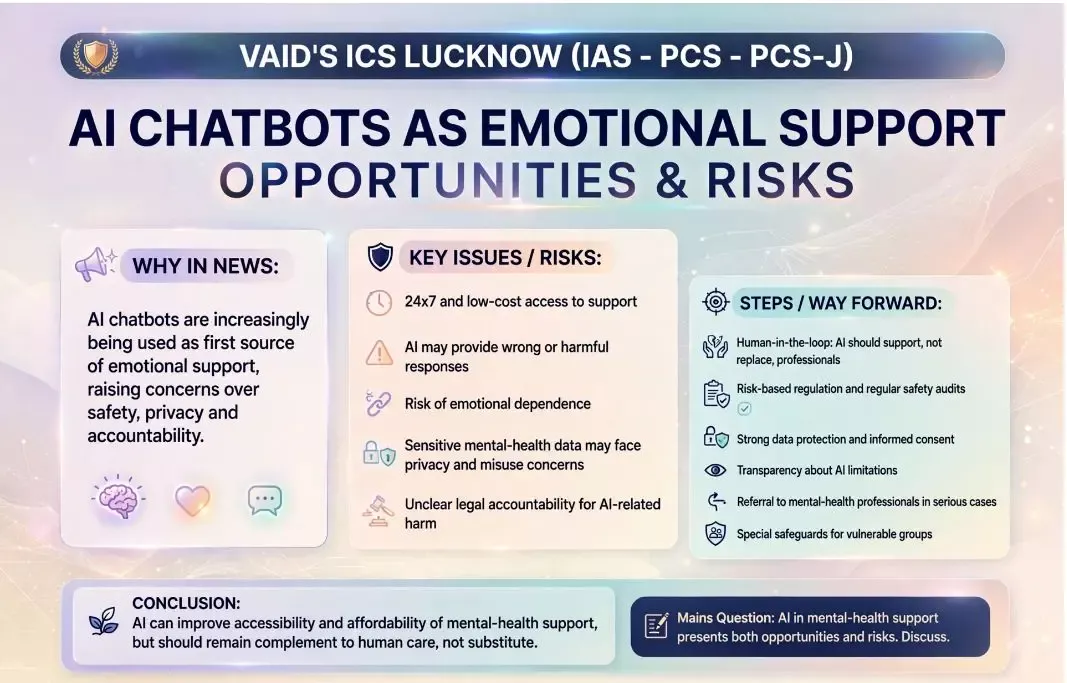
The growing use of AI chatbots as the first source of emotional support has raised concerns about their role in mental-health situations.
AI can offer instant, private and non-judgmental interaction, but it is not a substitute for trained mental-health professionals, particularly in serious or high-risk situations.
What is the Core Issue?
AI is increasingly moving from being a productivity tool to an emotional confidant.
People may turn to chatbots because they are:
-
Available 24×7
-
Easily accessible
-
Perceived as non-judgmental
-
Capable of remembering previous conversations
-
Able to respond in a personalised and conversational manner
This creates a dilemma:
AI can provide emotional support → but excessive dependence may create psychological, social and safety risks.
Potential Benefits:
-
Accessibility: Provides an easily available first point of support.
-
Affordability: Can reduce barriers to basic emotional-support resources.
-
Early expression: Users may find it easier to articulate emotions to AI.
-
Self-reflection: Can help organise thoughts and prepare for conversations with family, friends or professionals.
-
Mental-health awareness: Can provide general information and encourage users to seek appropriate professional help.
Major Concerns:
1. AI is not a Mental-Health Professional:
AI lacks the clinical judgement, human empathy and contextual understanding required for diagnosis and treatment.
2. Risk of Wrong or Misleading Responses:
AI can generate inaccurate, inappropriate or overly reassuring responses. This becomes particularly serious when users treat AI as an authority.
3. Emotional Dependence:
Continuous availability and personalised interaction can encourage users to depend excessively on AI for emotional validation and companionship.
4. Replacement of Human Relationships:
Excessive dependence may reduce meaningful interaction with family, friends and professional caregivers.
5. Privacy and Data Protection:
Mental-health conversations contain highly sensitive personal information. This raises concerns about:
Data collection + Storage + Profiling + Consent + Misuse
6. Accountability Gap:
When an AI system gives harmful or inappropriate advice, questions arise regarding responsibility, liability and regulatory oversight.
Ethical Dimensions:
The issue involves several ethical principles:
-
Autonomy: Users should know the limitations of AI.
-
Beneficence: AI should provide genuine benefit.
-
Non-maleficence: It should minimise the possibility of harm.
-
Privacy: Sensitive emotional and health-related data must be protected.
-
Human dignity: Technology should complement rather than undermine human relationships.
-
Accountability: Developers and platforms must remain responsible for safety standards.
Governance Challenges:
India needs to balance:
AI Innovation ↔ User Safety
Important areas requiring attention:
-
Clear safety standards for mental-health AI
-
Strong data protection and informed consent
-
Transparency about AI’s limitations
-
Independent safety testing and audits
-
Mechanisms for human oversight
-
Clear liability and accountability
-
Special safeguards for children and vulnerable users
-
Easy referral to qualified mental-health professionals where necessary
Way Forward:
Human-in-the-loop approach: AI should support—not replace—qualified professionals.
Risk-based regulation: Higher-risk applications involving mental-health decisions should face stricter safeguards.
Privacy by design: Sensitive mental-health data should be minimised, protected and processed only with meaningful consent.
Digital literacy: Users should understand that conversational ability does not equal professional expertise.
Responsible AI design: Systems should be designed to recognise their limitations and appropriately direct users towards human assistance.
Conclusion:
AI can become a useful first layer of emotional support, but it should not become the final authority on mental health.
The objective should be:
“AI as an assistive tool, humans as the ultimate caregivers.”
This approach can help India harness AI for accessible mental-health support while protecting privacy, dignity, safety and human agency.
Why in News?
मानसिक स्वास्थ्य संकट के समय लोग AI चैटबॉट्स को भावनात्मक सहायता के पहले स्रोत के रूप में इस्तेमाल कर रहे हैं।
AI तत्काल, निजी और बिना किसी पूर्वाग्रह के बातचीत की सुविधा देता है, लेकिन गंभीर मानसिक स्वास्थ्य परिस्थितियों में यह प्रशिक्षित मानसिक स्वास्थ्य विशेषज्ञों का विकल्प नहीं हो सकता।
मुख्य मुद्दा क्या है?
AI अब केवल उत्पादकता के साधन तक सीमित नहीं है, बल्कि एक भावनात्मक विश्वासपात्र (Emotional Confidant) के रूप में भी इस्तेमाल हो रहा है।
लोग AI की ओर इसलिए आकर्षित हो सकते हैं क्योंकि यह:
-
24×7 उपलब्ध रहता है।
-
आसानी से सुलभ है।
-
गैर-आलोचनात्मक बातचीत प्रदान करता है।
-
पिछली बातचीत को याद रखकर व्यक्तिगत प्रतिक्रिया दे सकता है।
-
मानवीय बातचीत जैसा अनुभव देता है।
मुख्य दुविधा:
AI भावनात्मक सहायता दे सकता है → लेकिन अत्यधिक निर्भरता मानसिक, सामाजिक और सुरक्षा संबंधी जोखिम पैदा कर सकती है।
संभावित लाभ:
-
सुलभता: आसानी से उपलब्ध प्रारंभिक भावनात्मक सहायता।
-
कम लागत: मानसिक स्वास्थ्य सहायता तक पहुँच की बाधाओं को कम कर सकता है।
-
भावनाओं की अभिव्यक्ति: व्यक्ति अपनी भावनाएँ AI के सामने व्यक्त करने में अधिक सहज महसूस कर सकता है।
-
आत्म-चिंतन: व्यक्ति अपने विचारों को व्यवस्थित कर सकता है।
-
जागरूकता: मानसिक स्वास्थ्य के बारे में सामान्य जानकारी और उचित पेशेवर सहायता लेने के लिए प्रोत्साहन।
प्रमुख चिंताएँ:
1. AI मानसिक स्वास्थ्य विशेषज्ञ नहीं है:
AI में नैदानिक निर्णय, मानवीय सहानुभूति और परिस्थितियों की गहरी समझ का अभाव हो सकता है।
2. गलत या भ्रामक प्रतिक्रिया:
AI कभी-कभी गलत, अनुचित या अत्यधिक आश्वस्त करने वाली जानकारी दे सकता है।
3. भावनात्मक निर्भरता:
लगातार उपलब्धता और व्यक्तिगत बातचीत से व्यक्ति AI से अत्यधिक भावनात्मक मान्यता और सहारे पर निर्भर हो सकता है।
4. मानवीय संबंधों पर प्रभाव:
अत्यधिक निर्भरता से परिवार, मित्रों और पेशेवर देखभालकर्ताओं के साथ वास्तविक संवाद कम हो सकता है।
5. निजता और डेटा सुरक्षा:
मानसिक स्वास्थ्य से जुड़ी बातचीत अत्यंत संवेदनशील होती है। इससे जुड़े प्रश्न हैं:
डेटा संग्रह + भंडारण + प्रोफाइलिंग + सहमति + दुरुपयोग
6. जवाबदेही की समस्या:
यदि AI की प्रतिक्रिया से नुकसान या गलत निर्णय होता है, तो यह प्रश्न उठता है कि जिम्मेदारी और कानूनी जवाबदेही किसकी होगी।
नैतिक आयाम:
यह मुद्दा कई नैतिक सिद्धांतों से जुड़ा है:
-
स्वायत्तता (Autonomy): उपयोगकर्ता को AI की सीमाओं की जानकारी होनी चाहिए।
-
हितकारीता (Beneficence): AI का उपयोग वास्तविक लाभ के लिए होना चाहिए।
-
अहानिकरता (Non-maleficence): संभावित नुकसान को न्यूनतम किया जाना चाहिए।
-
निजता (Privacy): संवेदनशील मानसिक स्वास्थ्य डेटा की सुरक्षा आवश्यक है।
-
मानवीय गरिमा: तकनीक को मानवीय संबंधों का विकल्प नहीं बनना चाहिए।
-
जवाबदेही (Accountability): AI विकसित करने वाली कंपनियों की सुरक्षा संबंधी जिम्मेदारी सुनिश्चित होनी चाहिए।
शासन संबंधी चुनौतियाँ:
भारत को संतुलन बनाना होगा:
AI Innovation ↔ User Safety
प्रमुख आवश्यकताएँ:
-
मानसिक स्वास्थ्य संबंधी AI के लिए स्पष्ट सुरक्षा मानक।
-
मजबूत डेटा संरक्षण और सूचित सहमति।
-
AI की सीमाओं के बारे में पारदर्शिता।
-
स्वतंत्र सुरक्षा परीक्षण और ऑडिट।
-
मानवीय निगरानी (Human Oversight)।
-
स्पष्ट कानूनी जिम्मेदारी और जवाबदेही।
-
बच्चों और कमजोर वर्गों के लिए विशेष सुरक्षा।
-
आवश्यकता पड़ने पर योग्य मानसिक स्वास्थ्य विशेषज्ञों से जोड़ने की व्यवस्था।
आगे की राह:
Human-in-the-loop: AI को विशेषज्ञों का सहयोगी बनाया जाए, उनका विकल्प नहीं।
Risk-based Regulation: अधिक जोखिम वाले मानसिक स्वास्थ्य AI अनुप्रयोगों पर अधिक कड़े नियम लागू हों।
Privacy by Design: संवेदनशील डेटा को न्यूनतम रखा जाए और प्रभावी सहमति के साथ ही उपयोग किया जाए।
Digital Literacy: लोगों को समझना चाहिए कि बातचीत करने की क्षमता = विशेषज्ञता नहीं है।
Responsible AI: AI सिस्टम को अपनी सीमाएँ पहचानने और आवश्यकता पड़ने पर मानव सहायता की ओर निर्देशित करने में सक्षम बनाया जाए।
निष्कर्ष:
AI मानसिक स्वास्थ्य सहायता की प्रारंभिक परत (First Layer of Support) बन सकता है, लेकिन इसे मानसिक स्वास्थ्य का अंतिम प्राधिकारी नहीं बनाया जाना चाहिए।
“AI सहायक उपकरण हो, जबकि मनुष्य अंतिम देखभालकर्ता रहें।”
इस दृष्टिकोण से भारत सुलभ मानसिक स्वास्थ्य सहायता के लिए AI की क्षमता का उपयोग करते हुए निजता, गरिमा, सुरक्षा और मानवीय स्वायत्तता की रक्षा कर सकता है।

May 19, 2026
October 17, 2025
October 16, 2025
October 6, 2025

