September 7, 2026
BRICS & Cross-Border Payments
Why in News?
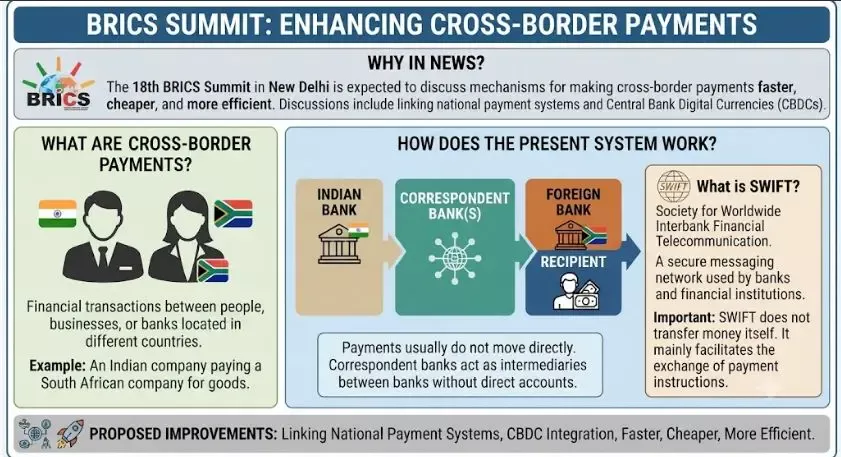
The 18th BRICS Summit in New Delhi is expected to discuss mechanisms for making cross-border payments faster, cheaper and more efficient. Discussions include linking national payment systems and Central Bank Digital Currencies (CBDCs).
What are Cross-Border Payments?
Cross-border payments are financial transactions between people, businesses or banks located in different countries.
For example, when an Indian company pays a South African company for goods, it involves a cross-border payment.
How does the Present System Work?
Payments usually do not move directly between the two banks.
Typical chain:
Indian Bank → Correspondent Bank(s) → Foreign Bank → Recipient
-
Correspondent banks act as intermediaries between banks that do not have direct accounts with each other.
-
Payment instructions are generally communicated through SWIFT.
-
Currency conversion may also be required.
What is SWIFT?
SWIFT (Society for Worldwide Interbank Financial Telecommunication) is a secure messaging network used by banks and financial institutions.
Important:
SWIFT does not transfer money itself. It mainly facilitates the exchange of payment instructions between financial institutions.
Why are Payments Costly?
The present system can involve:
-
Multiple intermediary fees
-
Foreign exchange conversion costs
-
Conversion through a vehicle currency, often the US dollar
-
Additional compliance and settlement costs
For example:
Rand → US Dollar → Indian Rupee
This may result in higher transaction costs.
Why does BRICS want to improve the System?
Economic Reasons:
-
Reduce transaction costs
-
Speed up settlement
-
Facilitate trade and investment
-
Reduce dependence on multiple intermediaries
-
Promote greater use of national currencies
Strategic Reasons:
-
Reduce excessive dependence on dominant international currencies
-
Minimise vulnerability to financial sanctions and external monetary policies
-
Create a more diversified international payment architecture
What Alternatives are being Explored?
National Payment System Linkages:
Directly connecting domestic payment systems of different countries.
Example:
India’s UPI has been linked with Singapore’s PayNow.
Common Payment Hub:
A shared platform could connect the payment systems of multiple countries.
Project Nexus:
A BIS-developed initiative aimed at connecting domestic instant payment systems. It is not a BRICS initiative.
CBDC-Based Settlement:
BRICS is also exploring the use of Central Bank Digital Currencies for cross-border settlement.
How can CBDCs help?
CBDCs issued by different central banks could potentially be exchanged through a common platform.
This can enable:
-
Faster settlement
-
Lower transaction costs
-
Reduced settlement risk
-
More efficient cross-border transactions
BRICS Clear:
The 2024 Kazan Declaration agreed to discuss and study the feasibility of BRICS Clear, an independent settlement mechanism.
However, it should not be considered an operational BRICS payment system.
India’s Position:
India has proposed linking the CBDCs of BRICS countries for trade and tourism payments.
India’s approach primarily focuses on:
Lower Costs + Faster Settlement + Payment Efficiency
rather than explicitly presenting the initiative as an attempt to replace the US dollar.
Key Challenges:
-
Different regulations and payment standards
-
Currency convertibility issues
-
Cybersecurity and data protection
-
Need for interoperability between payment systems
-
Building trust among participating countries
-
Concerns over sanctions and geopolitical tensions
Conclusion:
BRICS’ efforts on cross-border payments aim to create a faster, cheaper, safer and more interoperable payment system. For India, greater payment connectivity can support trade, tourism and the internationalisation of digital payment infrastructure, while maintaining a pragmatic approach towards the existing global financial system.
BRICS और सीमा-पार भुगतान :
चर्चा में क्यों:
18वाँ BRICS शिखर सम्मेलन नई दिल्ली में आयोजित होना है। इसमें सीमा-पार भुगतान को तेज, सस्ता और अधिक कुशल बनाने पर चर्चा होने की संभावना है। इसमें राष्ट्रीय भुगतान प्रणालियों और केंद्रीय बैंक डिजिटल मुद्राओं (CBDCs) को जोड़ने का विचार शामिल है।
सीमा-पार भुगतान क्या है:
जब दो अलग-अलग देशों में स्थित व्यक्तियों, कंपनियों या बैंकों के बीच धन का लेन-देन होता है, उसे सीमा-पार भुगतान कहते हैं।
उदाहरण:
भारत की कोई कंपनी दक्षिण अफ्रीका की कंपनी को सामान का भुगतान करती है।
वर्तमान भुगतान प्रणाली कैसे काम करती है:
भुगतान सामान्यतः सीधे दोनों बैंकों के बीच नहीं होता।
सामान्य प्रक्रिया:
भारतीय बैंक → Correspondent Bank(s) → विदेशी बैंक → प्राप्तकर्ता
-
Correspondent Banks ऐसे मध्यस्थ बैंक हैं जो अलग-अलग देशों के बैंकों के बीच भुगतान की सुविधा देते हैं।
-
भुगतान संबंधी निर्देश प्रायः SWIFT के माध्यम से भेजे जाते हैं।
-
आवश्यकता पड़ने पर मुद्रा विनिमय भी किया जाता है।
SWIFT क्या है:
SWIFT (Society for Worldwide Interbank Financial Telecommunication) बैंकों और वित्तीय संस्थानों के बीच सुरक्षित भुगतान-संदेश भेजने वाला नेटवर्क है।
महत्वपूर्ण:
SWIFT स्वयं पैसा ट्रांसफर नहीं करता; यह मुख्यतः भुगतान संबंधी निर्देशों के आदान-प्रदान की सुविधा देता है।
भुगतान महंगा क्यों होता है:
वर्तमान प्रणाली में:
-
मध्यस्थ बैंकों की फीस
-
Foreign Exchange Conversion Cost
-
कई बार US Dollar जैसी Vehicle Currency के माध्यम से रूपांतरण
-
Settlement और compliance से जुड़ी लागत
उदाहरण:
Rand → US Dollar → Indian Rupee
इससे लेन-देन की कुल लागत बढ़ सकती है।
BRICS व्यवस्था में बदलाव क्यों चाहता है:
आर्थिक कारण:
-
लेन-देन की लागत कम करना
-
Settlement को तेज करना
-
व्यापार और निवेश को बढ़ावा देना
-
मध्यस्थ बैंकों पर निर्भरता कम करना
-
राष्ट्रीय मुद्राओं के उपयोग को बढ़ावा देना
रणनीतिक कारण:
-
प्रमुख अंतरराष्ट्रीय मुद्राओं पर अत्यधिक निर्भरता कम करना
-
Financial Sanctions और बाहरी मौद्रिक नीतियों के प्रभाव को कम करना
-
अधिक विविध और वैकल्पिक अंतरराष्ट्रीय भुगतान व्यवस्था विकसित करना
किन विकल्पों पर विचार हो रहा है:
राष्ट्रीय भुगतान प्रणालियों को जोड़ना:
विभिन्न देशों की घरेलू भुगतान प्रणालियों को सीधे जोड़ा जा सकता है।
उदाहरण:
भारत का UPI और सिंगापुर का PayNow आपस में जुड़े हैं।
Common Payment Hub:
एक साझा प्लेटफॉर्म के माध्यम से कई देशों की भुगतान प्रणालियों को जोड़ा जा सकता है।
Project Nexus:
यह BIS द्वारा विकसित पहल है, जिसका उद्देश्य विभिन्न देशों की Instant Payment Systems को जोड़ना है।
महत्वपूर्ण:
Project Nexus, BRICS की पहल नहीं है।
CBDC आधारित Settlement:
BRICS देश Central Bank Digital Currencies (CBDCs) के माध्यम से सीमा-पार भुगतान की संभावनाओं का भी अध्ययन कर रहे हैं।
विभिन्न देशों की CBDCs को एक Common Platform के माध्यम से जोड़ा जा सकता है।
संभावित लाभ:
-
तेज Settlement
-
कम Transaction Cost
-
कम Settlement Risk
-
अधिक कुशल Cross-Border Payments
BRICS Clear:
2024 Kazan Declaration में BRICS देशों ने BRICS Clear नामक स्वतंत्र Settlement Mechanism की व्यवहार्यता पर चर्चा और अध्ययन करने पर सहमति व्यक्त की।
हालाँकि, इसे वर्तमान में संचालित BRICS Payment System नहीं माना जाना चाहिए।
भारत का रुख:
भारत ने BRICS देशों की CBDCs को जोड़ने का प्रस्ताव दिया है, विशेषकर:
-
Trade Payments
-
Tourism Payments
भारत का मुख्य जोर है:
कम लागत + तेज Settlement + बेहतर Payment Efficiency
भारत इसे सीधे तौर पर US Dollar को समाप्त करने की पहल के रूप में प्रस्तुत नहीं करता।
प्रमुख चुनौतियाँ:
-
अलग-अलग देशों के नियम और Payment Standards
-
Currency Convertibility की समस्या
-
Cybersecurity और Data Protection
-
विभिन्न Payment Systems के बीच Interoperability
-
देशों के बीच विश्वास की आवश्यकता
-
Geopolitical tensions और sanctions
निष्कर्ष:
BRICS का Cross-Border Payment सुधार प्रयास तेज, सस्ता, सुरक्षित और interoperable भुगतान तंत्र विकसित करने की दिशा में है। भारत के लिए यह व्यापार, पर्यटन और डिजिटल भुगतान व्यवस्था को मजबूत करने का अवसर है, साथ ही भारत मौजूदा वैश्विक वित्तीय व्यवस्था के प्रति व्यावहारिक और संतुलित दृष्टिकोण अपना रहा है।

May 19, 2026
October 17, 2025
October 16, 2025
October 6, 2025

