September 7, 2026
Gram Sabha Consent & Forest Clearance under FRA, 2006/Forest Rights Act (FRA), 2006
Why in News?
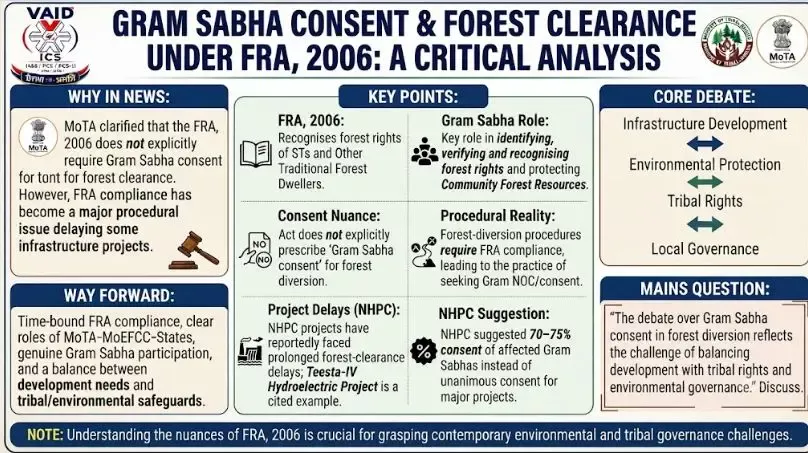
The Ministry of Tribal Affairs (MoTA) has stated that the Forest Rights Act (FRA), 2006 does not explicitly provide for Gram Sabha consent for forest clearance. The issue has emerged as a major bottleneck in several government infrastructure projects, particularly hydropower projects.
Core Issue:
-
FRA, 2006 recognises the forest rights of Scheduled Tribes and Other Traditional Forest Dwellers.
-
The Act makes the Gram Sabha an important authority in identifying and recognising forest rights.
-
However, the Act itself does not explicitly use the term “Gram Sabha consent” for forest diversion/clearance.
-
Government procedures for forest diversion require FRA-related processes to be completed before diversion of forest land.
-
This has resulted in the practice of obtaining Gram Sabha NOC/consent before forest diversion.
Why is it a Bottleneck?
-
Forest clearance for some under-construction projects has taken very long periods.
-
The Parliamentary Standing Committee on Public Undertakings reported an average of 106 months for forest clearance in certain NHPC projects.
-
Teesta-IV Hydroelectric Project was cited as an example where pending Gram Sabha consent has delayed the project.
-
NHPC suggested 70–75% consent of affected Gram Sabhas instead of unanimous consent for large projects of national importance.
Key Legal Point:
Forest Rights Act, 2006 ≠ Explicit provision for Gram Sabha consent for forest clearance
But:
Forest-diversion procedures → FRA compliance → Recognition/vesting of forest rights → Gram Sabha-related process/NOC
Thus, a distinction must be made between the statutory provisions of FRA and the administrative procedures governing forest diversion.
Role of Gram Sabha under FRA:
The Gram Sabha plays a crucial role in:
-
Initiating the process of determining forest rights.
-
Receiving and verifying claims to forest rights.
-
Protecting community forest resources.
-
Participating in decisions affecting forest-dwelling communities.
Major Concern:
The debate reflects a broader tension between:
Infrastructure Development ↔ Forest Conservation ↔ Tribal Rights ↔ Local Self-Governance
Reducing consent requirements may speed up projects but could weaken community participation and tribal rights.
Way Forward:
-
Clearly define the respective roles of MoTA, MoEFCC and State Governments.
-
Establish time-bound procedures for FRA compliance and forest clearance.
-
Ensure genuine participation of affected Gram Sabhas.
-
Avoid arbitrary dilution of tribal and community forest rights.
-
Balance strategic infrastructure needs with constitutional and legal safeguards.
UPSC/PCS Mains Question:
“The debate over Gram Sabha consent in forest diversion reflects the challenge of balancing development with tribal rights and environmental governance.” Discuss in the context of the Forest Rights Act, 2006.
FRA, 2006 के तहत ग्राम सभा की सहमति एवं वन स्वीकृति:
Why in News:
जनजातीय कार्य मंत्रालय (MoTA) ने कहा है कि वन अधिकार अधिनियम (FRA), 2006 में वन स्वीकृति के लिए ग्राम सभा की सहमति प्राप्त करने का कोई स्पष्ट प्रावधान नहीं है। यह मुद्दा विशेष रूप से जलविद्युत एवं अन्य बुनियादी ढाँचा परियोजनाओं में देरी का कारण बना हुआ है।
मुख्य मुद्दा:
-
FRA, 2006 अनुसूचित जनजातियों तथा अन्य परंपरागत वन निवासियों के वन अधिकारों को मान्यता देता है।
-
ग्राम सभा वन अधिकारों की पहचान एवं निर्धारण में महत्वपूर्ण भूमिका निभाती है।
-
लेकिन FRA में वन भूमि को गैर-वानिकी उपयोग में बदलने के लिए “ग्राम सभा की सहमति” शब्द का स्पष्ट उल्लेख नहीं है।
-
दूसरी ओर, वन भूमि के डायवर्जन की सरकारी प्रक्रिया में FRA के तहत प्रक्रियाओं को पूरा करना आवश्यक है।
-
इसी कारण व्यवहार में वन स्वीकृति से पहले ग्राम सभा की NOC/सहमति लेने की प्रक्रिया विकसित हुई है।
यह Bottleneck क्यों है:
-
कई परियोजनाओं में वन स्वीकृति में बहुत लंबा समय लग रहा है।
-
संसदीय समिति के अनुसार कुछ निर्माणाधीन NHPC परियोजनाओं में वन स्वीकृति में औसतन 106 महीने लगे।
-
तीस्ता-IV जलविद्युत परियोजना में कुछ ग्राम पंचायतों की लंबित सहमति के कारण परियोजना प्रभावित हुई।
-
NHPC ने राष्ट्रीय महत्व की बड़ी जलविद्युत परियोजनाओं के लिए 70–75% प्रभावित ग्राम सभाओं की सहमति को पर्याप्त मानने का सुझाव दिया।
कानूनी स्थिति:
FRA, 2006 → वन अधिकारों की मान्यता
लेकिन
वन भूमि डायवर्जन की प्रक्रिया → FRA अनुपालन → वन अधिकारों की पहचान/मान्यता → ग्राम सभा से संबंधित प्रक्रिया/NOC
अर्थात FRA के वैधानिक प्रावधान और वन डायवर्जन की प्रशासनिक प्रक्रिया के बीच अंतर समझना आवश्यक है।
FRA में ग्राम सभा की भूमिका:
-
वन अधिकारों की प्रक्रिया आरंभ करना।
-
वन अधिकारों के दावों की जाँच एवं सत्यापन।
-
सामुदायिक वन संसाधनों की सुरक्षा।
-
वन-आश्रित समुदायों से जुड़े मामलों में स्थानीय भागीदारी सुनिश्चित करना।
मुख्य चिंता:
यह विवाद मूलतः चार उद्देश्यों के बीच संतुलन का प्रश्न है:
विकास एवं अवसंरचना ↔ वन संरक्षण ↔ जनजातीय अधिकार ↔ स्थानीय स्वशासन
सहमति की शर्तों को कमजोर करने से परियोजनाओं में तेजी आ सकती है, लेकिन इससे जनजातीय एवं सामुदायिक अधिकारों पर प्रतिकूल प्रभाव पड़ने की आशंका भी है।
Way Forward:
-
MoTA, MoEFCC और राज्य सरकारों की भूमिकाएँ स्पष्ट की जाएँ।
-
FRA अनुपालन और वन स्वीकृति के लिए समयबद्ध प्रक्रिया बनाई जाए।
-
प्रभावित ग्राम सभाओं की वास्तविक एवं सार्थक भागीदारी सुनिश्चित हो।
-
जनजातीय एवं सामुदायिक वन अधिकारों को मनमाने ढंग से कमजोर न किया जाए।
-
विकास, पर्यावरण संरक्षण और आदिवासी अधिकारों के बीच संतुलित दृष्टिकोण अपनाया जाए।
UPSC/PCS Mains प्रश्न:
“वन भूमि के डायवर्जन में ग्राम सभा की सहमति को लेकर वर्तमान विवाद विकास, पर्यावरणीय शासन और जनजातीय अधिकारों के बीच संतुलन की चुनौती को दर्शाता है।” वन अधिकार अधिनियम, 2006 के संदर्भ में चर्चा कीजिए।

May 19, 2026
October 17, 2025
October 16, 2025
October 6, 2025

