August 20, 2026
Solid Waste : Role Gen z/Gen alpha/Family/Society
Why in News?:
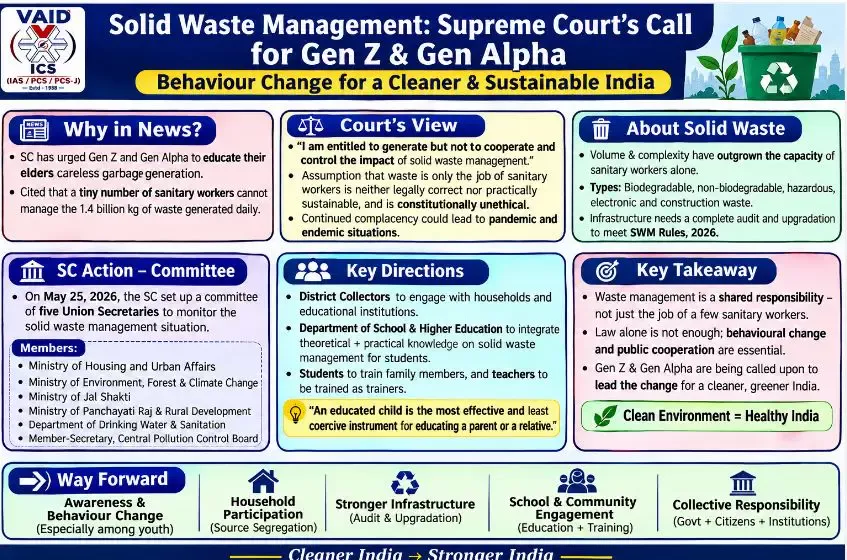
Supreme Court has urged Gen Z and Gen Alpha to educate their elders’ careless garbage generation, citing that a tiny number of sanitary workers cannot manage the 1.4 billion kg of waste generated daily.
Court’s View:
-
“I am entitled to generate but not to cooperate and control the impact of solid waste management.”
-
The assumption that waste is only the job of sanitary workers is neither legally correct nor practically sustainable, and is constitutionally unethical.
-
Continued complacency could lead to pandemic and endemic situations.
About Solid Waste:
-
Volume and complexity have outgrown the capacity of sanitary workers alone.
-
Types include biodegradable, non-biodegradable, hazardous, electronic, and construction waste.
-
Infrastructure needs a complete audit and upgradation to meet SWM Rules, 2026.
SC Action – Committee:
-
On May 25, 2026, the SC set up a committee of five Union Secretaries to monitor the solid waste management situation.
-
Members: Ministry of Housing and Urban Affairs, Ministry of Environment, Forest and Climate Change, Ministry of Jal Shakti, Ministry of Panchayati Raj and Rural Development, Department of Drinking Water and Sanitation, along with the Member-Secretary of the Central Pollution Control Board.
Key Directions:
-
District Collectors are directed to engage with households and educational institutions.
-
Department of School and Higher Education is directed to integrate theoretical and practical knowledge on solid waste management for students.
-
Students are tasked to train family members, and teachers are to be trained as trainers.
-
“An educated child is the most effective and least coercive instrument for educating a parent or a relative.”
Key Takeaway:
-
Waste management is a shared responsibility – not just the job of a few sanitary workers.
-
Law alone is not enough; behavioural change and public cooperation are essential.
-
Gen Z and Gen Alpha are being called upon to lead the change for a cleaner, greener India, upholding the principle that Clean Environment = Healthy India.
Way Forward:
-
Awareness & Behaviour Change: Focus especially among youth.
-
Household Participation: Implement source segregation.
-
Stronger Infrastructure: Focus on audit and upgradation.
-
School & Community Engagement: Combine education and training.
-
Collective Responsibility: Involve the government, citizens, and institutions together.
सुप्रीम कोर्ट ने जेन जी (Gen Z) और जेन अल्फा (Gen Alpha) से आग्रह किया है कि वे अपने बुजुर्गों की लापरवाह कचरा पैदा करने की आदत के बारे में उन्हें शिक्षित करें। साथ ही यह हवाला दिया गया है कि प्रतिदिन उत्पन्न होने वाले 1.4 अरब किलोग्राम कचरे को केवल मुट्ठी भर सफाई कर्मचारी प्रबंधित नहीं कर सकते।
Court’s View:
-
“मुझे कचरा पैदा करने का अधिकार है, लेकिन ठोस अपशिष्ट प्रबंधन के प्रभाव में सहयोग करने और उसे नियंत्रित करने का अधिकार नहीं है।”
-
यह धारणा कि कचरा साफ करना केवल सफाई कर्मचारियों का काम है, न तो कानूनी रूप से सही है और न ही व्यावहारिक रूप से टिकाऊ है, और यह संवैधानिक रूप से अनैतिक है।
-
निरंतर बनी रहने वाली आत्मसंतुष्टि महामारी (pandemic) और स्थानिक (endemic) स्थितियों का कारण बन सकती है।
About Solid Waste:
-
कचरे की मात्रा और जटिलता अकेले सफाई कर्मचारियों की क्षमता से कहीं अधिक बढ़ चुकी है।
-
प्रकार: जैव-विघटनकारी (biodegradable), गैर-जैव-विघटनकारी, खतरनाक, इलेक्ट्रॉनिक और निर्माण कचरा।
-
ठोस अपशिष्ट प्रबंधन (SWM) नियम, 2026 को पूरा करने के लिए बुनियादी ढांचे को पूर्ण ऑडिट और उन्नयन (upgradation) की आवश्यकता है।
SC Action – Committee:
-
25 मई, 2026 को सुप्रीम कोर्ट ने ठोस अपशिष्ट प्रबंधन की स्थिति की निगरानी के लिए पांच केंद्रीय सचिवों की एक समिति का गठन किया।
-
सदस्य: आवास और शहरी मामलों का मंत्रालय, पर्यावरण, वन और जलवायु परिवर्तन मंत्रालय, जल शक्ति मंत्रालय, पंचायती राज और ग्रामीण विकास मंत्रालय, पेयजल और स्वच्छता विभाग, साथ ही केंद्रीय प्रदूषण नियंत्रण बोर्ड के सदस्य-सचिव।
Key Directions:
-
जिला कलेक्टरों को निर्देश दिया गया है कि वे परिवारों और शैक्षणिक संस्थानों के साथ जुड़ें।
-
स्कूल और उच्च शिक्षा विभाग को छात्रों के लिए ठोस अपशिष्ट प्रबंधन पर सैद्धांतिक और व्यावहारिक ज्ञान को एकीकृत करने का निर्देश दिया गया है।
-
छात्रों को परिवार के सदस्यों को प्रशिक्षित करने का काम सौंपा गया है, और शिक्षकों को प्रशिक्षक (trainers) के रूप में प्रशिक्षित किया जाना है।
-
“एक शिक्षित बच्चा किसी माता-पिता या रिश्तेदार को शिक्षित करने के लिए सबसे प्रभावी और कम से कम दबाव वाला माध्यम होता है।”
Key Takeaway:
-
कचरा प्रबंधन एक साझा जिम्मेदारी है—यह केवल कुछ सफाई कर्मचारियों का काम नहीं है।
-
केवल कानून पर्याप्त नहीं है; व्यवहार में बदलाव और जनसहयोग आवश्यक है।
-
स्वच्छ और हरित भारत के लिए बदलाव का नेतृत्व करने हेतु जेन जी और जेन अल्फा का आह्वान किया जा रहा है, जिसके तहत स्वच्छ पर्यावरण = स्वस्थ भारत का सिद्धांत निहित है।
Way Forward:
-
जागरूकता और व्यवहार में बदलाव: विशेष रूप से युवाओं के बीच ध्यान केंद्रित करना।
-
घरेलू सहभागिता: स्रोत स्तर पर कचरे का पृथक्करण (source segregation) लागू करना।
-
मजबूत बुनियादी ढांचा: ऑडिट और उन्नयन पर ध्यान केंद्रित करना।
-
स्कूल और सामुदायिक सहभागिता: शिक्षा और प्रशिक्षण का संयोजन करना।
-
सामूहिक जिम्मेदारी: सरकार, नागरिकों और संस्थानों को एक साथ शामिल करना।

May 19, 2026
October 17, 2025
October 16, 2025
October 6, 2025

