August 12, 2026
Central Bank Digital Currency (CBDC)
Why in news?
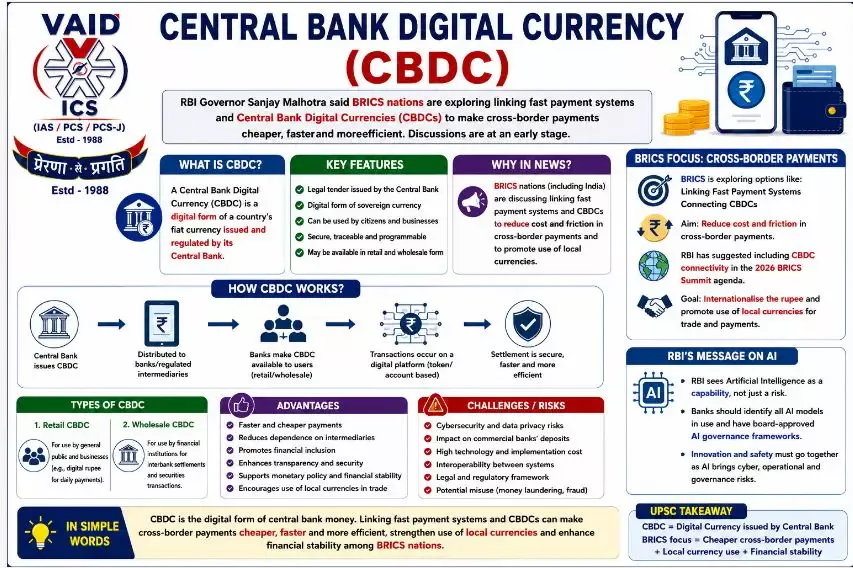
BRICS countries are exploring the possibility of linking their Fast Payment Systems and Central Bank Digital Currencies (CBDCs) to make cross-border payments cheaper, faster, and more efficient, with RBI suggesting CBDC connectivity for the 2026 BRICS Summit.
What is CBDC?
-
CBDC stands for Central Bank Digital Currency.
-
CBDC is the digital form of a country’s sovereign currency issued and regulated by its central bank.
-
In India, CBDC is called the Digital Rupee (e₹) and is issued by the RBI.
-
It represents central-bank money in digital form and is different from cryptocurrency because it is sovereign and centrally issued.
What is BRICS Trying to Achieve?
-
Problem with present cross-border payments: Sender- Bank – Correspondent Bank – International Payment Network – Foreign Bank – Receiver.
This involves multiple intermediaries, high transaction costs, delays, and currency conversion costs.
-
Proposed solution: Link Fast Payment Systems + Connect CBDCs – Faster and more direct settlement –Lower cost and greater efficiency.
Why are CBDCs Important for Cross-Border Payments?:
Connecting CBDCs could enable countries to settle payments more directly, yielding potential benefits such as:
-
Lower transaction costs
-
Faster settlement
-
Reduced dependence on intermediaries
-
Easier cross-border trade and greater use of local currencies
-
Potentially stronger international use of the Indian rupee
Note: CBDC connectivity is still under discussion and requires technological, legal, and regulatory coordination among participating countries.
CBDC vs Cryptocurrency:
| Basis | CBDC | Cryptocurrency |
| Issuer | Central Bank | Usually decentralised or private network |
| Sovereign Currency | Yes | No |
| Regulation | Government and Central Bank regulated | Varies |
| Value | Linked to national currency | Often highly volatile |
| Monetary Authority | Central bank | Generally no central issuing authority |
| Example | Digital Rupee (e₹) | Bitcoin, Ethereum |
CBDC vs Digital Payment:
-
Digital Payment: Transfer of money through digital systems such as bank accounts and payment platforms (e.g., UPI = Payment System).
-
CBDC: A form of digital money issued directly by the central bank (e.g., CBDC = Form of Money).
Types of CBDC:
-
Retail CBDC: Designed for individuals, consumers, and businesses for daily payments, person-to-person transactions, and retail purchases (e.g., Digital Rupee for everyday transactions).
-
Wholesale CBDC: Designed mainly for banks and financial institutions for large-value transactions like interbank settlements and securities transactions.
How Does CBDC Work?:
Central Bank issues CBDC –Distributed to users via Banks or Authorised Intermediaries –Individuals and Businesses use CBDC for payments-Digital settlement ensures fast and secure transactions.
Major Advantages of CBDC:
-
Faster payments and settlement with lower transaction costs
-
Reduced dependence on intermediaries and enhanced payment efficiency
-
Supports financial inclusion and digital financial innovation
-
Can improve transparency and reduce physical cash management costs
-
Encourages greater use of local currencies in cross-border settlements
Challenges and Risks:
-
Cybersecurity: Hacking, cyberattacks, and system failures.
-
Privacy: Balancing transparency and user privacy.
-
Financial Disintermediation: Shifting large amounts of money from bank deposits into CBDCs could pressure bank deposit bases.
-
Technology: Requires reliable digital infrastructure, interoperability, scalability, and payment resilience.
-
Regulatory Challenges: Requires coordination on AML/CFT rules, data protection, consumer protection, and currency regulations.
CBDC and India:
-
The RBI is developing the Digital Rupee (e₹) in both retail and wholesale segments.
-
Strategic Importance: CBDC drives digital payments, financial inclusion, payment innovation, efficient cross-border settlement, and the internationalisation of the rupee.
CBDC and Internationalisation of the Rupee:
India wants greater use of the rupee in international trade and payments. CBDC and payment-system connectivity can facilitate trade settlement in local currencies, reduce dependence on intermediary currencies, and increase the international utility of the rupee.
However, rupee internationalisation also requires deep financial markets, macroeconomic stability, greater convertibility, strong institutions, and investor confidence.
CBDC vs Fast Payment System:
-
Fast Payment System: A payment infrastructure that allows money to be transferred quickly.
-
CBDC: A form of money issued by the central bank.
-
BRICS Approach: CBDC Connectivity + Fast Payment System Connectivity $\rightarrow$ Cheaper, faster, and more efficient cross-border payments.
RBI’s Message on Artificial Intelligence:
The RBI Governor highlighted the growing role of Artificial Intelligence in banking, noting that AI should be viewed as a capability to harness rather than only a risk to contain.
Key Requirements for Banks:
-
Identify all AI models being used.
-
Establish board-approved AI governance frameworks.
-
Manage cyber and operational risks.
-
Ensure accountability and governance (Innovation + Safety + Governance).
समाचार में क्यों?:
सीमा पार भुगतान को सस्ता, तेज़ और अधिक कुशल बनाने के लिए BRICS देश अपनी तेज़ भुगतान प्रणालियों (Fast Payment Systems) और सेंट्रल बैंक डिजिटल करेंसी (CBDC) को आपस में जोड़ने की संभावना तलाश रहे हैं, और RBI ने 2026 BRICS शिखर सम्मेलन के एजेंडे में CBDC कनेक्टिविटी को शामिल करने का सुझाव दिया है।
सेंट्रल बैंक डिजिटल करेंसी (CBDC) नोट्स
CBDC क्या है?:
-
CBDC का पूर्ण रूप सेंट्रल बैंक डिजिटल करेंसी (Central Bank Digital Currency) है।
-
CBDC किसी देश की सप्रभु मुद्रा का डिजिटल रूप है जिसे उसके केंद्रीय बैंक द्वारा जारी और विनियमित किया जाता है।
-
भारत में, CBDC को डिजिटल रुपया (e₹) कहा जाता है और इसे RBI द्वारा जारी किया जाता है।
-
यह डिजिटल रूप में केंद्रीय-बैंक का पैसा है और क्रिप्टोकरेंसी से अलग है क्योंकि यह सप्रभु और केंद्रीय रूप से जारी किया जाता है।
BRICS क्या हासिल करने का प्रयास कर रहा है?:
-
वर्तमान सीमा पार भुगतान में समस्या:प्प्रेषक से बैंक, बैंक से कॉरेस्पॉन्डेंट बैंक, कॉरेस्पॉन्डेंट बैंक से अंतर्राष्ट्रीय भुगतान नेटवर्क, अंतर्राष्ट्रीय भुगतान नेटवर्क से विदेशी बैंक, और विदेशी बैंक से प्राप्तकर्ता।
इसमें कई मध्यस्थ, उच्च लेनदेन लागत, देरी और मुद्रा रूपांतरण लागत शामिल होती है।
-
प्रस्तावित समाधान: फास्ट पेमेंट सिस्टम को जोड़ना + CBDC को जोड़ना $\rightarrow$ तेज़ और अधिक प्रत्यक्ष निपटान $\rightarrow$ कम लागत और अधिक दक्षता।
सीमा पार भुगतान के लिए CBDC क्यों महत्वपूर्ण हैं?:
CBDC को आपस में जोड़ने से देशों को भुगतान अधिक सीधे तौर पर निपटाने में मदद मिल सकती है, जिससे संभावित लाभ मिलते हैं जैसे:
-
कम लेनदेन लागत
-
तेज़ निपटान
-
मध्यस्थों पर कम निर्भरता
-
आसान सीमा पार व्यापार और स्थानीय मुद्राओं का अधिक उपयोग
-
भारतीय रुपये का संभावित रूप से मजबूत अंतर्राष्ट्रीय उपयोग
नोट: CBDC कनेक्टिविटी अभी भी चर्चा के अधीन है और इसके लिए भाग लेने वाले देशों के बीच तकनीकी, कानूनी और विनियामक समन्वय की आवश्यकता है।
CBDC बनाम क्रिप्टोकरेंसी:
| आधार | CBDC | क्रिप्टोकरेंसी |
| जारीकर्ता | केंद्रीय बैंक | आमतौर पर विकेन्द्रीकृत या निजी नेटवर्क |
| सप्रभु मुद्रा | हाँ | नहीं |
| विनियमन | सरकार और केंद्रीय बैंक द्वारा विनियमित | भिन्न होता है |
| मूल्य | राष्ट्रीय मुद्रा से जुड़ा हुआ | अक्सर अत्यधिक अस्थिर |
| मौद्रिक प्राधिकरण | केंद्रीय बैंक | आमतौर पर कोई केंद्रीय जारी करने वाला प्राधिकरण नहीं |
| उदाहरण | डिजिटल रुपया (e₹) | बिटकॉइन, एथेरियम |
CBDC बनाम डिजिटल भुगतान:
-
डिजिटल भुगतान: बैंक खातों और भुगतान प्लेटफार्मों जैसे डिजिटल सिस्टम के माध्यम से पैसे का हस्तांतरण (जैसे UPI = भुगतान प्रणाली)।
-
CBDC: केंद्रीय बैंक द्वारा सीधे जारी किया गया डिजिटल धन का एक रूप (जैसे CBDC = धन का रूप)।
CBDC के प्रकार:
-
रिटेल CBDC (खुदरा CBDC): दैनिक भुगतान, व्यक्ति-से-व्यक्ति लेनदेन और खुदरा खरीद के लिए व्यक्तियों, उपभोक्ताओं और व्यवसायों के लिए डिज़ाइन किया गया (जैसे रोज़मर्रा के लेनदेन के लिए डिजिटल रुपया)।
-
होलसेल CBDC (थोक CBDC): मुख्य रूप से बैंकों और वित्तीय संस्थानों के लिए अंतर-बैंक निपटान और प्रतिभूतियों के लेनदेन जैसे बड़े मूल्य के लेनदेन के लिए डिज़ाइन किया गया।
CBDC कैसे काम करता है?:
केंद्रीय बैंक CBDC जारी करता है $\rightarrow$ बैंकों या अधिकृत मध्यस्थों के माध्यम से उपयोगकर्ताओं को वितरित किया जाता है $\rightarrow$ व्यक्ति और व्यवसाय भुगतान के लिए CBDC का उपयोग करते हैं $\rightarrow$ डिजिटल निपटान से तेज़ और सुरक्षित लेनदेन सुनिश्चित होता है।
CBDC के प्रमुख लाभ:
-
कम लेनदेन लागत के साथ तेज़ भुगतान और निपटान
-
मध्यस्थों पर कम निर्भरता और बेहतर भुगतान दक्षता
-
वित्तीय समावेशन और डिजिटल वित्तीय नवाचार का समर्थन करता है
-
पारदर्शिता में सुधार कर सकता है और भौतिक नकदी प्रबंधन लागत को कम कर सकता है
-
सीमा पार निपटान में स्थानीय मुद्राओं के अधिक उपयोग को प्रोत्साहित करता है
चुनौतियाँ और जोखिम:
-
साइबर सुरक्षा: हैकिंग, साइबर हमले और सिस्टम विफलताएँ।
-
गोपनीयता (Privacy): पारदर्शिता और उपयोगकर्ता की गोपनीयता के बीच संतुलन बनाना।
-
वित्तीय मध्यस्थता में कमी (Financial Disintermediation): बैंक खातों से बड़ी मात्रा में धन को CBDC में स्थानांतरित करने से बैंक जमा आधार पर दबाव पड़ सकता है।
-
प्रौद्योगिकी: इसके लिए विश्वसनीय डिजिटल बुनियादी ढांचे, अंतर-संचालनीयता (interoperability), स्केलेबिलिटी और भुगतान लचीलेपन की आवश्यकता होती है।
-
नियामक चुनौतियाँ: इसके लिए AML/CFT नियमों, डेटा संरक्षण, उपभोक्ता संरक्षण और मुद्रा नियमों पर समन्वय की आवश्यकता होती है।
CBDC और भारत:
-
RBI रिटेल और होलसेल दोनों segmentos में डिजिटल रुपये (e₹) का विकास कर रहा है।
-
रणनीतिक महत्व: CBDC डिजिटल भुगतान, वित्तीय समावेशन, भुगतान नवाचार, कुशल सीमा पार निपटान और रुपये के अंतर्राष्ट्रीयकरण को बढ़ावा देता है।
CBDC और रुपये का अंतर्राष्ट्रीयकरण:
भारत अंतर्राष्ट्रीय व्यापार और भुगतानों में रुपये का अधिक उपयोग चाहता है। CBDC और भुगतान-प्रणाली कनेक्टिविटी स्थानीय मुद्राओं में व्यापार निपटान को सुगम बना सकती है, मध्यवर्ती मुद्राओं पर निर्भरता को कम कर सकती है, और रुपये की अंतर्राष्ट्रीय उपयोगिता को बढ़ा सकती है।
हालांकि, रुपये के अंतर्राष्ट्रीयकरण के लिए गहरे वित्तीय बाजारों, व्यापक आर्थिक स्थिरता, अधिक परिवर्तनीयता, मजबूत संस्थानों और निवेशक के विश्वास की भी आवश्यकता होती है।
CBDC बनाम फास्ट पेमेंट सिस्टम:
-
फास्ट पेमेंट सिस्टम: एक भुगतान बुनियादी ढांचा जो तेजी से धन हस्तांतरित करने की अनुमति देता है।
-
CBDC: केंद्रीय बैंक द्वारा जारी किया गया धन का एक रूप।
-
BRICS दृष्टिकोण: CBDC कनेक्टिविटी + फास्ट पेमेंट सिस्टम कनेक्टिविटी $\rightarrow$ सस्ते, तेज़ और अधिक कुशल सीमा पार भुगतान।
आर्टिफिशियल इंटेलिजेंस पर RBI का संदेश:
RBI गवर्नर ने बैंकिंग में आर्मीफिशियल इंटेलिजेंस (AI) की बढ़ती भूमिका पर प्रकाश डाला, यह नोट करते हुए कि AI को केवल एक जोखिम के रूप में देखने के बजाय एक ऐसी क्षमता के रूप में देखा जाना चाहिए जिसका उपयोग किया जा सके।
बैंकों के लिए प्रमुख आवश्यकताएँ:
-
उपयोग किए जा रहे सभी AI मॉडलों की पहचान करना।
-
बोर्ड द्वारा अनुमोदित AI शासन फ्रेमवर्क स्थापित करना।
-
साइबर और परिचालन जोखिमों का प्रबंधन करना।
-
जवाबदेह और शासन सुनिश्चित करना (नवाचार + सुरक्षा + शासन)।

May 19, 2026
October 17, 2025
October 16, 2025
October 6, 2025

