August 10, 2026
Mecca Joint Defence Agreement
Why in news?:
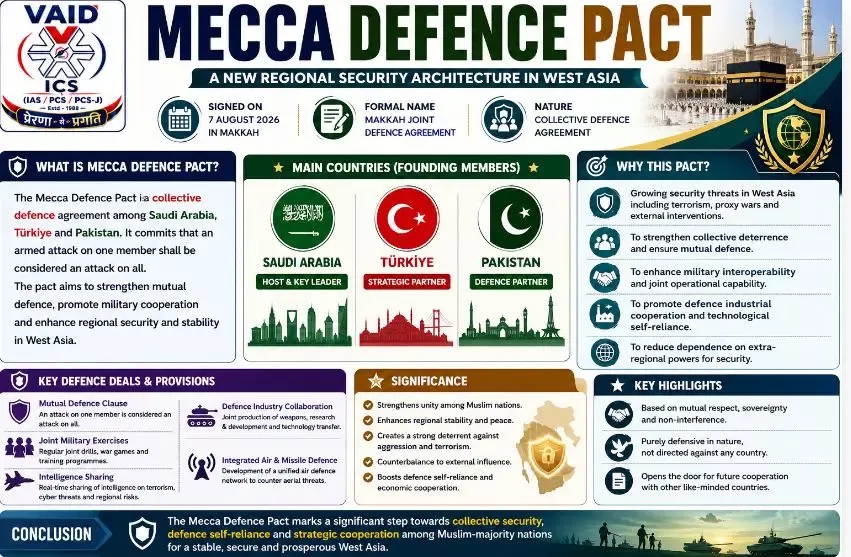
Pakistan, Saudi Arabia, and Türkiye have signed the Mecca Joint Defence Agreement in Mecca, committing to ‘collective defense’ and ‘collective deterrence’ amidst mounting instability in West Asia.
Key Features of the Agreement:
-
Collective Deterrence: Formulates a pledge to treat an armed attack on any single member state as an attack on all three.
-
Military Integration: Focuses on bolstering military coordination, joint defense cooperation, and enhanced security synchronization.
-
Non-Aggressive Stance: Framed by Ankara as a cooperative, defense-oriented partnership rather than an offensive alliance targeting external or regional adversaries.
Strategic Significance:
-
Shift Toward Regional Security Architecture: Represents a transition away from absolute historical reliance on external powers like the United States toward autonomous regional frameworks.
-
Trilateral Expansion: Builds upon existing bilateral foundations, such as the Pakistan-Saudi Arabia Strategic Mutual Defence Agreement (2025), by incorporating Türkiye into a unified trilateral structure.
-
Ankara’s Assertive Foreign Policy: Extends Türkiye’s strategic footprint into West Asia, reinforcing its ambitions as a premier regional security architect.
-
Riyadh’s Strategic Diversification: Allows Saudi Arabia to diversify its security matrix to counter drone, missile, and regional proxy threats.
Effectiveness of Collective Defence:
-
Implementation Challenges: Past bilateral pacts did not always trigger immediate mutual military interventions during crises.
-
Operational Determinants: Real-world efficacy remains tied to:
-
Clear obligations and legal definitions of aggression.
-
Interoperability, joint training, and institutionalized command structures.
-
Intelligence sharing and early-warning coordination.
-
Implications for India:
-
Diaspora and Economic Stakes: Instability in West Asia directly threatens India’s energy security, remittance inflows, maritime trade routes, and the safety of the Indian expatriate community.
-
Validation of Strategic Autonomy: The emergence of alternative minilateral security pacts highlights the vitality of India’s multi-alignment foreign policy.
-
Geopolitical Monitoring: Requires careful tracking of Pakistan’s elevated diplomatic and defense standing in West Asia without disrupting New Delhi’s strong bilateral ties with Gulf partners.
Challenges and Regional Dynamics:
-
Divergent Foreign Policies: The three signatory states maintain unique, occasionally contradictory geopolitical priorities and regional relationships.
-
The Iran Factor: Despite official denials, the pact is strategically viewed within the framework of ongoing Saudi-Iranian power balances.
-
The NATO Complication: Türkiye’s primary security obligations as a NATO member state introduce strategic friction.
-
Bloc Politics Risk: Multiplying military groupings threaten to further fracture an already fragile West Asian security environment.
Way Forward:
-
Prioritizing Soft Security: Focus the agreement’s scope on intelligence sharing, counter-terrorism, maritime safety, and disaster relief rather than hard-power bloc confrontation.
-
Confidence-Building Measures: Use multilateral frameworks to reduce regional tensions and complement active diplomatic channels rather than substitute them.
-
Adherence to International Law: Ensure all operational guidelines respect regional sovereignty and promote conflict avoidance.
Conclusion:
The Mecca Joint Defence Agreement marks a critical institutional milestone in the evolving security landscape of West Asia. Its true value will be measured not by the rhetoric of automatic military intervention, but by its capacity to foster practical defense cooperation and long-term regional stability.

May 19, 2026
October 17, 2025
October 16, 2025
October 6, 2025

